By Dale Boyd
Amidst the memories of heartbreak, funerals and sadness tied to the overdose crisis in B.C., which is disproportionately affecting Indigenous communities, there is still hope.
“I’ve been doing this for six years and it is such a passion, and finally the numbers for the province are starting to climb less quickly. Maybe some of the stuff we are doing is making a difference … there’s hope,” said Jennifer May-Hadford, an epidemiologist working on the overdose response with the First Nations Health Authority in the Interior region.
She was one of dozens who came out to the Osoyoos Indian Band offices on the morning of Aug. 27, kicking off the two-day Purple Ribbon Campaign Caravan trip with a drive-thru breakfast for the community.
With glimpses of hope came reverence for the scope of the crisis which has seen the death rate from opioid-related overdoses increase 21 per cent from 2017 to 2018 for the Indigenous people in B.C. More Indigenous women have been susceptible to the epidemic compared to non-Indigenous overdose stats, according to the First Nations Health Authority. Forty-six per cent of Indigenous overdose events involve women — compared to 27 per cent of women involved in non-indigenous overdose events. The Purple Ribbon Campaign is touring up and down the Okanagan and Similkameen to raise awareness and change the conversation around addictions and overdoses.
“The culture is changing but amongst the people that are open to the concept and the idea that it is not a moral failing or a choice,” May-Hadford said. “We still know there are people that really believe that you are choosing to do this, that you don’t want to, you’re irresponsible, step up to the plate.”
Opioid addiction physically changes the structure and chemical make-up of the human brain, she said.
“It’s not that people are just making this choice every day and saying ‘well, what do I want to do today? I think I’ll be addicted to drugs,’ it is because you become physically dependent on it. It is not a moral failing.”
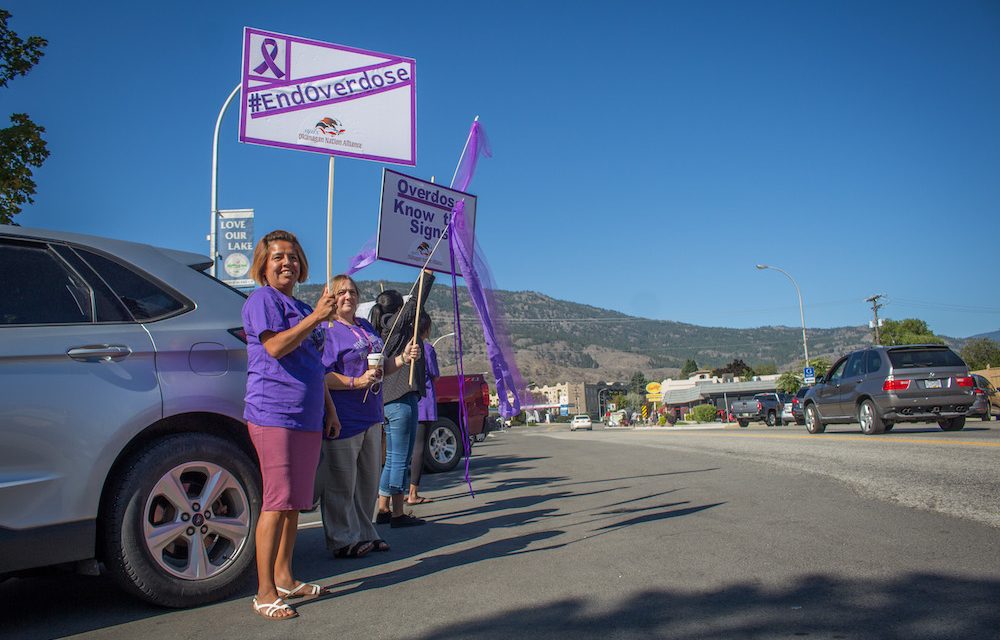
Dozens of supporters wore purple shirts, buttons and ribbons, with cars clad in slogans and purple streamers taking to the road later in the morning heading to meetings and events at the Lower Similkameen Indian Band and in Penticton as well. The awareness campaign made its way through Main Street Osoyoos Tuesday morning.
Among those out to raise awareness was Wellness Manager for the Okanagan Nation Alliance, Jennifer Lewis. She, like many gathered outside the band offices, has seen the impact of overdose deaths firsthand.
“In the Okanagan, we are pretty much all related. I have cousins who I could talk about … (who say) I died four times this weekend and they don’t care. They don’t think anyone cares. This is about saying we care,” Lewis said.
Changing the conversation is only one piece of the puzzle. Strides have been made in terms of co-operation in recent years between the provincial and Indigenous health authorities.
“The sharing of information has not happened historically. We have Interior Health staff here, and First Nations health staff here with us. So the collaboration is not usually what occurs in history, so that is different,” Lewis said.
Caring, and helping to remove the stigma of irresponsibility or shame from discussions around addiction are another effort made by the awareness campaign. Drug-related issues have drawn harsh critical responses from community residents to politicians, Lewis said.
“What I see from the general population though, in terms of comments, it is still that they are undeserving addicts, that they’re just throw-away people. They are just nuisances. And I think that behaviour drives members of parliament and members of legislative assemblies, they are the funders, they are the governors. So the general public opinion really counts,” she said.
Child and Family Community Planner with the Okanagan Nation Alliance, Kirsta Lindstrom, had a simple reason for coming out to raise awareness with the campaign.
“I’ve been to enough funerals that I’d rather be doing something positive like this, something proactive than going to another funeral and just talking about ‘what a shame.’” Lindstrom said.
The caravan continues farther north in the Okanagan Wednesday starting in Westbank and ending in Centennial Park in Merritt.