By Don Urquhart, Times Chronicle
The war on aquatic invasive species was given a boost recently with British Columbia’s chief veterinarian issuing an order making it illegal to transport watercraft in the province with the drain plug still in place.
“This order is part of our ongoing actions to contain and prevent further spread of whirling disease and keep invasive mussels out of BC waterways,” said Nathan Cullen, Minister of Water, Land and Resource Stewardship.
Beginning May 17, 2024, boat operators in British Columbia are required to pull the plug before moving a boat or any equipment between water bodies.
What is notable about this announcement is the specific reference to “whirling disease”, which has now become a top priority in the fight to keep invasive species out of BC’s lakes. “It’s an imminent threat,” says Birgit Arnstein, President of the Osoyoos Lake Water Quality Society (OLWQS).
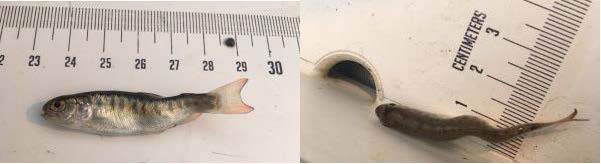
Whirling disease is caused by an aquatic parasite (Myxobolus cerebralis) that has two hosts: a fish and a freshwater worm. Fish – trout, salmon and whitefish) can be infected directly or by consuming worm.
Once inside the fish the parasite affects the cartilage near the spine, leading to skeletal deformities which causes the fish to swim in circles until it dies.
The tell-tale signs of infection include a bent spine, a blackened tail and swimming in a whirling pattern. The mortality rate is up to 90 per cent of juvenile fish but not all populations or species are impacted to the same degree.
First detected in 2016 in Banff National Park, it is now found in multiple watersheds in southwestern Alberta and in late 2023 was confirmed to have spread to Yoho National Park, part of the Columbia River watershed.
In an unprecedented step, Parks Canada closed public access to all lakes within the park and has since extended the closures to all lakes in Kootenay National Park as well.
BC’s Ministry of Water, Land and Resource Stewardship says the parasite can be transmitted through spores that attach to equipment used for swimming, paddling, boating, water pumping, fishing, pets, or through infected fish (alive or dead) and fish parts.
There is currently no treatment available to eradicate whirling disease but provincial authorities highlight there are no health concerns for people swimming in or drinking water that contains whirling disease.
Arnstein notes that the parasites, like the invasive zebra and quagga muscles, can travel in the bilge of a boat, even in tiny crevices or in boat’s propeller for instance.
While the province’s Invasive Mussel Defence Program (IMDP) has so far been successful in keeping zebra and quagga mussels out of BC’s waterways, the whirling disease parasite is proving more difficult.
“And once these parasites are in the lake they like to go after particularly trout and salmon,” she says. “The Okanagan Nation Alliance has been working very hard at reintroducing salmon to local lakes and it would be a great shame if this parasite got into our lakes because it will decimate the salmon.”
“We do know that veligers, which are the larval form of invasive mussels, can stick in the little bit of pooling water for three days in a boat. So if it’s drained, the veligers won’t have any water to survive.”
“Urgent action is needed to protect communities and wildlife from whirling disease and invasive mussels, and that’s what we’re doing,” said George Heyman, Minister of Environment and Climate Change Strategy. “We cannot allow the introduction of these threats to the ecosystems that support families, industries, First Nations and communities.”
The province’s invasive mussel defense program works through early-detection lake monitoring, watercraft inspection stations and public outreach. The program has strong and active collaborations with neighbouring jurisdictions in Western Canada and the US.
IMDP inspection stations are open from April until October to prevent zebra and quagga mussels from hitching a ride on boats or any water equipment and entering BC waterways. Watercraft includes sailboats, motorboats, car toppers, kayaks, canoes, and paddle boards being transported in the province.
Failing to stop at an open inspection station is punishable with a $345 fine.
Inspectors will now also be checking watercraft for compliance with the chief veterinarian’s “pull the plug” order.
The move was also heralded by Blair Ireland, Chair of the Okanagan Basin Water Board.
“We’re very happy to see the province answer our call for pull-the-plug regulations. One litre of water can carry 9,000 invasive mussel larvae.
“This is an important step forward, while the Okanagan Basin Water Board continues to push for additional action, especially federal funding. In the meantime, this is a tangible way boaters can help protect the waterways they love to visit and play in.”