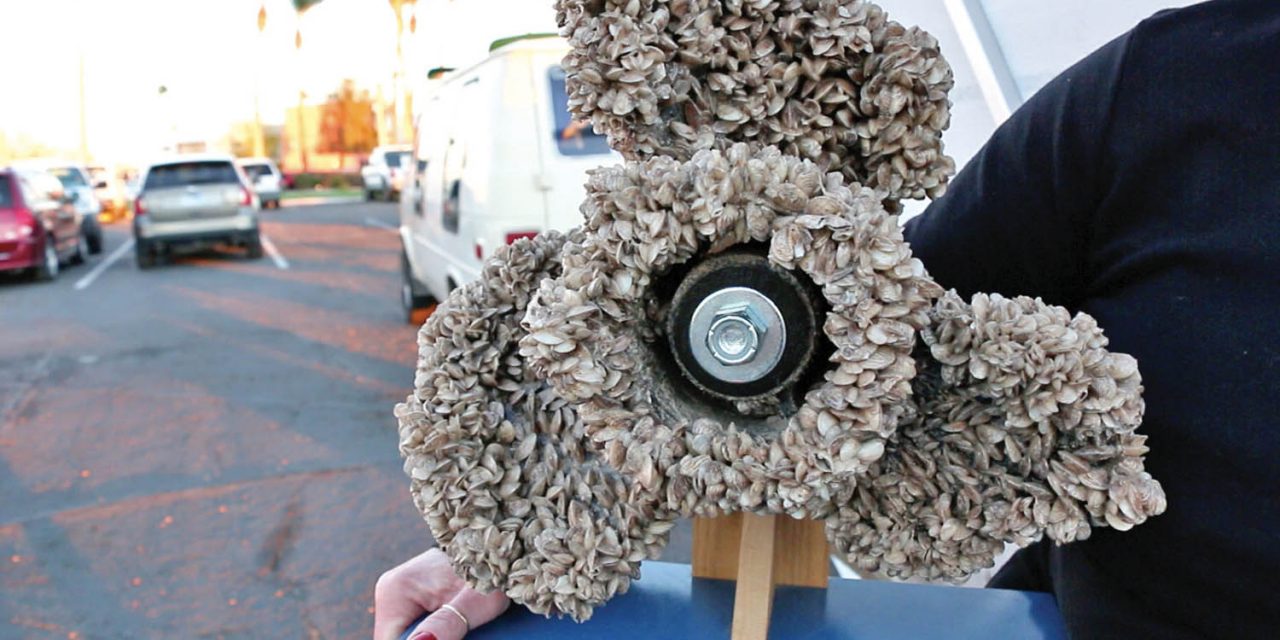
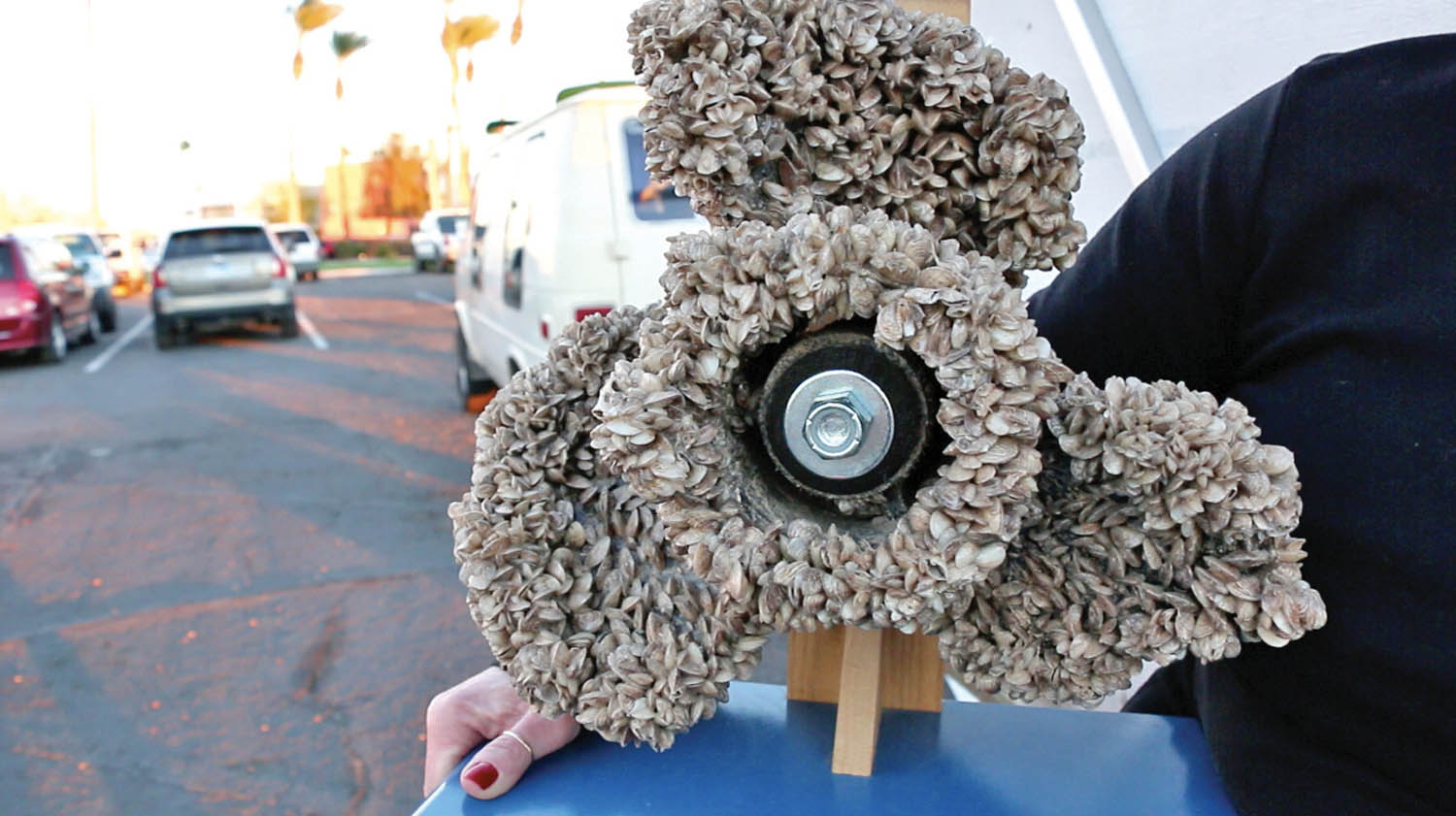
Quagga mussels encrust a boat propeller in this shot from the short film Mussel Threat. The Okanagan Basin Waterboard (OBWB) has warned if zebra or quagga mussels make it into the Okanagan, it would cost an estimated $43 million annually to mitigate the problem. (Photo supplied)
B.C. will be establishing eight permanent inspection stations at entry points into the province in an effort to stop the spread of invasive mussels.
Premier Christy Clark made the announcement Wednesday afternoon. It had been expected.
In recent years, the Okanagan Basin Water Board (OBWB) has been lobbying the government to establish such station. Although it welcomed the introduction of mobile inspection and decontamination units, which were in use last summer, OBWB continued to argue that permanent inspection stations were necessary.
Five stations will be set up along the B.C.-Alberta border and three will be along the B.C.-U.S. border. They will be operational April 1 for the 2016 boating season.
RM
Government news release follows:
Permanent stations to protect B.C. from invasive mussels
Following a successful pilot program last year, today Premier Christy Clark announced a $2 million boost to the province’s invasive mussel defence program that will see eight permanent mussel inspection stations installed at major entry points along B.C.’s borders.
“B.C. is leading the fight against invasive species,” said Premier Clark. “To date, no zebra or quagga mussels have ever been detected in B.C.’s waterways – and we’re going to keep it that way. Eight more inspection stations are yet another tool towards ensuring we remain mussel-free.”
Quagga and zebra mussels pose a serious threat to B.C.’s aquatic ecosystems, salmon populations, hydro power stations and other infrastructure facilities. They can clog pipes, cause ecological and economic damage, displace native aquatic plants and wildlife, degrade the environment and affect drinking water quality.
Thanks to the generous support from BC Hydro, FortisBC, Columbia Power and the Columbia Basin Trust, $2 million in funding will enhance the successful program and introduce more protection at B.C.’s borders. The Province is also contributing in kind with staff, equipment and office space.
“Invasive mussels are a concern to BC Hydro and we applaud the Province for taking strong measures to protect B.C.’s rivers and lakes,” said Mark Poweska, vice president, Generation BC Hydro. “BC Hydro is proud to support this initiative since invasive mussels have a detrimental impact on the environment and can impact our ability to produce power by plugging up pipes and equipment in our dams. In B.C. we rely heavily on the clean, cost-effective power provided by hydroelectric facilities and we are pleased to see the threat from invasive mussels being mitigated.”
Five inspection stations will be set up along the B.C.-Alberta border, and three along the B.C.-United States border. These stations will be operational April 1 for the 2016 boating season.
In total, 32 conservation officers will work the stations, which will operate 10 hours a day, seven days a week from April through October. This is an increase of 20 crew members from last year’s pilot and an additional six mobile decontamination units are being added to the fleet of equipment. The eight inspection stations will have the capability to become mobile if the need arises, travelling to locations throughout B.C. where watercrafts are being detained, waiting for decontamination.
The program will also consist of:
- Increased highway signage at permanent inspection station locations
- Expanded monitoring for quagga and zebra mussels
- Expanded Report All Poachers or Polluters response line coverage
- Increased opportunities to promote “Clean, Drain Dry” education and outreach activities
“These enhancements to the province’s mussel defence program are a significant step towards protecting our waterways from the threat of quagga and zebra mussels,” said Environment Minister Mary Polak. “Through ongoing efforts, partnerships and outreach programs, we are providing the information, tools and necessary border coverage to stop invasive mussels from entering B.C. and creating irreversible damage.”
“FortisBC views environmental protection as an important part of creating a sustainable future for British Columbians,” said Jody Drope, vice president, Human Resources and Environment, Health and Safety, FortisBC. “The collaborators in this program have demonstrated leadership in protecting our freshwater ecosystem. This permanent program will decrease the ongoing threat that invasive mussels pose to the province, including to our hydroelectric dams.”
The Invasive Mussel Defence pilot program was launched in 2015. During May-October 2015, over 4,300 boats were inspected, of which 70 were identified as coming from an invasive mussel infested province or state. Out of these 70 watercrafts, 34 required decontamination and 15 were confirmed to be transporting invasive mussels or their larvae. Six were issued a 30-day quarantine order due to risk of live mussels.
“Quagga and zebra mussels pose significant risk to more than just ecosystems, but to agricultural irrigation and more,” said Agriculture Minister Norm Letnick. “It is important to keep invasive mussels out of B.C. to reduce the risk of financial hardship for the agricultural industry.”
“Protecting aquatic infrastructure and the environment is a priority for Columbia Power and we are pleased to support the creation of permanent mussel inspection stations,” said Columbia Power’s president and chief executive officer, Frank Wszelaki. “Protecting hydroelectric generating stations from the invasion of harmful quagga and zebra mussels is crucial to maintain the generation of renewable hydroelectricity for the Province of British Columbia.”
“While we saw great successes from last year, these enhancements to the program will continue to protect our lakes and rivers for generations to come,” stated Forests, Lands and Natural Resource Operations Minister Steve Thomson. “I urge all boaters to be aware of the dangers and practise “Clean, Drain, Dry” to prevent the spread of invasive mussels.”
“As with elsewhere in the province, lakes and rivers in the Columbia Basin region are an incredibly important asset, relied upon for everything from power generation to recreation and tourism to community water supply and irrigation,” said Neil Muth, Columbia Basin Trust president and chief executive officer. “Keeping these waterways free from invasive mussels is essential and fits with our environmental goal of maintaining and enhancing the health of our aquatic ecosystems.”
“The Invasive Species Council of BC has been working with the Province and other partners to educate British Colombians since launching the Clean Drain Dry program, and are pleased to see the expansion of the Invasive Mussels Defence Program,” said Dr. Brian Heise, chair of the Invasive Species Council of BC. “We celebrate this announcement and the growing formal partnerships and investment in boat inspections, and look forward to working with people from across B.C. to prevent the spread of these species.”
The public is encouraged to report mussel-affected boats/equipment to the B.C. Conservation Officer Service’s Report All Poachers and Polluters (RAPP) hotline at 1 877 952-7277.
Find out more about quagga and zebra invasive mussel species and the environmental, economic and social impacts they pose to freshwater:https://news.gov.bc.ca/factsheets/invasive-quagga-mussels-and-zebra-mussels
Find out more about the Clean Drain Dry program, and the Invasive Species Council of BC at: http://bcinvasives.ca/resources/programs/clean-drain-dry
For images of these tiny hitchhikers and their damaging effects:http://bcinvasives.ca/resources/photo-gallery/zebra-and-quagga-mussels
News release from Okanagan Basin Water Board follows:
Okanagan Water Board welcomes provincial effort to protect B.C. from invasive mussels
Kelowna, B.C. – The Okanagan Basin Water Board applauds the Province of B.C. and several partners who have come forward to help establish the inspection stations it has been pushing for since 2012 to help prevent the spread of invasive zebra and quagga mussels into B.C. waters.
Today, the province announced a $2 million program for the 2016 boating season to have five mandatory, inspection stations set up at key crossings along the B.C.-Alberta border and three along the B.C.-Washington border, stopping boats and other watercraft. The program is being funded thanks to $1.2 million from BC Hydro, and $250,000 each from Fortis BC, Columbia Power and Columbia Basin Trust. The province is also providing $250,000 in-kind in staff time, office space and equipment.
“It’s a massive step forward,” said a pleased Doug Findlater, Chair of the OBWB. “When coupled with the perimeter defence of other provinces and states, this gives us much better protection than we’ve had in the past.”
The stations will be located at Golden, Valemount, and Dawson Creek, as well as Cranbrook (with the ability to set up in Sparwood, Roosville or at the Paterson border crossing), Invermere (with ability to set up in Windermere and Radium Hot Springs), Nelson (covering also additional key locations in the area), Penticton (covering also Midway, Osoyoos and Kaleden), and the Lower Mainland (covering Sumas, Aldergrove and weigh scales in Hope). Inspections will be conducted starting April 1 to October, during the busiest time of year for water recreation.
In addition to the stations, funding has been used to hire and train 20 additional Auxiliary Conservation Officers as aquatic invasive species inspectors (up from 12 in 2015 for 32 in total). Funding will also go to the purchase of 6 new mobile decontamination units (to add to the two purchased by the province last year), ensuring each station is equipped with a unit. As well, there will be increased mussel monitoring, highway signage, outreach and a permanent Invasive Mussel Coordinator position at the province.
“We appreciate the stations, the staffing, signage and decontamination units,” continued Findlater, adding a note of caution. “External agency funding partnerships are great, but they don’t last forever. We hope the province makes this a permanent mussel defence program and commits to ongoing core funding.”
In the meantime, the OBWB and its Okanagan WaterWise program will continue its outreach and education efforts through its Don’t Move A Mussel initiative (www.DontMoveAMussel.ca) and provide support to partner agencies such as the Province of B.C., the Invasive Species Council of BC and its affiliates, including the Okanagan and Similkameen Invasive Species Society.
“We all have a responsibility to become educated and spread the message. If you have neighbours who boat, kayak, paddle board, fish, talk with them,” Findlater stressed.
The Water Board is also talking with federal officials to push for more to be done, including possible inspection stations at National Parks, similar to what is set up in Manitoba, following the discovery of the mussels there in October 2013.
An extensive study conducted for the OBWB in 2013 estimated that zebra or quagga mussels could cost at least $43 million each year to the Okanagan alone, in lost revenue, added maintenance of aquatic infrastructure and irreparable ecological damage.
The Pacific NorthWest Economic Region recently released an estimated cost of $500 million a year to the Pacific Northwest.
Last year’s provincial inspection results found 36% of high-risk boats (the largest portion) entering the province were headed to the Okanagan, and 51% to the Southern Interior.
The OBWB acknowledges the support of the Kelowna Chamber of Commerce and its affiliates, as well as local governments through the Southern Interior Local Government Association and the Union of BC Municipalities, and the many other agencies and individuals who joined the Water Board in its call for greater protection of B.C. waters.
“As far as we know, B.C. is still mussel-free and we want to keep it that way,” Findlater concluded.
For more information on the mussels, and the risks and expected impacts to the Okanagan, please visit www.DontMoveAMussel.ca.