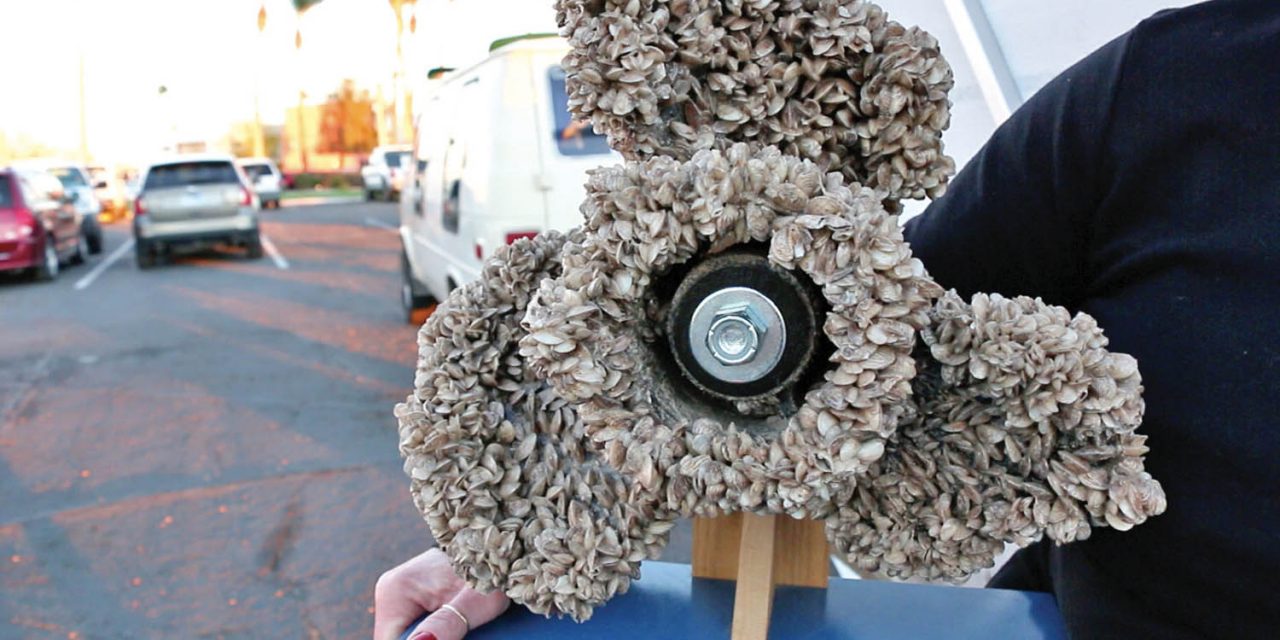
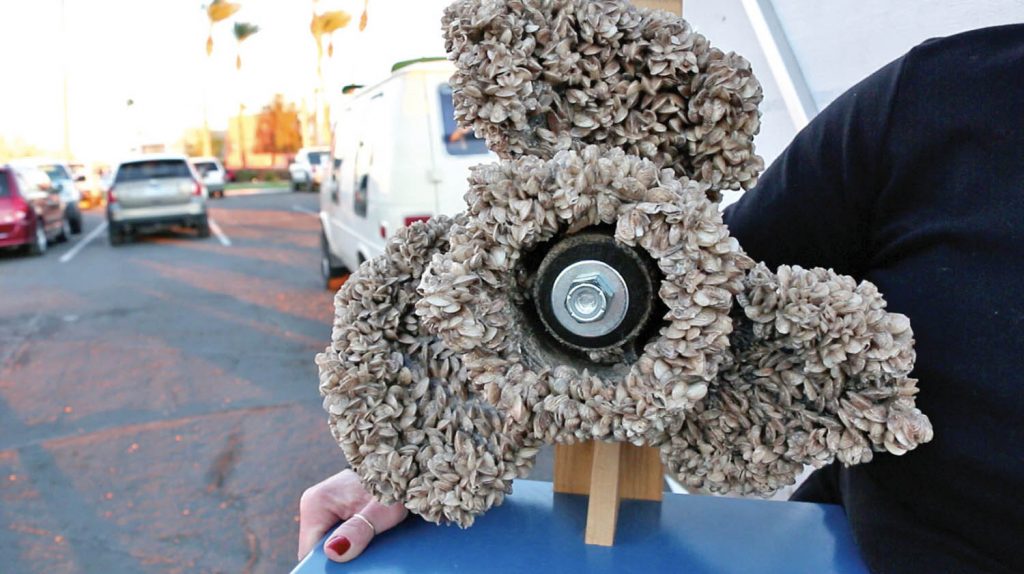
Mussels completely encrust a boat propeller in a still image from the short ducmentary Mussel Threat by Brynne Morrice. Zebra and quagga mussels will encrust any other surface in the water including water intakes, docks, boats, and power generation equipment. The razor-sharp shells also cover beaches, preventing people from going barefoot. (Photo supplied)
The B.C. government has stepped up its program to intercept invasive zebra and quagga mussels entering the province with eight permanent mandatory inspection stations near the Alberta and U.S. borders.
The station serving the Osoyoos border crossing, however, will be based in Penticton.
The announcement of the stepped-up program won support from the Okanagan Basin Water Board (OBWB), which has been calling for permanent inspection stations since 2012.
The Invasive Species Council of B.C. is also applauding the announcement of the permanent stations.
The new program came into effect last Friday, April 1.
Invasive mussels have spread to much of North America, mainly by the transportation of recreational boats that have not been properly cleaned, drained and dried after being used in infested lakes. They were initially spread to North America from Europe in ships’ ballast water.
The mussels, which encrust themselves on every surface in waterways, have already done billions of dollars in damage across the continent. They have reached the Southwest U.S., but so far they have been kept out of waterways in the Pacific Northwest.
Last year B.C. implemented roving inspection and decontamination units, which the OBWB welcomed. But the board representing Okanagan regional districts continued to argue permanent stations would be more effective.
In making the announcement, Premier Christy Clark said B.C. is leading the fight against invasive mussels and that none have ever been detected in B.C. waterways.
Nonetheless, most of the $2 million in annual funding comes from private companies and non-governmental organizations.
The program is being funded with $1.2 million from B.C. Hydro and $250,000 each from FortisBC, Columbia Power and the Columbia Basin Trust.
The province is providing $250,000 of in-kind staff time, office space and equipment.
“It’s a massive step forward,” said Doug Findlater, chair of the OBWB in a news release. “When coupled with the perimeter defence of other provinces and states, this gives us much better protection than we’ve had in the past.”
Findlater, however, cautioned that there’s a risk in funding the program from non-government sources.
“External agency funding partnerships are great,” but they don’t last forever,” he said. “We hope the province makes this a permanent mussel defence program and commits to ongoing core funding.”
The portable station serving Osoyoos, as well as Midway and Kaleden, will be based in Penticton. Nonetheless, Canadian Border Services Agency (CBSA) officials in Osoyoos are now authorized to intercept and detain infected boats at the border as the result of federal regulations brought in last year.
Stations will also be located at Golden, Valemount and Dawson Creek, as well as Cranbrook (with the ability to set up in Sparwood, Roosville or at the Paterson border crossing). An Invermere station will have the ability to set up in Windermere and Radium Hot Springs. Nelson will cover additional key locations in the area. A Lower Mainland station will cover Sumas, Aldergrove and the weigh scales in Hope.
In total, 32 conservation officers will work the stations, which will operate 10 hours a day, seven days a week from April through October.
This is an increase of 20 crewmembers from last year’s pilot project, the provincial government said in a news release.
There will be an additional six mobile decontamination units added to the fleet of equipment. The eight inspection stations will have the capability to become mobile if the need arises, travelling to locations throughout B.C. where watercraft are detained and waiting for decontamination, the government said.
Osoyoos town councillors, however, expressed concern at their Monday meeting that the permanent inspection station will be in Pentiction rather than at the Osoyoos border crossing.
Mayor Sue McKortoff said she will write to the province to express council’s displeasure and would raise the matter at OBWB’s monthly meeting Tuesday in Vernon.
“It only takes one boat” sneaking through the border to a Canadian lake or river to cause a catastrophe, said McKortoff.
Coun. C.J. Rhodes said it makes no sense to have the inspection station in Penticton, when thousands of boats cross the Osoyoos border crossing each year.
“I can’t understand the reasoning for this location,” he said. “They have the room at the border … and their staff have already started training.
“I just don’t get it … I would like an explanation of why they would open this station in Penticton. I just don’t get it. It’s a bad, bad decision.”
An OBWB study in 2013 estimated that zebra or quagga mussels would cost at least $43 million each year to the Okanagan alone in lost revenue, added maintenance of aquatic infrastructure and irreparable ecological damage.
The Pacific Northwest Economic region recently estimated that region-wide costs would be $500 million annually.
Last year’s provincial inspection results found that 36 per cent of high-risk boats entering the province were headed to the Okanagan and 51 per cent were going to the Southern Interior.
RICHARD McGUIRE
Osoyoos Times
– With files from Keith Lacey