
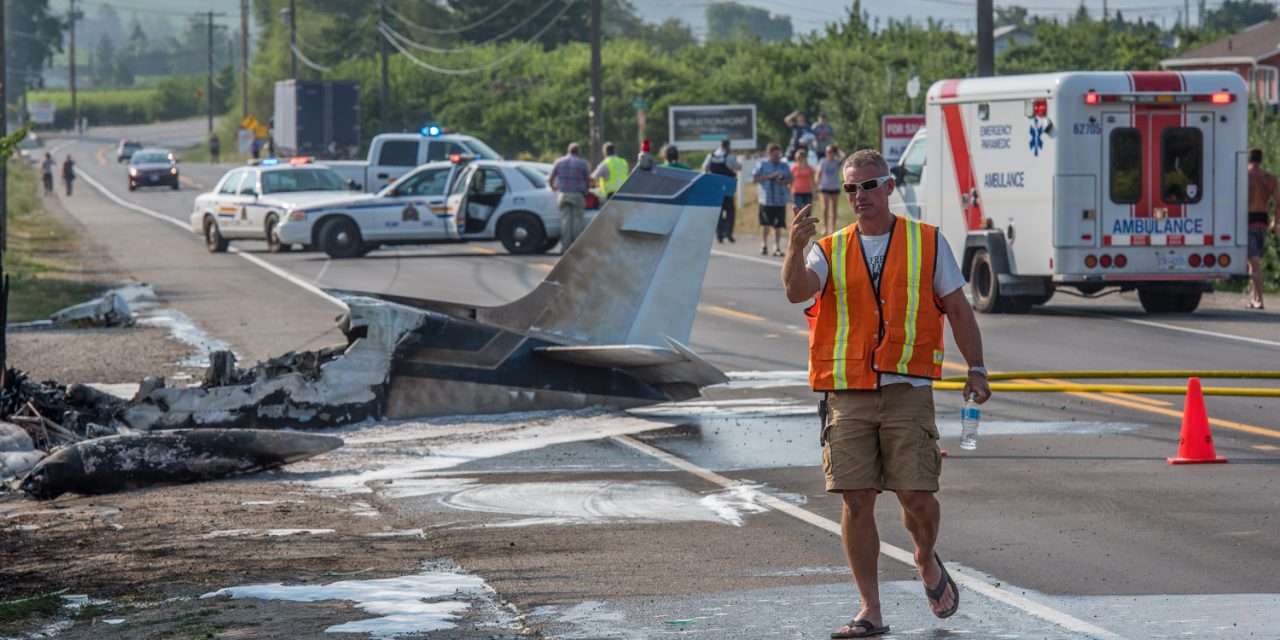
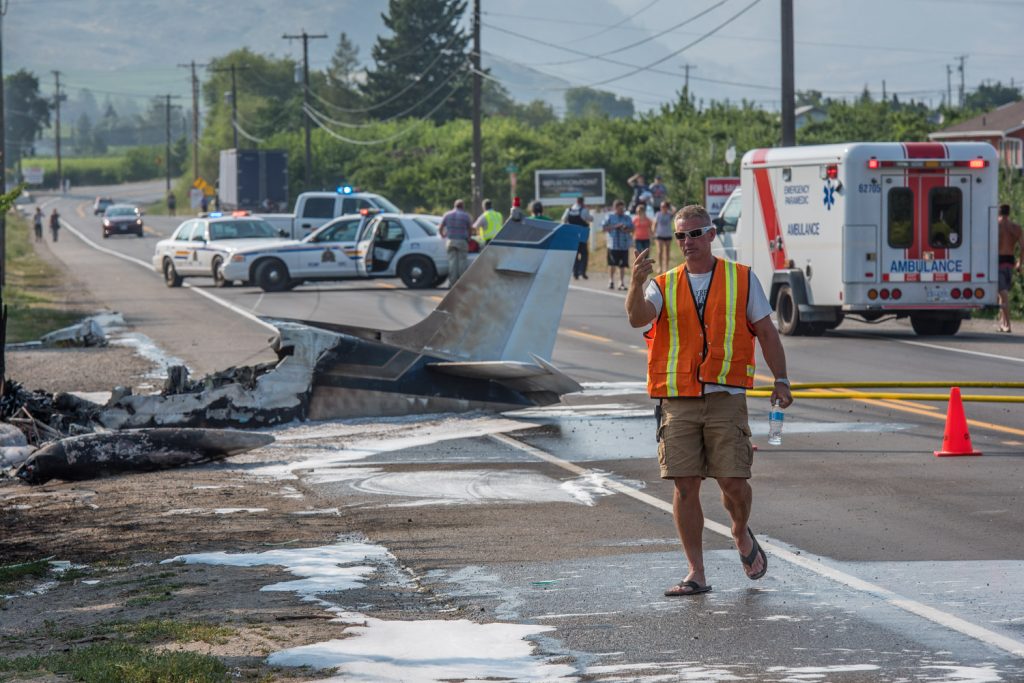
Highway 97 was closed in both directions after a small plane crashed just north of Osoyoos in July 2015. The Transportation Safety Board of Canada released an investigation report Thursday saying that vapour lock likely cut off fuel to the engine leading the pilot to attempt an emergency landing The use of gasoline instead of aviation fuel may have contributed to the vapour lock. (Richard McGuire file photo)
A plane that crashed on Highway 97 north of Osoyoos in July 2015 was likely starved of fuel as a result of vapour lock, caused by using automobile gasoline in place of aviation fuel.
That’s the conclusion announced last Thursday following an investigation by the Transportation Safety Board of Canada (TSB).
The Beachcraft A36 Bonanza (C-GPDK) force-landed on the highway, struck a truck and a power pole and burst into flames. The pilot was able to escape, but sustained serious burns.
The accident occurred at 4:45 p.m. on July 7, 2015 when the plane lost engine power.
The privately owned plane had just departed from Oliver Municipal Airport with only the pilot on board for a flight to Boundary Bay Airport.
The investigation determined that the aircraft’s engine was likely starved of fuel due to vapour lock and lost power as a result.
Vapour lock occurs when fuel, normally in liquid form, changes to vapour while still in the fuel delivery system.
This change causes a reduction in pressure to the fuel pump, disrupts fuel flow, and can result in temporary or complete loss of engine power.
The TSB investigation report suggests that automobile gasoline may have been used in place of aviation fuel in the plane, increasing the risk of vapour lock.
Use of automobile gasoline in this type of plane is not approved.
The pilot had experienced fuel-flow fluctuations and power losses on previous flights with C-GPDK, but was able on those occasions to successfully regain normal power and engine operation.
He recorded cellular phone video of the instruments when this occurred on a previous flight, and the TSB report says this was consistent with vapour lock.
Those previous successes in regaining full engine power may have delayed the pilot’s selection of a forced landing area.
The nearest airport was then not an option and Highway 97 was chosen as the next best emergency landing area.
Post-impact fires have been documented as a risk to aviation safety in previous TSB investigation reports.
In 2006, the TSB issued a recommendation to reduce the number of post-impact fires in impact-survivable accidents.
C-GPDK did not have, and was not required to have, any of the technologies, materials, or components identified in Recommendation A06-10.
If aircraft are not fitted with crashworthy fuel-system components that retain fuel or with systems that eliminate ignition sources, the risk of injury or death due to post-impact fire is increased.
“It could not be determined what type of fuel was being fed to the engine at the time of power loss,” said the TSB investigation report. “However, since the pilot had a history of using automotive gasoline (MOGAS) and the aircraft tip tanks emitted a strong odour of MOGAS, it is likely there was a mixture of aviation fuel (AVGAS) and MOGAS in the aircraft fuel tanks.”
SPECIAL TO THE TIMES
Osoyoos Times

