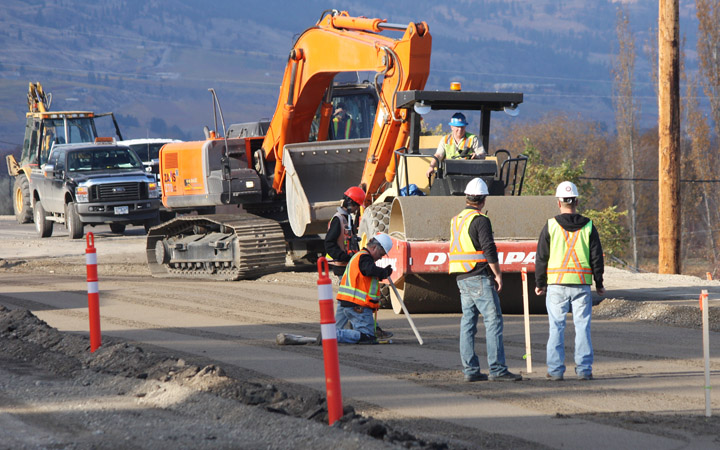
Construction crews were laying down a bottom layer of pavement on the new, four-laned section of Hwy. 97 north of Osoyoos last week. By the weekend, the new stretch of road was connected to the existing highway. Photo by Paul Everest - Click on picture for larger image
OSOYOOS TIMES-November 17, 2010
By Paul Everest – Osoyoos Times
Motorists had their first chance last week to drive on a new two-kilometre section of highway that has been under construction since March.
Construction crews have been paving the Osoyoos Lake passing lanes on Hwy. 97 between Graveyard Hill and Dead Man’s Lake for the past month and, at the end of last week, the new four lanes of highway were attached to the existing portions of Hwy. 97 south of 204th Avenue and north of Road 22.
This is the first layer of paving and Rampaul Dulay, the provincial Transportation and Infrastructure Ministry’s project manager for the passing lanes project, said the second and final layer of paving is expected to be completed by the end of the month.
As of Nov. 15, he said, crews were paving gravel sections linking the new lanes and existing highway at both ends of the passing lanes.
The old section of Hwy. 97 that runs parallel to the new lanes to the west has now become a frontage road to service residences, businesses and farmland on the west side of the highway.
Dulay said once the paving is done, construction crews will focus their efforts on completing a new turnoff between the Orchard Hill Estate Cidery and Fruit Market and the Golden Mile Fruit Market on the west side of the highway.
The turnoff was incorporated into the highway expansion plans earlier this year to address the concerns of the owners of the fruit markets who expressed fears their businesses would be hurt when access to the highway was cut off once the new lanes open.
Building the new turnout which connects the new passing lanes with the frontage road required that some of the property belonging to the owner of the Orchard Hill Estate Cidery and Fruit Market be used.
Construction crews will also install concrete and cable barriers along the new stretch of roadway, Dulay said, and finishing work will be carried out at the highway’s intersections with Road 22 and 204th Avenue and the new pullout on the west side of the highway at 204th Avenue.
Although work will stop once the weather turns bad during the winter, cleanup for the project will take place in March and the entire project is expected to be completed by March 31, 2011.
The budget for the project that was announced last year is $8 million.
Dulay said there no indication the work will go over-budget.
While construction crews were preparing the new section of highway, the 204th Avenue access to the Willow Beach area was closed and for several days Willow Beach residents were advised to follow an access road to Road 22 in order to get on to the highway.
At least one Willow Beach resident, who asked not to be identified, complained that the closure of 204th Avenue inconvenienced people living in the area and presented a safety risk if emergency crews needed to access Willow Beach.
But Mike Holmes, who also lives at Willow Beach, said residents had the option of using a government access road that runs south from the site and connects with Hwy. 97 near 95th Street.
He said 204th Avenue was only closed for four days and he was not aware of any other residents complaining about the closure.
Holmes added, however, that he was concerned about whether the province would be installing lights, guardrails and proper drainage systems on Hwy. 97 directly south of the 204th Avenue intersection.
Dulay said there will be concrete barriers approaching 204th Avenue from the south.
Other concerns that have arisen since construction began on the project focus on amphibians that use wetlands near the new section of highway.
Sara Ashpole, a researcher with Ontario’s University of Waterloo, has been working with the ministry since the spring to find ways to reduce any impact the construction would have on tiger salamanders, spadefoot toads and other amphibians that regularly cross the highway to reach wetlands near the southeast corner of the intersection of Hwy. 97 and Road 22.
She said conditions for amphibian breeding in the area were better this year than they have been in a decade thanks to a wet and warm spring and summer.
“It’s the best year for breeding, the worst year to build a road,” she said.
Researchers from the university under Ashpole’s direction spent hundreds of hours surveying amphibian movements in the area around the construction zone.
They found that amphibians were moving from the highland areas on the west side of the highway in the spring to lowlands on the east side of the highway for breeding.
The amphibians would return to the highlands in the fall.
Unfortunately, Ashpole said, the highway is in their way.
Between April 15 and July 3, researchers recorded 717 dead adult spadefoots and 459 live ones in a stretch of Hwy. 97 from the U.S. border to the Oasis service station north of Oliver and including Black Sage Road.
Of the 717 dead spadefoots, 359 were found on the highway where road construction is taking place.
The dead toads had been run over, Ashpole said.
The situation was not much better for tiger salamanders as the researchers found nine dead and one alive in the same area.
The good news, Ashpole said, is that the ministry is working with her to alleviate the stresses on the local amphibian population.
She has been in discussions with the ministry about enhancing the turnout area west of the 204th Avenue to provide habitat for amphibians that breed there.
The ministry has also agreed, based on Ashpole’s recommendations, to install nine culverts under the highway that will allow amphibians to move back and forth between the highlands and lowlands without having to dodge traffic.
Special fencing will also be installed to channel the amphibians toward the culverts.
Ashpole said she and her researchers will return to the area next spring to see if the amphibians are using the culverts.
[email protected]