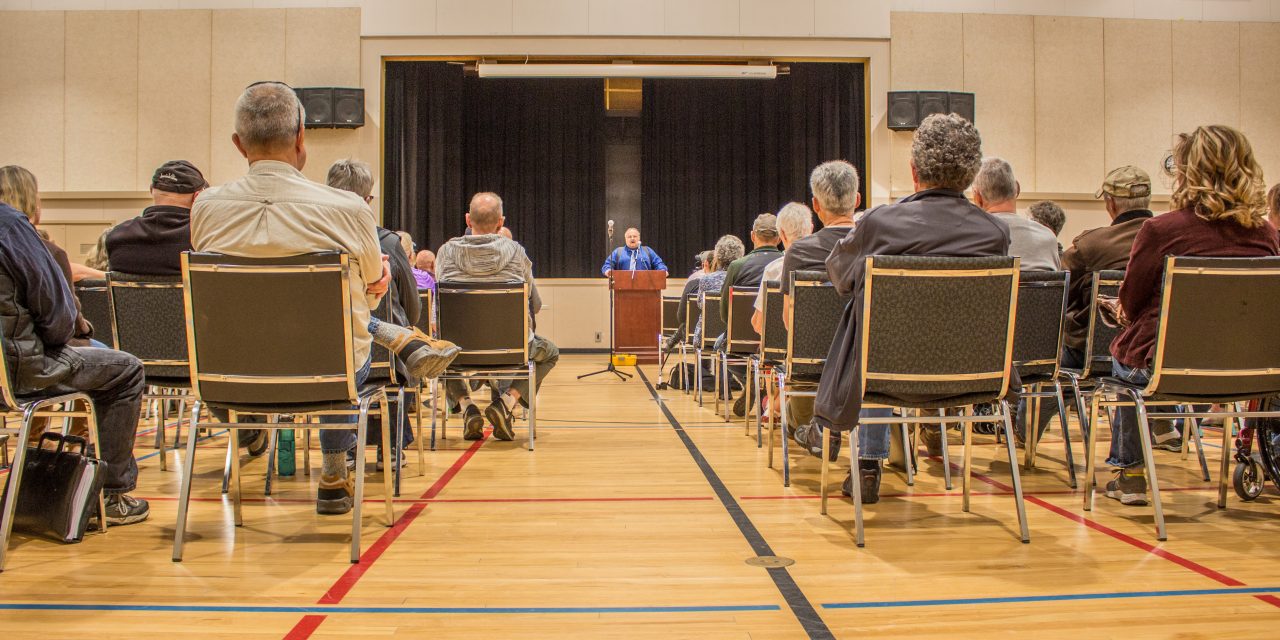
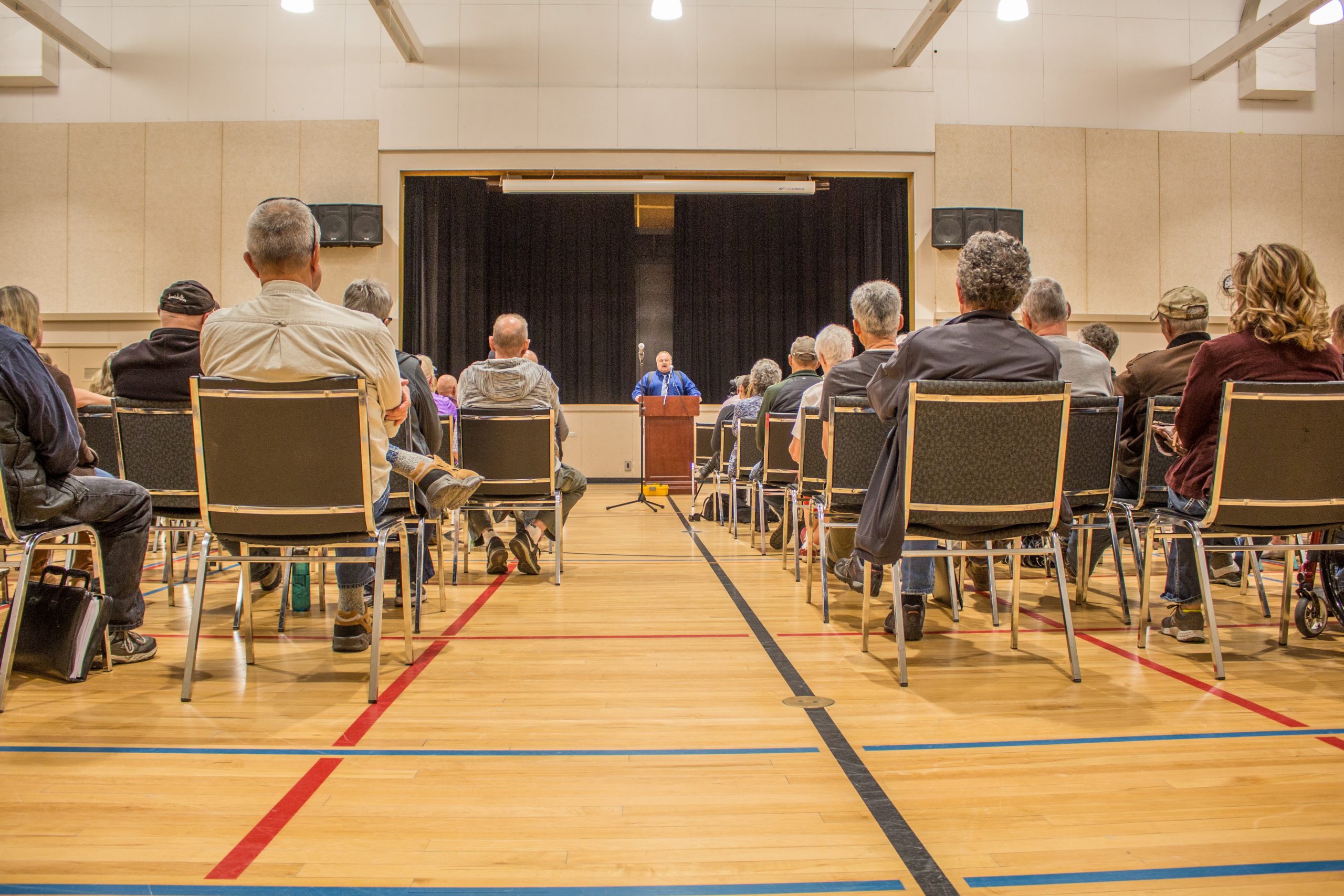
Regional district Area C director Rick Knodel spoke as a panellist at a public forum on the proposed national park reserve in the South Okanagan – Similkameen at the Sonora Centre in April. (Vanessa Broadbent / Osoyoos Times)
By Dale Boyd
Osoyoos Times
Four out of ten respondents to a survey conducted by Parks Canada have concerns about a proposed South Okanagan national park.
The most pressing issue is the restriction of land use.
Out of 2,848 people who responded to the Parks Canada consultation, 41 per cent, made up of primarily local residents, addressed unprompted concerns about the proposed park boundary.
Of those, 14 per cent had concerns over restrictions to land use and eight per cent were concerned about hunting and fishing restrictions.
Roughly one half (49 per cent) of survey respondents, who were primarily non-residents, identified unprompted benefits with 20 per cent of those respondents identifying ecosystem and land preservation as a benefit and eight per cent saying wildlife and habitat conservation would be a benefit from the park.
The four-month long consultation process released in a “What We Heard” report compiled by NRG Research Group concluded “establishing the proposed national park reserve will require ongoing efforts to reconcile differing views on the initiative.”
“The public consultation process is not intended to build consensus, but to identify challenges and opportunities associated with the proposal that require ongoing efforts to address,” the report states in its conclusions.
The consulting firm recommends more clarity and communication moving forward from Parks Canada, who are hosting public information sessions this week. The report also recommends Parks Canada make efforts to educate the community, municipalities and “clarifying First Nations uses and practices in a national park reserve,” as well as more clarity on ranching and grazing rights.
• Read more: National park opponents host public meeting
Indigenous stakeholders are holding their own consultation, which the report notes is separate from Parks Canada’s consultation.
The survey took place from Dec. 10, 2018 to March 15, 2019 involving in-person and conference calls reaching 627 individuals, 146 people plotting their activities on a map of the working boundary and 2,848 total surveys. Of those surveys, 2,488 were completed online and 360 were sent in by mail or email.
Through 39 meetings, Parks Canada fielded questions and concerns from a variety of groups including provincial ministries, HNZ Topflight, local ranchers, heritage societies and wine associations to name a few.
Out of those meetings, the report states, some stakeholders feel “the proposed national park reserve is being forced upon them, while others see the value in establishing the national park reserve, in terms of long-term sustainability of this important ecosystem.”
Stakeholders also had specific concerns over “a number of current uses that are not allowed within Canada’s national parks,” and were seeking clarification on how this park reserve would differ.
The bulk of the nearly 3,000 respondents live in B.C., 49 per cent live in the Regional District Okanagan-Similkameen, eight per cent from the Central Okanagan Regional District, 36 per cent responded from the rest of B.C. and another eight per cent were outside of B.C. or had no address.
The public will have their chance to meet face-to-face with Parks Canada officials with multiple upcoming public information sessions this week throughout the valley.
Meetings take place in Osoyoos on May 15 at the Sonora Community Centre from 10 a.m. to 2 p.m.; Oliver on May 14 at Venables Theatre from noon to 8 p.m.; Keremeos on May 15 at Keremeos Victory Hall from 4 to 8 p.m. and in Penticton at the Shatford Centre on May 16 from noon to 8 p.m.