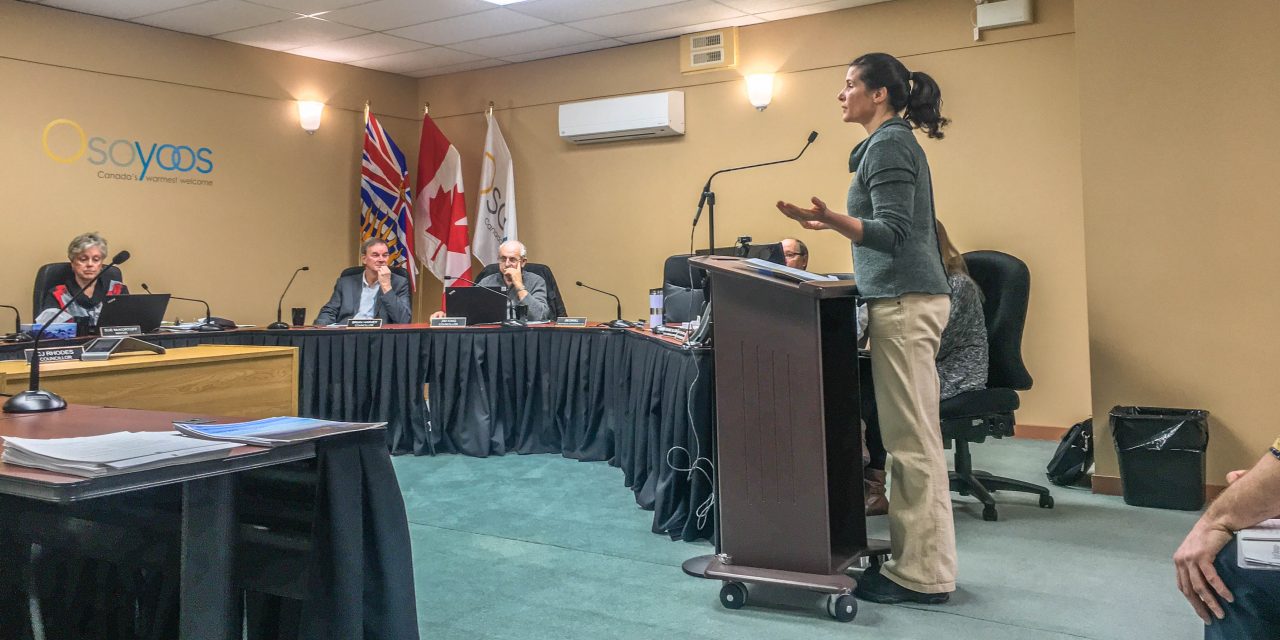
Sarah Boyle, Parks Canada’s project manager for the proposed national park reserve in the South Okanagan presented to town council on Monday morning. (Vanessa Broadbent photo)
By Vanessa Broadbent
Osoyoos Times
With the end of Parks Canada’s public consultation process on the proposed national park reserve in the South Okanagan approaching at the end of the month, project manager Sarah Boyle is busy hosting stakeholder meetings and presentations, including one to Osoyoos town council on Monday morning.
Boyle visited council to share up-to-date information and provide an overview about the park proposal.
Boyle told council that Parks Canada’s goals for the park are “primarily ecological.”
“This is one of the most biologically diverse areas in Canada, one of the most endangered ecosystems in Canada,” she said.
What will make the national park reserve different from standard national parks is the recognition of aboriginal rights and title; a reserve allows for traditional practice by indigenous people on the land.
Currently, the planned site is a working boundary, which Boyle said is a term used to describe the proposed area.
“The line on the map is what Parks Canada proposes to achieve at some point in time. It will take a number of years to realize that.”
• Read more: Parks Canada launches website and survey for public consultation on proposed national park reserve
Although some lands included in the boundary are private property, the national park designation will not apply to them and the current governing body will retain control.
The only time where private lands may be considered to be included in the park reserve, Boyle said, is on a willing seller – willing buyer basis.
“In order for guests or family or friends or patrons to access the property, there will not be a need to pay toll fees or pay road fees or anything to that extent.”
In previous discussions about the park, dating back to 2003, talk surrounded phasing out cattle ranching and Boyle told council Parks Canada has no plans to do so.
“We heard loud and clear from the public and members of the ranching industry as well as the government that that wasn’t an option,” she said.
“Part of being invited back to the table by the province as well as the Okanagan Nation Alliance is that long-term relationships with ranchers will be critical to the future success of the national park reserve.”
Commercial livestock raising isn’t normally allowed in national parks, but Parks Canada is willing to work with ranching families, Boyle said.
Off-road vehicle use will be allowed for operational purposes for ranchers as well. However, recreational off-road vehicle use will be prohibited, along with firewood collection, parachuting and base jumping, mushroom picking and drone use.
Fishing and horseback riding will be allowed, and hunting will only be permitted on private lands. In accordance with federal law, transported firearms will need to be unloaded, disabled and securely encased.
As for fire management, Parks Canada plans to work with existing local fire departments.
“We recognize that a collaborative approach to fire management will be required and hope to add to that capacity to help address and prevent catastrophic wildfire in the area.”
• Read more: Majority want referendum on national park reserve, new poll suggests
Boyle said she’s also heard worries about the area becoming similar to Banff and Jasper national parks and see a steep influx in tourism.
However, Banff and Jasper parks, both much larger and built over 125 years ago, are “very old models” which are not used today. Newer parks and park reserves are completely dependant on collaborating with local communities, Boyle said.
Data collected by Parks Canada, including from five local parks including Manning Park, and 10 national parks and national park reserves that have similar characteristics, the proposed park reserve in the South Okanagan would only see an additional 2,300 to 3,900 people visit the area in the first year.
Parks Canada projects to see 73,200 visitors in the first year, growing to 77,200 by the fifth year. Local residents make up 56 per cent of visitors, while 44 per cent will be tourists with 5.3 per cent of those being visitors not in the region for other reasons.
“There would be modest growth,” Boyle said. “The first five years really are for planning and development of park infrastructure and visitor services. That allows for visitation to be planned and increased sustainably but strategically over time so that you’re not looking at carrying capacity issues.”
Currently, the park reserve is in planning phases and it’s unclear what will happen with existing tenures, such as helicopter and guiding.
“In the high likelihood that this national park reserve does go ahead we would then go into more detailed negotiations and planning,” Boyle said.
Once the public consultation process closes at the end of the month, a “What We Heard” report will be created and presented to a steering committee and provincial and federal environment ministers.
“This is what the consultation process is for,” Boyle said. “This boundary is just a line and we want feedback.”