By Don Urquhart, Times Chronicle
“The salmon people are our relatives,” was the fundamental message for non-Indigenous participants at the start of the 2022 Nk’mip (Osoyoos Lake) Water Science Forum in Osoyoos last week.
This year’s water forum took on a very ambitious aim to bridge traditional Indigenous approaches to water issues with Western scientific methods.
Likely most of the nearly 140 attendees at the two-and-a-half-day event would agree that the substantial program saw a wealth of cultural and scientific information exchanged, friendships formed and cultural understanding greatly furthered.
But in order for this bridging of approaches to bear fruit, it was important for non-Indigenous participants to understand and respect the unique ways of seeing and understanding of the world through an Indigenous lens.
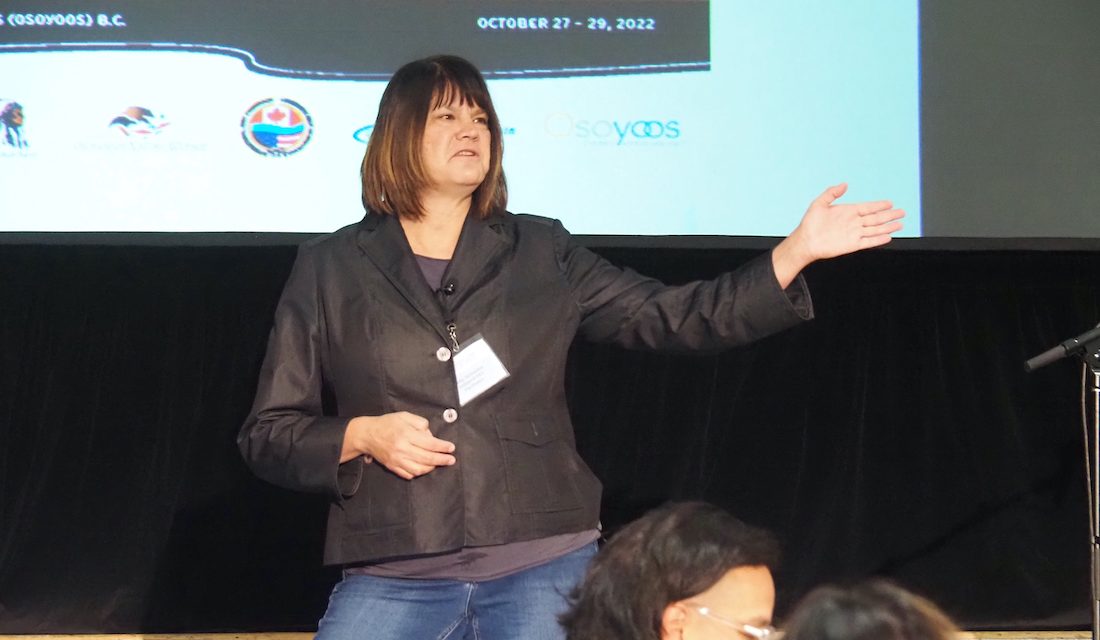
This was a key task of Kelly Terbasket, the Program Director of IndigenEYEZ and Aaron Derrickson both from the Syilx Nation who were facilitators for the event.
“I see myself as a cultural bridge because of my mixed heritage,” Terbasket said noting both her Silyx and white settler roots.
She says that going back and forth between her families and cultures as a child she saw “a lot of diverse lived realities but I also saw a lot of inequities and lack of understanding. I really want in my life to be a part in bridging that understanding,” she said.
She related a conversation she had with her daughter who asked her what was the purpose of her training program that she leads. “I was like, ‘to decentre us as humans. Decolonizing is learning how to decentre ourselves and put ourselves in the circle as one part of the circle, not the centre of the circle’.” To which her daughter replied: “Wow, that’s a tough job.”
“I use the term micro-shifts and so part of my role in this conference is bridging and being part of those micro-shifts. Those little incremental changes we do, we can do together and slowly start shifting the way we are in our relationships with each other and with the land and with the water and with our salmon relatives,” Terbasket said.
Speaking at the opening ceremony at the Nk’mip Desert Cultural Centre, Osoyoos Indian Band (OIB) Chief Clarence Louie noted that the conference was to cover very important topics. “Water is always front and centre, especially for First Nations,” he said.
“This lake is highly important not just to native people but to newcomers, and an important part is the quality of the water,” he said adding that “it is important for the salmon people,” he said.
“When we talk about the salmon people returning to the waters around here each year, those are our relatives, none of us would be around if it wasn’t for those salmon people. Even when your people [white settlers] came here, from Hudson Bay Company historic records, your people wouldn’t have survived here without the salmon people giving up their lives,” Louie said.
Louie also highlighted the different outlooks and understanding of the natural world that Indigenous people have. When humans do something that may impact nature the questions an Indigenous person will ask are: Are the salmon people going to be okay? Is the land going to be okay? Are the four-legged relatives going to be okay? Are the humans going to be okay?
“That question – are the humans going to be okay – should always come after the other questions and that is the way our people look at things,” Louie said.
He also highlighted that while many non-Indigenous simply dismiss Indigenous beliefs as legends or myths they are a valid and important way of seeing and understanding the natural world.
Louie said Indigenous people could just as easily dismiss the Bible as a collection of myths or legends. “The captikʷł is our Bible, it isn’t myths or legends,” Louie said.
The captikʷł are a collection of teachings about Syilx Okanagan laws, customs, values, governance structures and principles that, together, define and inform Syilx Okanagan rights and responsibilities to the land and to their culture.
Arnie Marchand, an elder from the Colville Confederated Tribes in Washington State noted the importance of Osoyoos Lake to the entire Okanagan Valley from the head of the lake all the way down to Brewster, Washington.
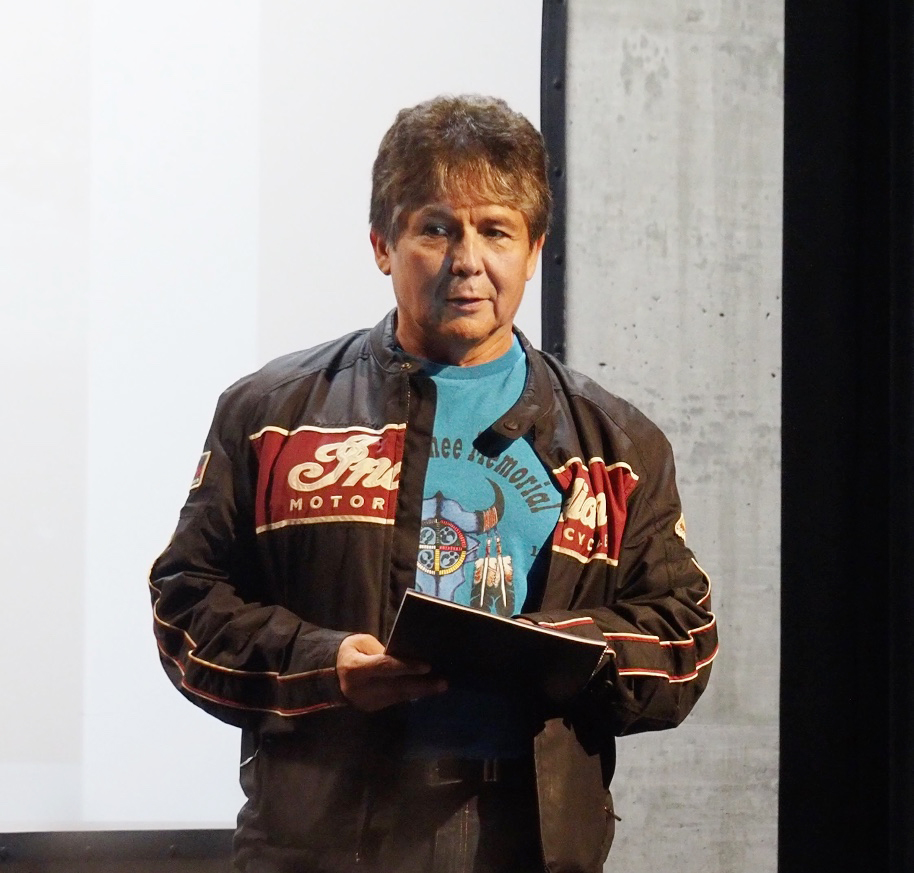
Osoyoos Indian Band Chief Clarence Louie. Don Urquhart photos
“Whatever happens to Osoyoos Lake is caused by what isn’t being done up, what isn’t being done down. Osoyoos Lake is the middle, it is the heart, it is the soul of the Okanagan. If you want to know how well we’re doing look at the lake from any perspective you want and that’s going to tell you the health of it,” he said.
Marchand also noted that Indigenous people are “having to learn again how to deal with the lake using your technology to help us better handle what we’ve been handling for these thousands of years in terms of our relationship with water. It is our relative,” he added.
The Times Chronicle will feature a series of stories covering the 2022 Nk’mip (Osoyoos Lake) Water Science Forum in the weeks ahead.