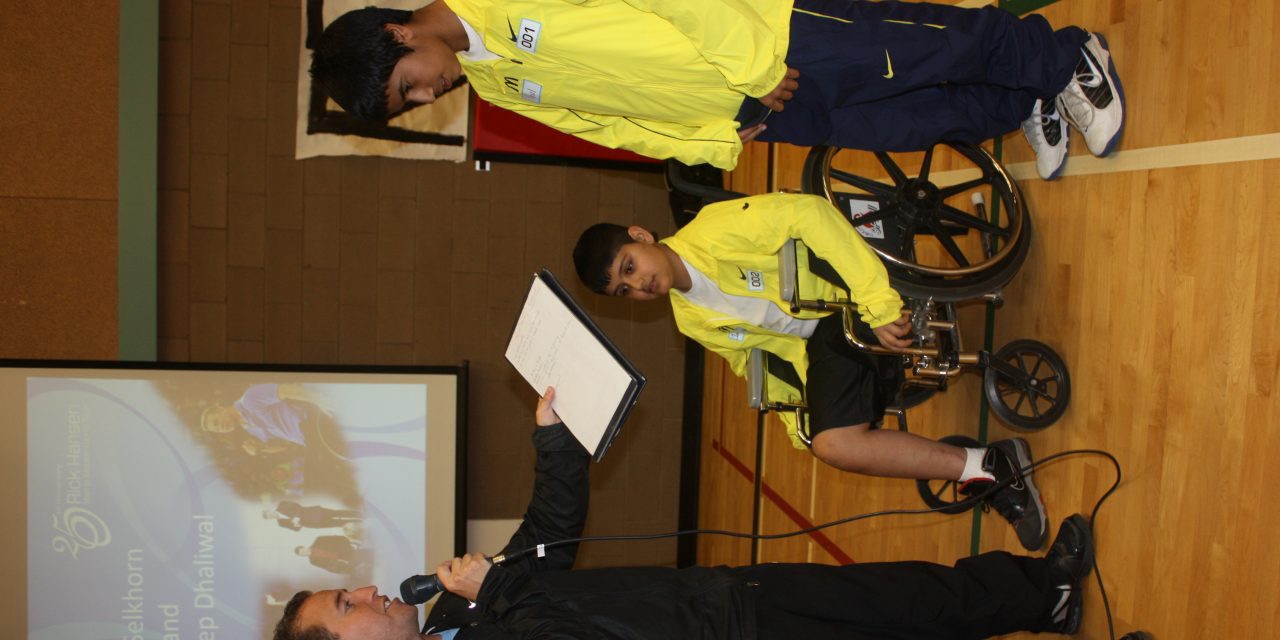
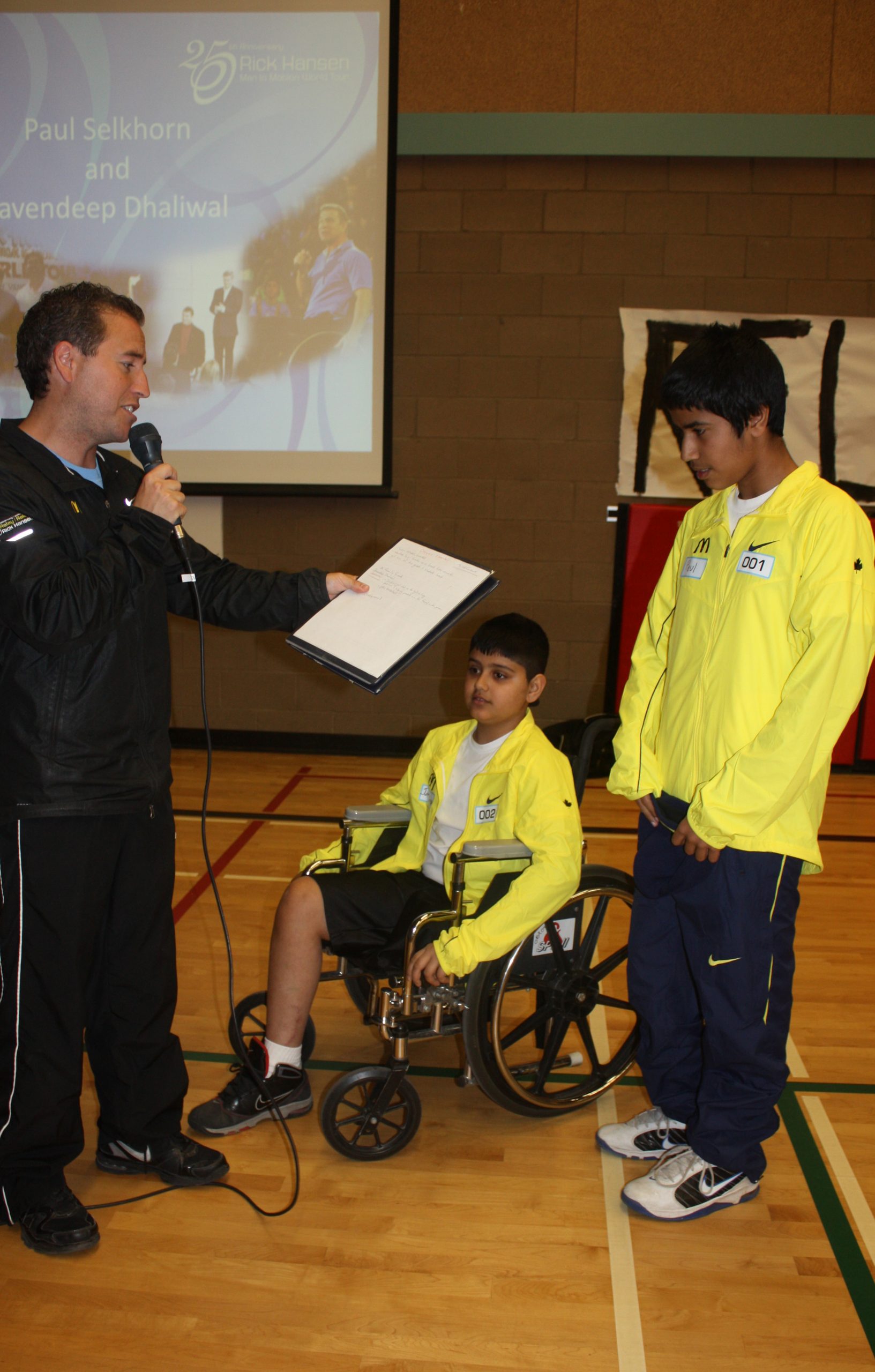
Billy Pilon, part of the events team with the Rick Hansen 25th Anniversary Relay, talks to Javendeep Dhaliwal, left, and Paul Selkhorn, who were the two students from Osoyoos Elementary School selected to participate in the relay in Osoyoos last Tuesday. Pilon gave students, staff and parents a terrific presentation about the hardships Hansen and his crew had to endure during the original Man in Motion World Tour a quarter century ago, when he travelled to 34 countries in 26 months. Photo by Keith Lacey
Students at Osoyoos Elementary School got a history lesson about a Canadian hero last week and parents and teachers also learned a lot of things they probably didn’t know about Rick Hansen and his Man in Motion World Tour.
Students Paul Selkhorn and Javendeep Dhaliwal also had a day they won’t soon forget as the two good friends were selected as the first of several medal bearers to participate in the Rick Hansen 25th Anniversary Relay through the streets of Osoyoos last Wednesday morning.
The relay, which started last August in Newfoundland, wraps up next week in Vancouver. More than 7,000 Canadians have been selected as medal bearers as part of a national tour designed to honour Hansen’s Man in Motion Tour, which took him to 34 countries around the world 25 years ago.
In the process, Hansen’s two-year tour raised almost $30 million for spinal cord injury research and made him a household name and national hero in Canada.
Billy Pilon, part of the events team with the Rick Hansen 25th Anniversary Anniversary Relay, had students, teachers and parents jumping up and down and screaming “anything is possible”, which happens to be Hansen’s favourite saying and his motto during the Man in Motion tour.
Almost all Canadians over age 30 know that Hansen travelled around the world in his wheelchair a quarter century ago, but most probably didn’t know a lot of what Pilon revealed during his excellent presentation in the school gymnasium.
As an example, Pilon informed his captive audience that the Man in Motion tour started disastrously.
There wasn’t a single supporter in the parking lot of the Vancouver mall and Hansen’s small team of supporters had made the unwise decision to strap several of the wheelchairs Hansen would be using in wooden crates that were placed on top of the Man in Motion van, said Pilon.
Less than 10 seconds into their journey, the wooden crates came crashing down as the van passed through a tunnel because there wasn’t nearly enough clearance.
“What a way to start the Man in Motion tour,” said Pilon laughing. “He was leaving for a two-year journey around the world and only seconds into it, the crates carrying his wheelchairs were smashed into hundreds of pieces.
“But Rick has always been overcoming obstacles and that was just the first obstacle on his tour around the world.”
During his journey from Vancouver to Los Angeles, Hansen spent “almost the entire part of that trip in the pouring rain,” said Pilon.
He also endured several days in Manitoba when the temperature dipped below minus 40 degrees, he said. When the Man in Motion Tour made its way to Australia, there again was very little public support, but some animals sure were interested in Hansen as Pilon showed pictures of a large pack of wild dingos chasing Hansen in his wheelchair.
That was followed by another picture of Hansen’s wheelchair coming to a complete stop in New Zealand as Hansen and his team were surrounded by thousands of sheep that had closed off the highway he was travelling on.
When Hansen and his team travelled to China, trying to get his wheelchair onto the Great Wall of China wasn’t exactly easy, as team members had to use their feet to roll the wheelchair onto the flat surface.
“Do you think they had wheelchair accessibility on the Great Wall of China?” he asked.
During the entire 26-month Man in Motion World Tour, overcoming obstacles was all part of the fun, said Pilon.
“Rick has always believed anything is possible and that became his motto,” he said.
After travelling to 33 countries around the world, the tour had raised “about a million dollars, which was basically enough to cover expenses,” said Pilon.
“But Rick had said all along that when he got back to Canada everything would change and people would come out. And he was right.”
When the Man in Motion World Tour returned to Canada, Hansen had become a household name and national hero and the response was overwhelming, said Pilon.
Within a couple of months, Hansen had raised more than $26 million for spinal cord injury research.
When Hansen returned to that same Vancouver mall where his journey started, tens of thousands of people were in attendance as he received a hero’s welcome, said Pilon.
Twenty-five years later, Hansen’s 25th anniversary celebration tour is a reminder of what he accomplished and that more needs to be done to improve the quality of life for people suffering from spinal cord injuries, he said.
“A lot of the people who get the same injury Rick received can now lead normal lives,” he said.
The students, teachers and parents were then shown a video of Hansen doing his first bungee jump on CBC’s Rick Mercer Show several years ago.
Strapped in his wheelchair, Hansen drops several hundred metres with a huge grin on his face.
“His daughter had said, ‘dad you always say you can do anything’ so I want you to try bungee jumping, so he did,” said Pilon.
The clip ends with Mercer asking Hansen how he enjoyed the experience.
Hansen quickly fires back, “I can’t feel my legs,” which had everyone in the audience howling with laughter.
Following the presentation, Selkhorn and Dhaliwal received a standing ovation as they proudly carried the Rick Hansen Relay medals out of the gym and down the streets of Osoyoos.