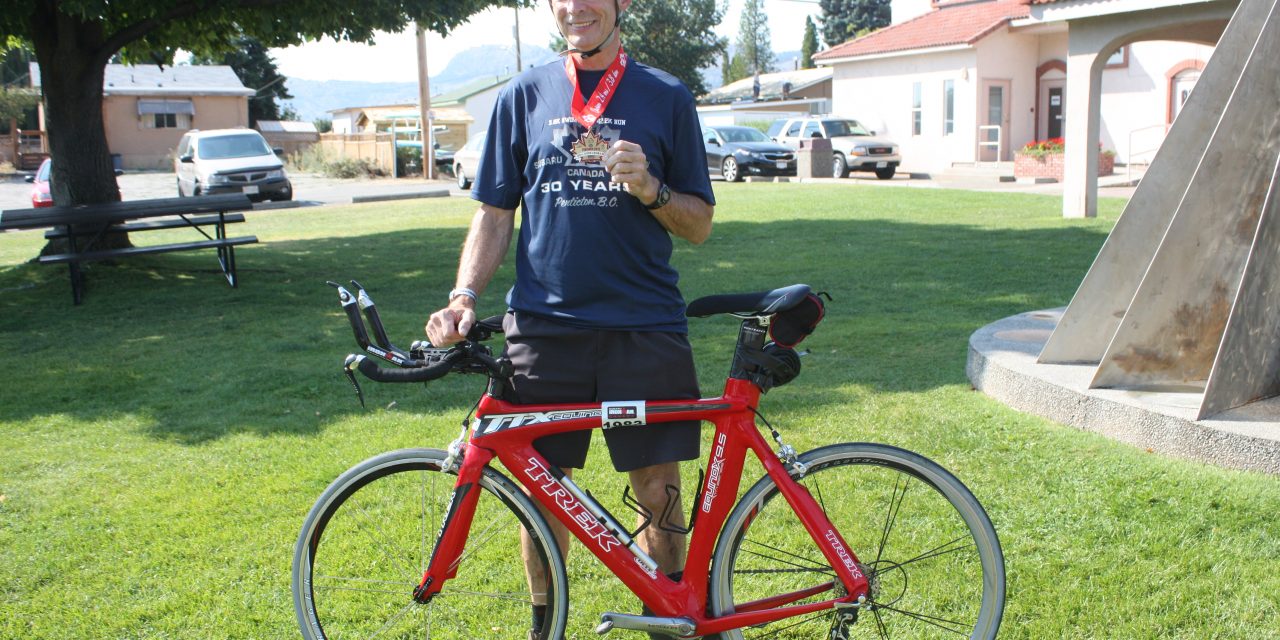
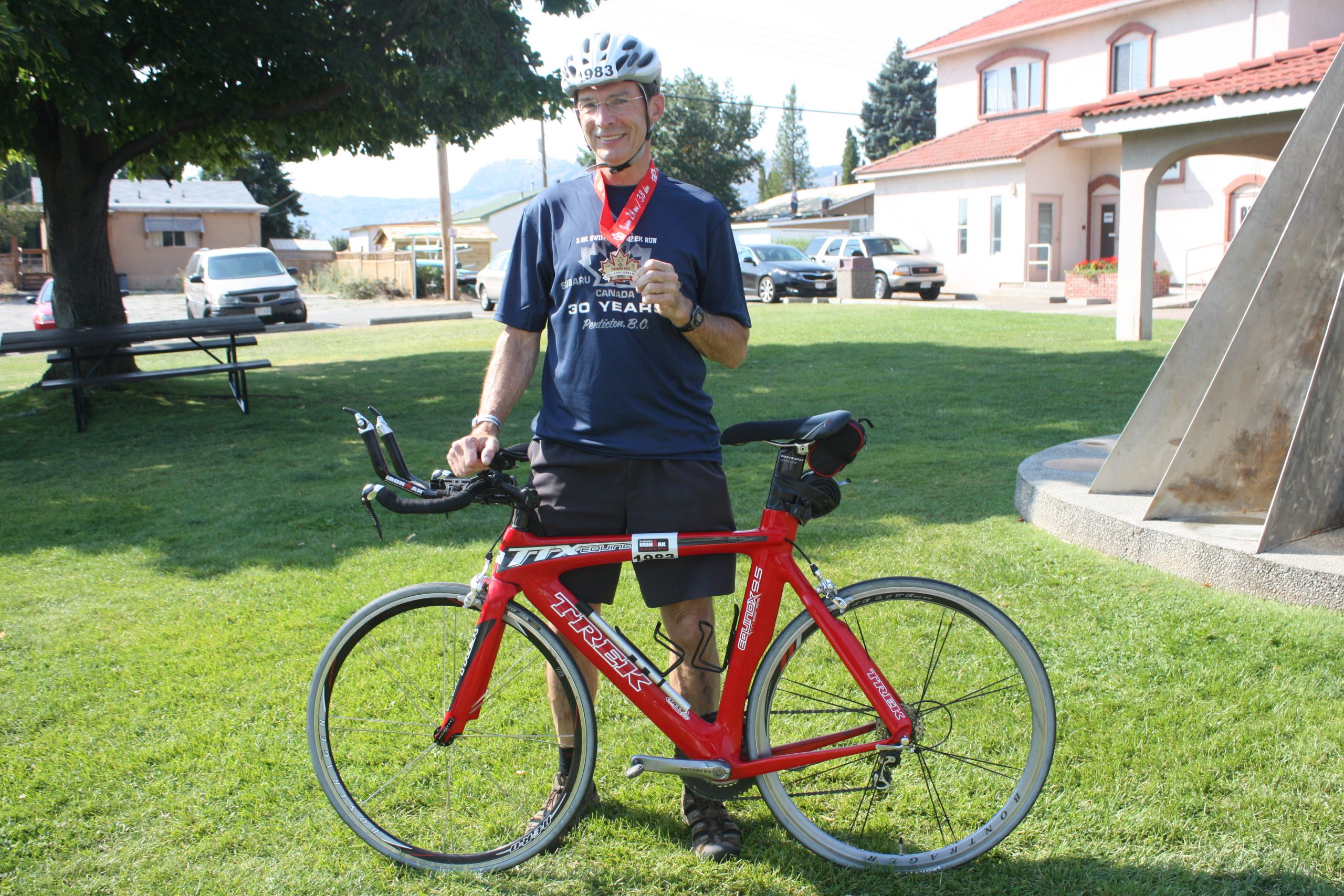
Osoyoos physician Dr. Robert Calder completed the Subaru Canadian Ironman in Penticton for the fifth time this past Sunday. His goal entering the grueling race was to cross the finish line and he managed to accomplish his goal late Sunday evening after 16 hours. Calder said talking to fellow competitors on the course helped him through his journey. Photo by Keith Lacey.
When you finish one of the most grueling athletic competitions in the world, you have earned the right to be proud and get a little emotional, says Dr. Robert Calder.
The well-known Osoyoos physician, 64, did something very few people his age could even think of accomplishing by completing the 2012 Subaru Ironman Triathlon in Penticton on Sunday.
He finished the exceptionally challenging course in just under 16 hours.
Calder, who has been a physician in Osoyoos for 35 years, has come a long way considering he ran his first marathon in Kelowna back in 2001, a year before competing in his first Ironman triathlon.
“My only goal was to finish after crashing my bike and not being able to finish back in 2008, which is the last time I ran the Ironman,” said Calder. “There’s a real sense of satisfaction in being able to complete this race because it’s so tough.”
Calder competed in his first Penticton Ironman event 10 years ago and finished the 3.8 kilometre swim, 180-kilometre cycling race and full 42.2 kilometre marathon in 15.5 hours. He lowered his time to just over 14 hours two years later in 2004 and was around 16 hours once again in 2006, when he competed only six months after a serious operation.
After crashing his bike early on in the 2008 race and breaking a rib in the process, Calder admitted he was hesitant about signing up for this year’s race, but he had trained exceptionally well and felt wonderful heading into the race.
After 16 grueling hours, he felt better than he ever has at the finish line this past Sunday near 11 p.m. before hundreds of screaming fans at the finish line on Lakeshore Drive in downtown Penticton.
“Considering I had taken four years off between Ironmans, I was very pleased with my time,” said Calder. “I had done the half Ironman in Osoyoos in about eight hours, so I thought I would be ready, but a full Ironman is just so difficult, but I felt good the entire race and when I got to the finish line I felt fantastic … better than I had ever felt before.
“I think I finally found the balance between running the race and eating the right food and liquid intake. I felt strong the whole race because I think I’ve finally figured that out. During my first Ironman, I couldn’t keep down any food at all and I was so weak and I only finished on guts.”
Each and every person who has the guts, fortitude and physical ability to finish an Ironman deserves the huge ovation they receive from the huge army of volunteers and fans who show up every year to cheer on the competitors, said an emotional Calder.
“The volunteers and the people of Penticton are simply incredible,” said Calder, his eyes welling up. “The amount of support and spirit that’s involved in this event is truly amazing … it’s an incredible thing to be a part of.”
To break up what is an extremely long and challenging day, Calder said he engaged in conversation with as many of his fellow competitors as he possibly could throughout the competition.
“Before the swimming race to kick things off, there’s a lot of butterflies and nerves, so I struck up a conversation with a fellow who was running his first Ironman and wished him good luck,” he said. “Out on the bike course, I had this one fellow keep passing me five or six times and I passed him five or six times, so we struck up a conversation and shared a few laughs.
“Then during the marathon, I met up with this lady from Kelowna and she was having a really tough time with about 10 kilometres to go, so I started talking to her and we agreed we would finish the race together. I was ready to walk in those final few kilometres, but she wanted to run, so we took our time and ran the final 10 kilometres together. We helped each other out a lot. There are experiences like this that you never forget during these races.”
At age 64, Calder said he’s proud he was able to finish the race and is amazed so many competitors older than himself had the same goal and simply wanted to complete the course.
“It’s not a race for most people, but simply about doing it and saying you finished an Ironman,” he said. “Everyone who finishes an Ironman has a real sense of accomplishment, as they should because it’s so very difficult and tough.”
Having an Elvis impersonator out on the quiet streets of Keremeos and several ladies singing Petula Clark’s hit tune Downtown are indelible memories he won’t ever forget, said Calder.
“The amount of spirit and kindness shown by so many people is what makes me keep coming back,” he said. “The entire City of Penticton seems to be out there as volunteers and cheering us on. It really is something.”
The only negative memory he will have stems from the fact it appears this is the last Subaru Ironman as the City of Penticton has announced its plans to take over as official sponsor and change the format to a more family-friendly competition, said Calder.
“I talked to a lot of people this weekend and none of them want anything to change,” he said. “The main brass from Ironman Canada sent me an email and said they don’t want to let this go and can you help us.
“I don’t know all the details, but I do know the City of Penticton apparently wants to run the event and wants to change the format and I think that’s a very sad thing as this event remains a tremendous success with competitors from all over the world coming here. I would hate to see anything change to be quite honest.”
Besides some very sore feet, Calder said he felt “fantastic” the next morning after the race. He was back riding on his bike early Monday morning.
Calder says you never stop learning in life and you certainly never stop learning new things as a triathlete as it has taken him years of training to find the right balance to get properly prepared to compete in an Ironman competition.
You have to build endurance over several months of training and can’t “burn yourself out”, especially at his age by training too hard leading into the big race, he said.
Seeing competitors even older than himself along the course provides a great deal of inspiration as he knows there are others going through the same mental and physical challenges as him, said Calder.
While he wouldn’t rule out competing in another Ironman next year or the year after, Calder said he never plans that far ahead and considers himself very lucky to be in terrific shape at age 64.