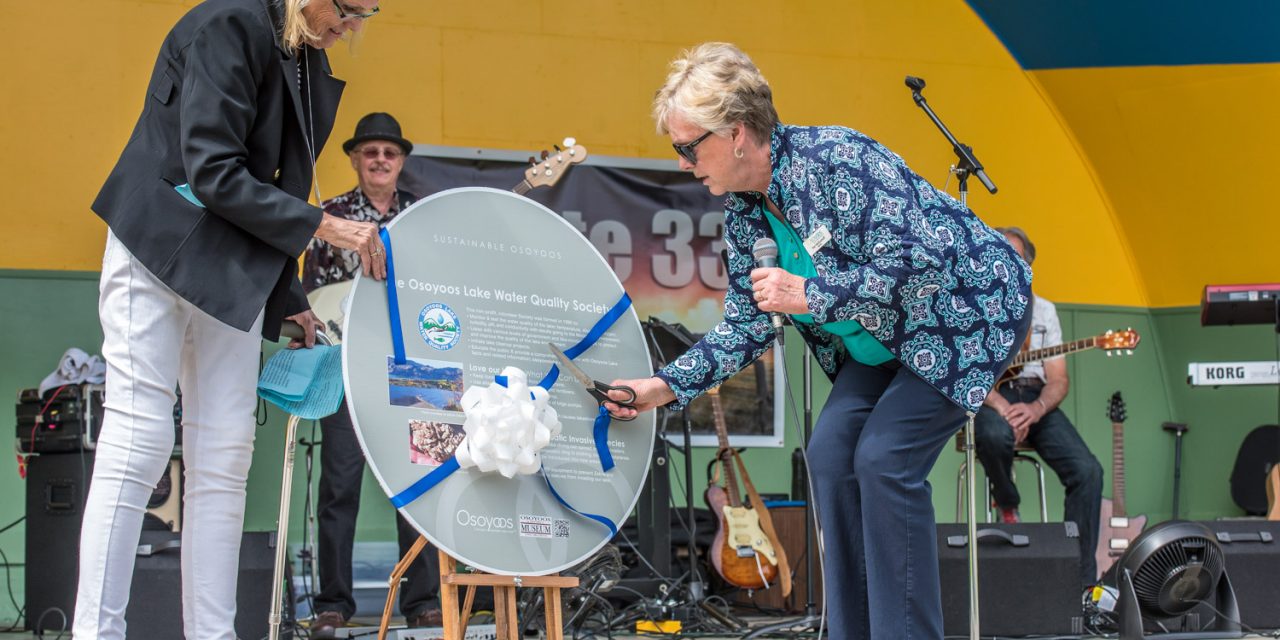
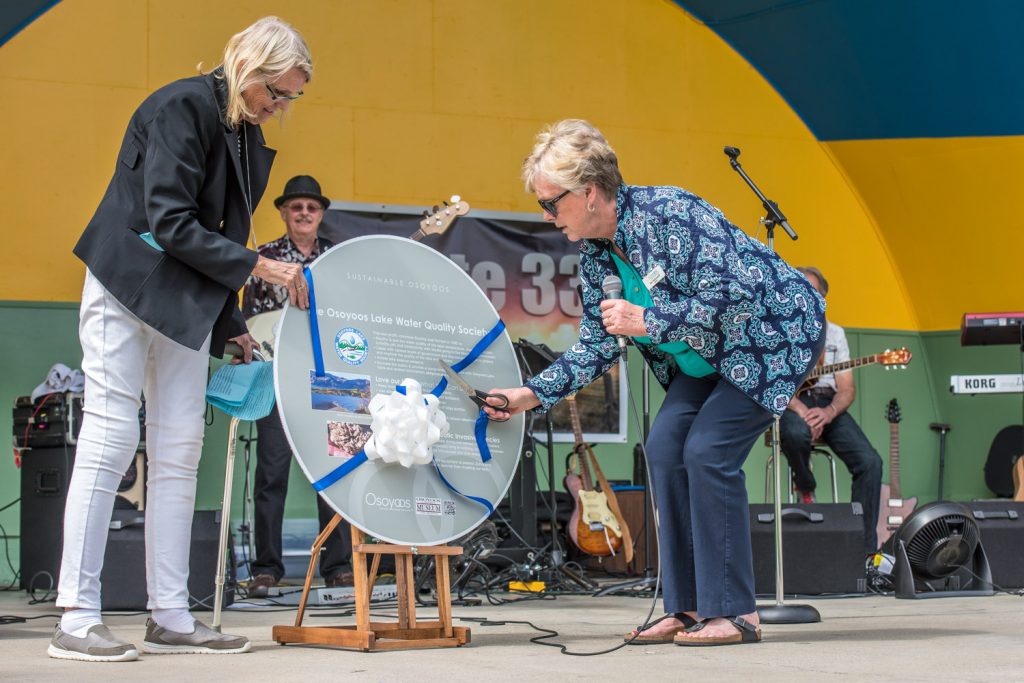
As Birgit Arnstein, president of the Osoyoos Lake Water Quality Society, steadies a new plaque, Mayor Sue McKortoff cuts the ribbon. The plaque will be installed by the walkway north of the museum. (Richard McGuire photo)
Water conservation, invasive species, the restoration of the sockeye salmon fishery and water quality more generally – those were some of the themes that came up Saturday at Osoyoos Lake Appreciation Day.
The event aimed to raise awareness of challenges facing the lake, while also celebrating the 25th anniversary of the Osoyoos Lake Water Quality Society (OLWQS).
But it was overshadowed by a news release issued Monday morning warning that OLWQS is in danger of folding at its May 27 annual general meeting.
President Birgit Arnstein, who played a key role in organizing Saturday’s event, said she will be stepping down as president at the AGM unless several board members who plan to resign can be replaced with enthusiastic and committed new members.
No one has stepped forward to take the positions of the board members who are leaving, she said.
“There is simply too much work to be done by too few volunteers,” Arnstein said in the release.
The group’s AGM is scheduled for Friday from 6:30 to 8 p.m. at the Sonora Community Centre.
Saturday’s lake appreciation event brought together people from many parts of the valley concerned about the lake and water. The morning drizzle had ended when the event kicked off at 2 p.m. at Gyro Park.
Mayor Sue McKortoff welcomed a number of municipal representatives from Oroville and Tonasket, whom she had invited to take part in the event.
Guest speakers Richard Bussanich, a fisheries biologist with the Okanagan Nation Alliance (ONA), and Anna Warwick Sears, executive director with the Okanagan Basin Water Board (OBWB), brought substance to the discussion.
About 50 people watched at the main stage, while others wandered around looking at information booths or checking out the boat used by OLWQS to take weekly measurements of the health of Osoyoos Lake throughout the summer.
At the boat, board members Brian Faltinson and Denis Potter showed off some of the equipment that volunteers use to measure such things as turbidity of water and temperature at various depths in select locations.
Children got their faces painted by present Osoyoos Royalty and this year’s contestants. Other children played on a nearby bouncy castle.
McKortoff cut the ribbon on a new circular information panel about OLWQS and its work, which will be placed along the walkway north of the museum.
Judy Dallas, the wife of OLWQS pioneer Lionel Dallas, who died in December, cut the cake to celebrate the 25th anniversary of the community volunteer organization. She was joined by Alicia Osland, an OLWQS fixture for many years.
Between remarks from dignitaries and after ceremonies were over, the band Route 33 from Trail, B.C. played popular songs from the 1970s and 1980s.
McKortoff, Sears and Ford Waterstrat, from Oroville, were three members of the International Osoyoos Lake Board of Control attending the event.
This board, under the International Joint Commission (IJC), provides for joint international management of Osoyoos Lake. Until recently, Sears said, its membership consisted of public servants who don’t live in the Okanagan.
“It’s been a source of frustration over the years for the local communities, because there wasn’t someone who understood really what was happening on a day-to-day basis,” said Sears.
Along with John Arterburn, a biologist with the Confederated Tribes of the Colville Reservation, the four local members have added a new dynamic.
Sears said the new members tried to look at how they could add value to this body overseeing Osoyoos Lake, or “how we can shake the board up a little bit.”
One idea, she said, was to look at doing a project on water quality monitoring using U.S. and Canadian federal funds from the International Watersheds Initiative (IWI).
That program is based on the idea that solutions to transboundary watershed problems often emerge from local communities. It looks at managing ecosystems as a whole, rather than being constrained by international boundaries.
The idea, however, hit a snag when the IJC reminded board members that the board’s mandate is limited to regulating lake levels.
“That sort of stopped us in our tracks on doing any water quality monitoring grant applications,” said Sears.
Clearly still committed to the idea, but stressing that she was not speaking in her capacity as a member of the board of control, Sears chose her words carefully to suggest that the board’s mandate could be changed with community pressure.
In order to change the mandate, a reference would be required from the government of Canada or the United States, she said.
The board of control can’t ask for a reference, she added, but “theoretically” communities such as Osoyoos or Oroville could ask for one by contacting and writing to political representatives.
The ONA, OLWQS, Osoyoos Indian Band and Colville Confederated Tribes could also write letters, she added.
“Actually the only way that I think a reference would happen is if the communities asked for it,” said Sears, acknowledging her remarks could get her in trouble. “I’m not telling you to write letters.”
Sears also spoke about invasive species, noting that it only took a couple years in the late 1970s for milfoil to take over Osoyoos Lake.
“Milfoil is a nuisance, but relatively speaking, it’s a walk in the park compared to zebra and quagga mussels,” she said, referring to these invasive mussels that are spreading across North America, but haven’t yet taken hold in B.C.
She also spoke about water conservation and the impact that climate change will have.
Bussanich spoke about ONA-led efforts to restore the sockeye salmon fishery since its decline to just 5,000 returning sockeye in 1995.
“This is actually the most productive lake in all of North America from a fisheries perspective,” he said, noting that Osoyoos Lake generates 10,000 kilograms of smolts per hectare. A smolt is a young salmon that turns silvery and begins its migration downriver.
More typically on other lakes, the average is about 200 to 1,000, he said.
In the past year, about four million smolts left Osoyoos Lake, he said, noting that the number tends to range between four and 10 million.
This, however, is a far cry from 100 to 200 years ago when the number of smolts leaving Osoyoos Lake was probably in the 100 million to 200 million range, Bussanich said.
These estimates come from both traditional knowledge as well as data from cannery records, he said.
“We still have a lot of work left to do, the protection and the conservation that we’re all working on together,” said Bussanich.
The theme of collaboration was also one highlighted by Arnie Marchand from Oroville, who gave opening remarks.
Marchand has worked with the Colville Confederated Tribes, of which he is a member, as well as with the Borderlands Historical Society and the Economic Alliance Board.
He was pleased that for the first time representatives of Tonasket and Oroville were invited to Osoyoos for this event and he expressed hope that one of the Washington communities will invite Osoyoos representatives next year.
“It’s really an important thing that we begin because we’re all in this together,” said Marchand.
RICHARD McGUIRE
Osoyoos Times
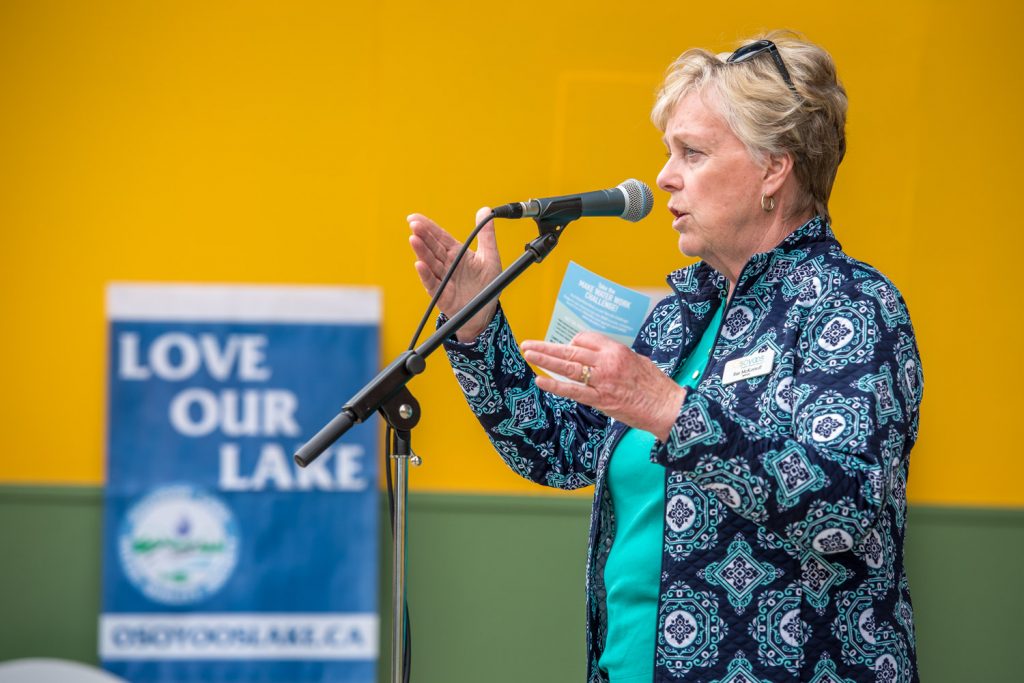
Mayor Sue McKortoff speaks at Osoyoos Lake Appreciation Day on Saturday. (Richard McGuire photo)
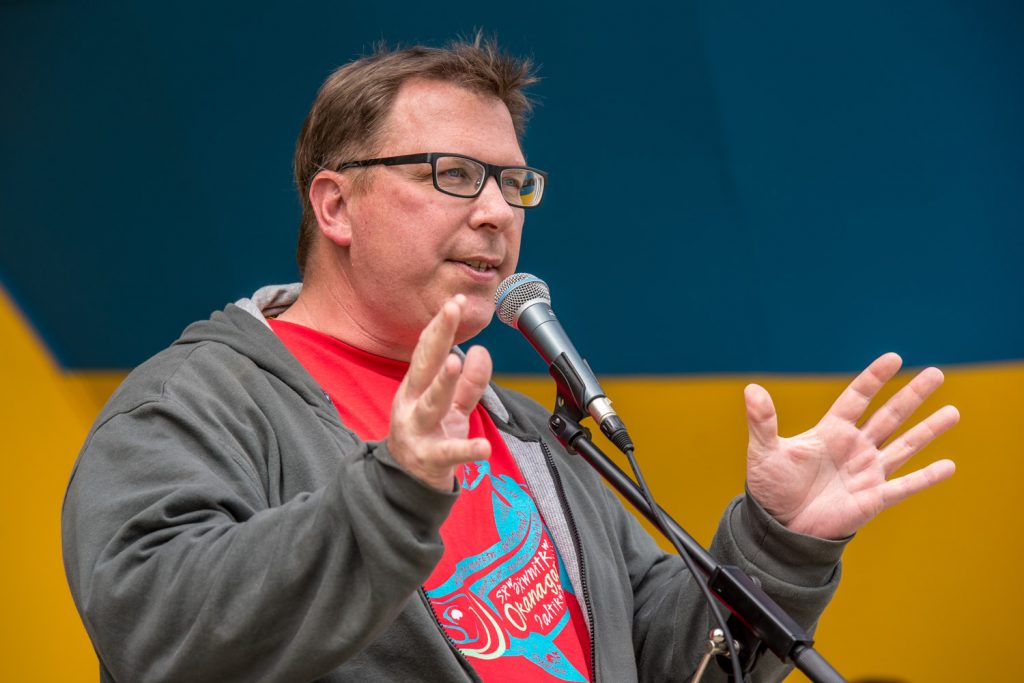
Richard Bussanich, a fish biologist with the Okanagan Nation Alliance, speaks about the importance of Osoyoos Lake to the restoration of the sockeye salmon fishery. (Richard McGuire photo)
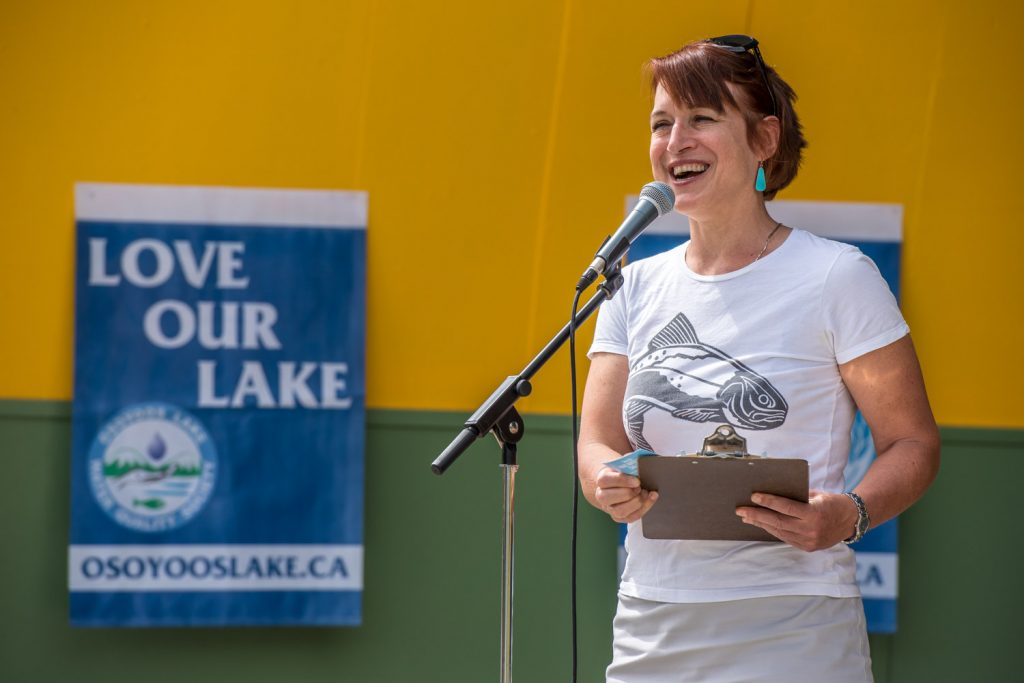
Anna Warwick Sears, executive director of the Okanagan Basin Water Board, was keynote speaker at Osoyoos Lake Appreciation Day on Saturday. (Richard McGuire photo)
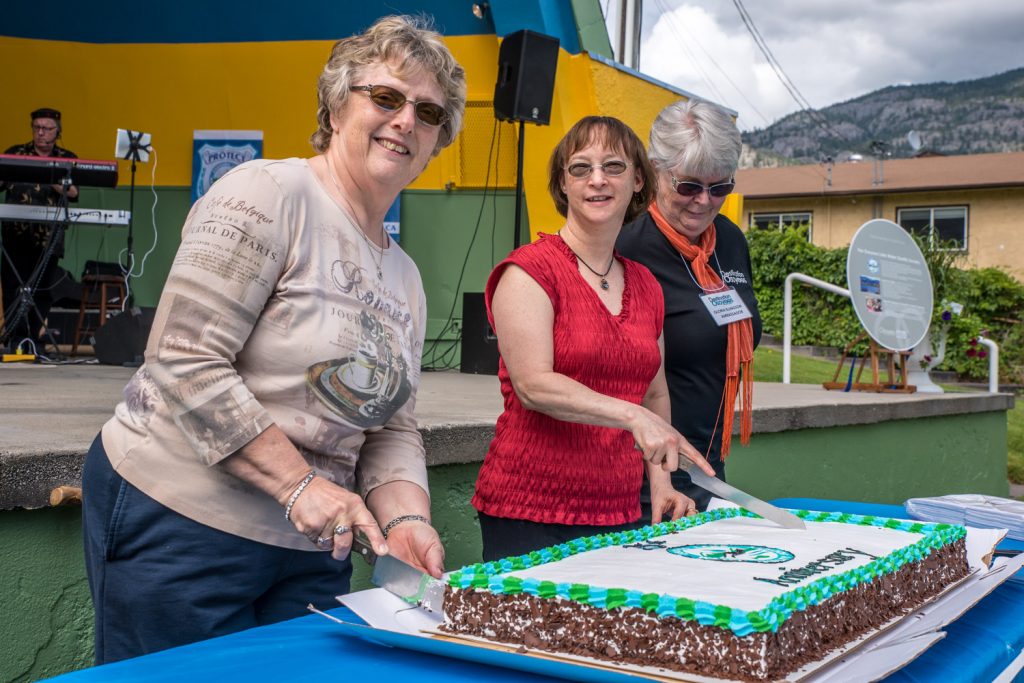
Judy Dallas (left) and Alicia Osland prepare to cut a cake celebrating the 25th anniversary of the Osoyoos Lake Water Quality Society. Ambassador Gloria Ellingson looks on, preparing to help serve. Dallas is the wife of the late OLWQS pioneer Lional Dallas and Osland was involved with the society for many years. (Richard McGuire photo)
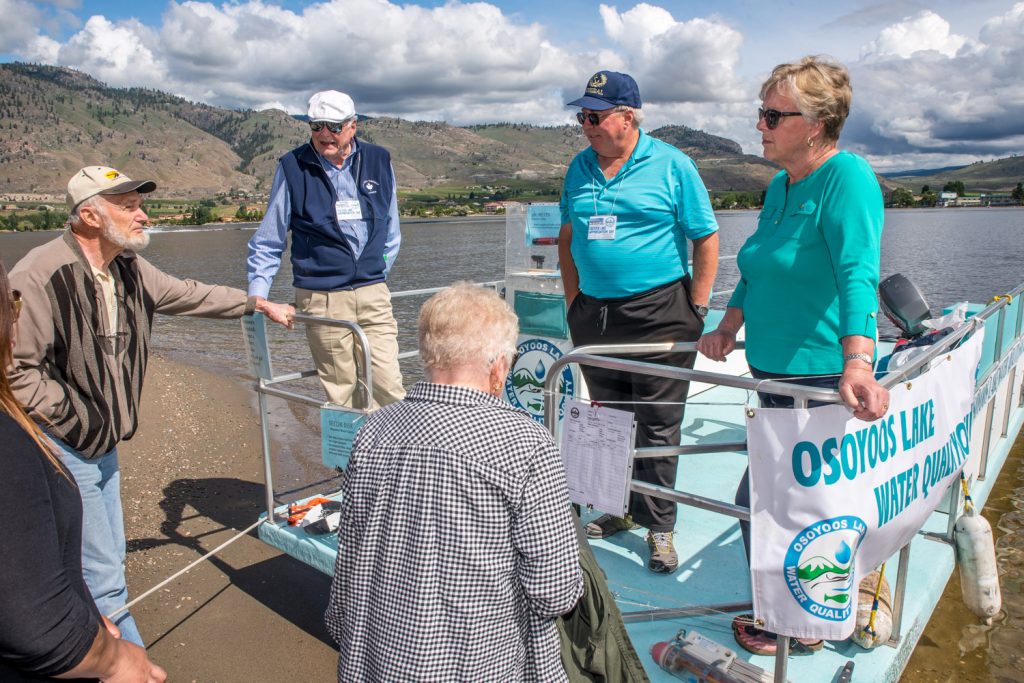
Denis Potter (second from left) and Brian Faltinson (second from right) show off the boat and equipment used by the Osoyoos Lake Water Quality Society. They answered questions from Jacob de Raadt (left) and other members of the public while Mayor Sue McKortoff (right) listens. (Richard McGuire photo)
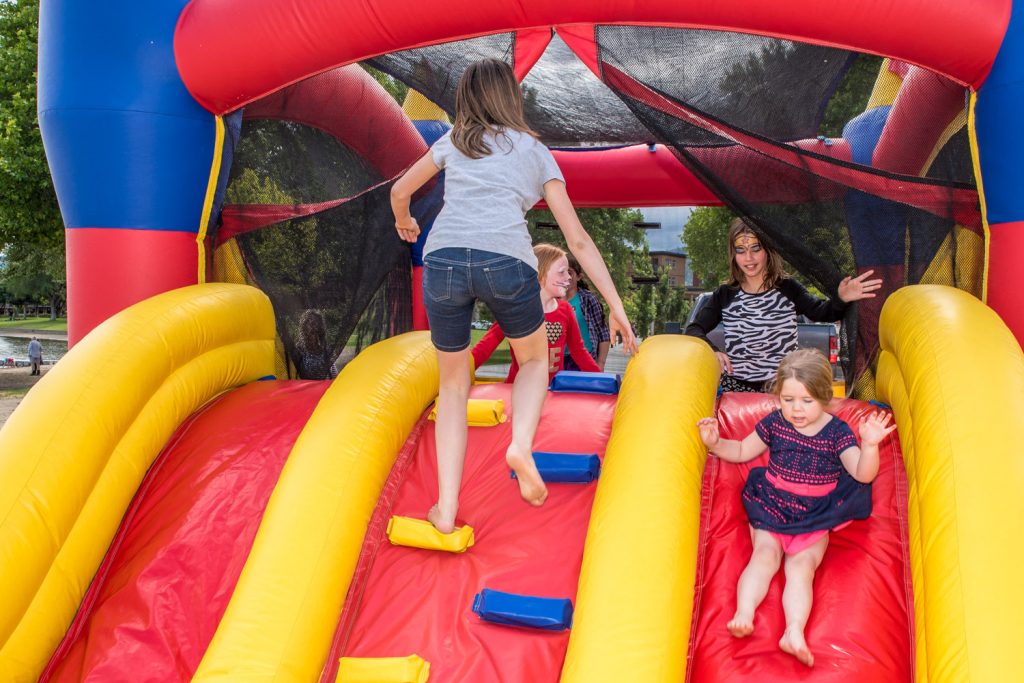
Children play on the bouncy castle at Osoyoos Lake Appreciation Day at Gyro Park on Saturday. (Richard McGuire photo)