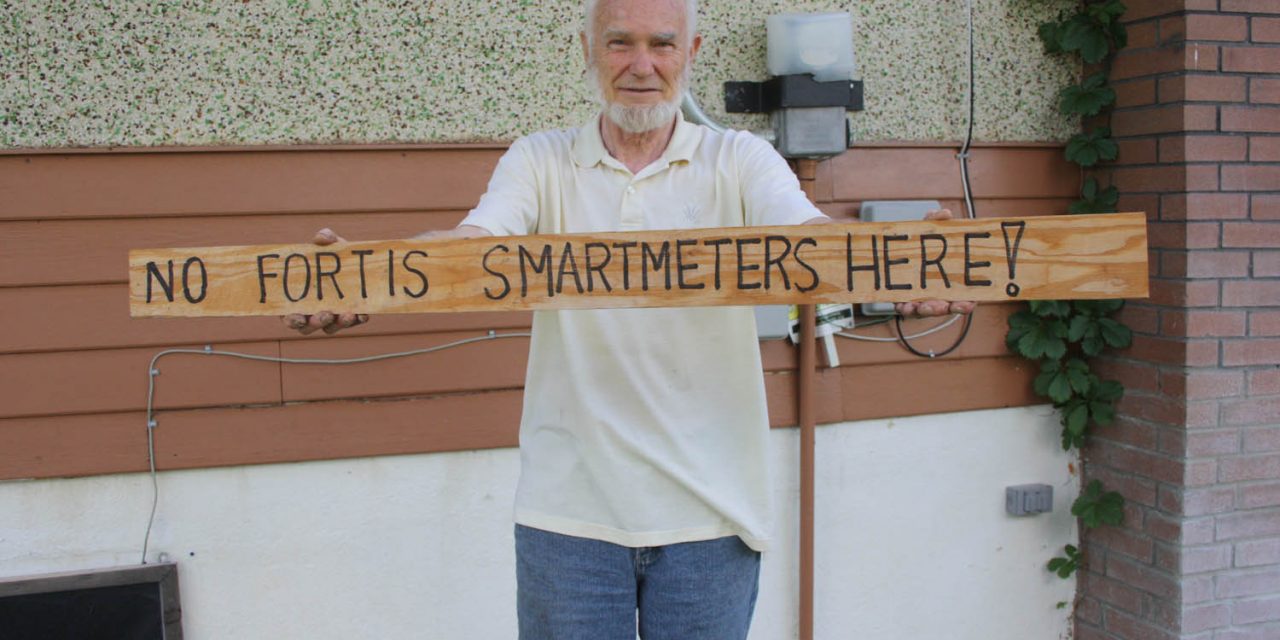
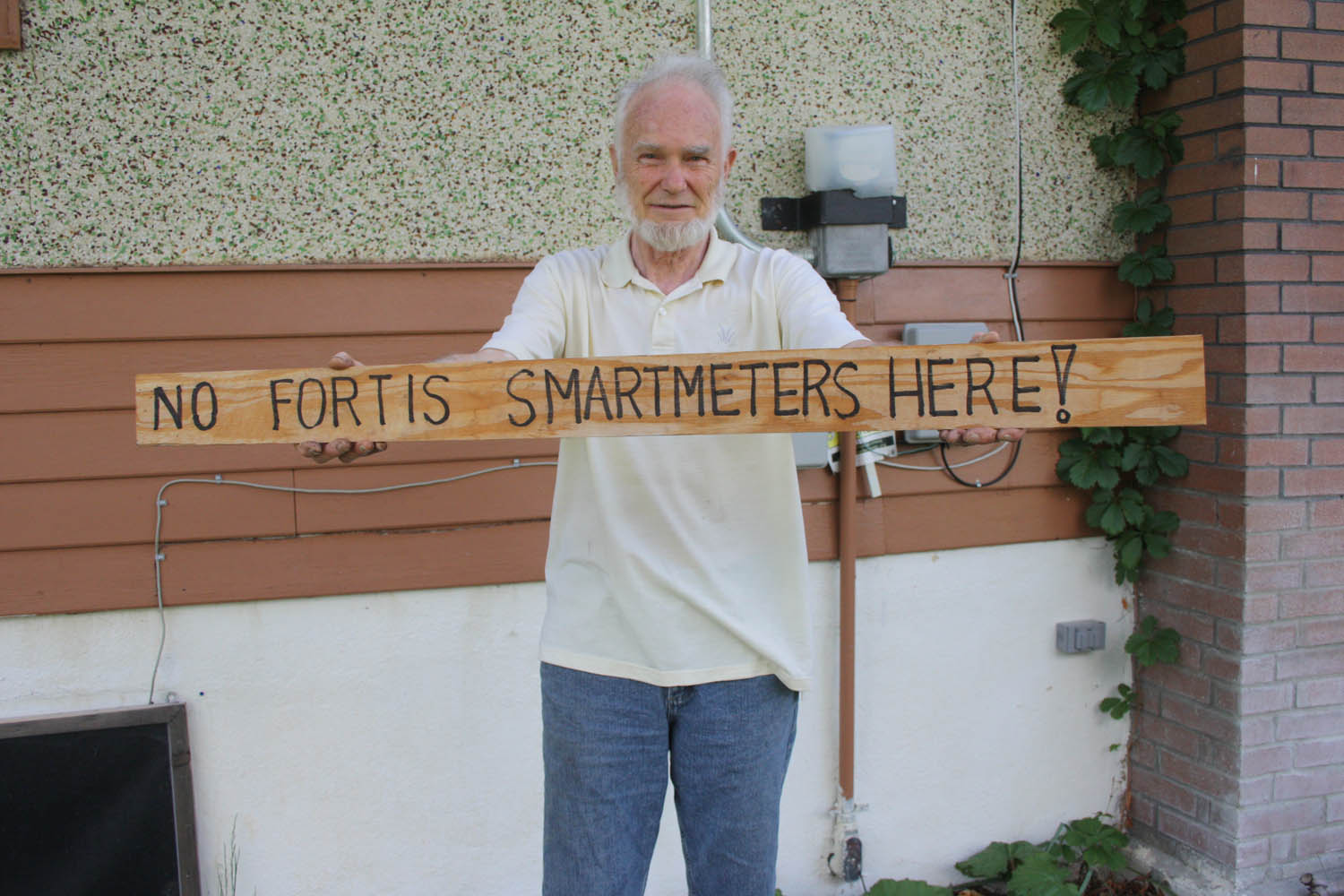
Jacob de Raadt, who lives with his wife Lydia on the outskirts of the Town of Osoyoos, installed this homemade sign warning FortisBC technicians to not replace the analog meter outside his home with a smart meter. De Raadt said he and his wife would rather live without electricity than have a smart meter on their property. (Keith Lacey photo)
An Osoyoos couple insists they will prepare to live “off the grid” without electricity rather than have a “smart meter” from FortisBC installed at their home near Osoyoos.
Jacob de Raadt and his wife Lydia, who have been married for 48 years, refuse to be part of FortisBC’s advanced metering infrastructure – better known as smart meter – program.
The reason de Raadt and his wife decided to move to Osoyoos two years ago was because Lydia said she became violently ill when the condo strata at their home in Langley installed smart meters three years ago.
“My heart was beating out of control, I got severe headaches and I couldn’t sleep for weeks,” she said. “We had spent two months in Arizona that winter and were out walking every single day and climbing mountains, but when we went back to our condo in Langley, they had installed smart meters and I became sick within hours.”
Her husband said he also suffers symptoms from exposure to smart meters, so they decided to put their condo up for sale and move to Osoyoos, in large part, because this town was serviced by FortisBC and they had not announced any intention to replace analog meters with smart meters.
That all changed not long after de Raadt and his wife moved to Osoyoos.
Just last week, FortisBC began a program to replace 1,900 analog meters for residential and business customers in Osoyoos with smart meters.
Last Tuesday, two technicians from Fortis showed up at de Raadt’s home on 112nd Avenue, just outside town limits.
De Raadt had written several letters to FortisBC management over the past two years making it clear he didn’t want any part of their smart meter program. He insisted his analog meter worked just fine and he would even volunteer to provide meter readings over the phone every second month.
He also installed a steel bracket around his analog meter so it couldn’t be removed or replaced. When installing the bracket, he used four lug nuts and one of the nuts ended up breaking the glass protecting his analog meter.
The technicians looked at his meter, but de Raadt made it very clear once again that he did not want a smart meter installed at his home.
Minutes later, one of the technicians used a boom truck to cut off the electricity to his home.
The de Raadt’s have been living without electricity ever since.
They insist they would find ways to live off the grid rather than have a smart meter installed at their residence.
They have installed one solar panel on the roof of their home and one on a large trailer that sits on their property. They are considering switching to natural gas appliances and have neighbours helping them by allowing them to use their fridge and freezers.
“I will not have one of those meters installed on my home,” said a defiant de Raadt. “Our lives will be difficult at times, but we would rather live without power than have one of those meters.
“They make both of us ill … and there’s nothing wrong with my analog meter. I’ve made it very clear to FortisBC that I will not have one installed at my home. At least they respected that decision, but they did turn off the power and we’re now forced to live without electricity.”
De Raadt said he was assured by FortisBC management through several letters dating back two years that they would not install a smart meter at his home, but they have broken that promise, he said.
David Wylie, spokesperson for FortisBC, said the power to the de Raadt home was turned off for safety reasons because the glass protection on his analog meter was broken, exposing it to the elements.
“The meter had broken glass and was exposed to the elements and our crew determined immediately that this was unsafe,” said Wylie. “Our No. 1 priority is always safety. It was unsafe for our customer and unsafe for our employees and a decision was made to turn off the power.”
FortisBC has installed 75,000 smart meters in B.C. over the past two years without any significant problems, said Wylie.
De Raadt and his wife have been informed they can use the “opt out clause” offered by FortisBC to turn the electromagnetic frequency pulse turned off at a cost of $88, plus a $9 per month administrative fee, said Wylie.
De Raadt refuses to pay any such fees.
“That is legalized extortion,” he said. “I’ve done my homework and I know it costs them less than five cents to turn off the pulse to my meter. It’s a matter of principal I will not pay for legalized extortion.
“People like my wife and I who want to keep our analog meters should be able to keep using them. If not, they can turn off the pulse on my meter and charge no fee.”
If that doesn’t change, de Raadt and his wife insist they will live without electricity.
Wylie said “that’s their choice to make” but FortisBC was given permission by the BCUC to replace analog meters with smart meters and that’s what technicians will continue to do.
The smart meters being installed meet all Health Canada safety regulations, he said.
“If you hold a cellphone to your ear for a two-minute phone call, that will emit 17,000 times more electromagnetic frequency an AMI meter,” said Wylie.
Wylie said he would gladly talk to de Raadt about trying to come up with a solution agreeable to all parties.
De Raadt said he and his wife are confident they will manage quite nicely without electricity for the spring, summer and fall and will see what happens once the cold weather returns in the winter.
“No matter what happens, we will not have one of those meters attached to our home,” he reiterated. “We truly believe these meters are dangerous to our health. We moved here from Langley to get away from smart meters and it’s hard to believe we’re having to go through this now.”
KEITH LACEY
Osoyoos Times