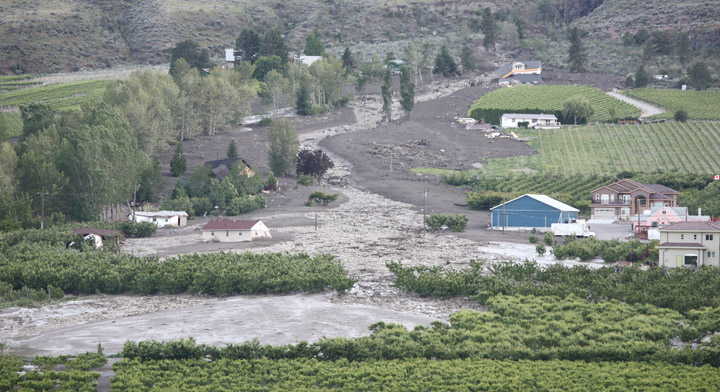
The Testalinden reservoir dam failed on June 13 causing a mudslide that damaged a number of properties south of Oliver. A report on the mudslide found that four provincial dams, including one in the Osoyoos area, needed immedate attention following dam assessments by provincial employees. Photo by Paul Everest/OsoyoosTimes Files - Click on picture for larger image
OSOYOOS TIMES-October 20, 2010
By Paul Everest – Osoyoos Times
A dam in the Osoyoos area was one of four dams found as needing immediate attention after provincial crews assessed hundreds of dams across B.C. in the wake of the Testalinden mudslide in June.
On Oct. 14, the B.C. Environment Ministry released its response to recommendations included in a report prepared in July by B.C.’s deputy solicitor general on the failure of the Testalinden Dam on June 13.
The failure of that dam caused a torrent of mud and debris to flow down a mountainside south of Oliver which damaged dozens of properties west of Hwy. 97 near Road 16.
Included in the ministry’s response was information that the deputy solicitor general’s report had found that four dams, including the Goertzen Pond dam in the Osoyoos area, required “immediate follow-up attention” after dam assessments were carried out across the province.
The owner of the Goertzen Pond dam did take immediate action, an Environment Ministry media release states, by pumping the reservoir down to a safe elevation below the dam crest.
The ministry did not respond to requests for more information about the Goertzen Pond dam.
The three other dams that required immediate attention were the Grafton Lake Dam on Bowen Island, the Eagle Rock reservoir south of Chase and the Allan Spring Dam in Saanich.
Action was also taken to address concerns regarding these three dams, the ministry stated, and an additional 379 dams in B.C. required “less urgent follow-up.”
The deputy solicitor general’s report, released one month after the Testalinden mudslide, concluded that “more could have been done to avert the disaster.”
It found that warnings and concerns about the Testalinden Dam dated back to the 1960s but little was done to address any of these concerns prior to the mudslide.
The report also concluded that communication protocols between different government agencies in the province need to be improved and the public needs to be provided with more information about who to call when they observe a dam or reservoir that could breach or is in need of repair.
Twelve recommendations were laid out in the report for the province to consider in order to prevent future mudslides of this nature from happening.
These included recommendations that the Environment Ministry review its record keeping practices when it comes to dams and install signage at all dam locations to inform passersby that the structure is a dam while providing emergency contact information.
It was also recommended that Emergency Management BC work with local officials, police and first-response agencies to provide a quick reference list of key contact numbers focused on “who to call when.”
Two days before the mudslide happened, a hiker from Osoyoos noticed that the Testalinden reservoir was full and that water was overflowing onto the road.
The hiker passed this information on to the Osoyoos Visitor Information Centre, which informed the RCMP.
The Mounties contacted the B.C. Forests and Range Ministry which passed the information along to the Ministry of Forests’ compliance and enforcement technician.
The information was left on a voicemail for the technician, however, and was not retrieved until after the dam breached.
The Environment Ministry announced on Oct. 14 that it has accepted all the recommendations made in the deputy solicitor general’s report.
In its response to the report, the ministry stated that it released a new “E-Licensing” system in May which “streamlines and simplifies water management record keeping.”
This system is included in the provincial dam registry.
The ministry also stated that an amendment to the BC Dam Safety Regulation has been drafted to require signage for “very high, high and low consequence dams on Crown Land.”
The amendments will be submitted to the provincial cabinet this fall and the proposed signage will provide people with information on what conditions to be aware of regarding dams and who they should contact in an emergency situation.
As for the need for a reference list of who to call in an emergency situation, the ministry reported that Emergency Management BC has “confirmed that the existing processes and contact numbers for reporting emergency situations are appropriate.”
For all urgent safety issues, 911 should be called, the report states, while the public can call local police or fire services for non-emergency issues and local governments can call 1-800-663-3456 to contact the province’s Emergency Coordination Centre.
The ministry also stated it has allocated four new staff members dedicated to dam safety.
While the province acknowledged its own failings in July with respect to the Testalinden mudslide, ministry conservation officers had been investigating the responsibilities of the Testalinden reservoir’s licence holder, Elkink Ranch Ltd., in the matter since June.
The owner of Elkink Ranch Ltd. is Ace Elkink.
The Environment Ministry told the Osoyoos Times on Oct. 15 that the Conservation Officer Service completed its investigation last week and a report recommending charges against Elkink Ranch Ltd. has been forwarded to Crown counsel.
A ministry spokesman said he could not comment on the nature of the recommended charges and added that it will be up to the Crown to decide if Elkink will be charged.
Dale Kronebusch, an emergency services supervisor for the Regional District Okanagan-Similkameen (RDOS), said the ministry’s response to the deputy solicitor general’s report shows the province is paying more attention now to concerns about communication protocols for emergency situations.
Although he said that, to his knowledge, the ministry has yet to sit down with the RDOS to flesh out the most efficient reporting processes for emergencies such as the Testalinden mudslide, the lesson that seems to have been learned by all government agencies is “if you receive a call, you need to act on it.”
Kronebusch said he has contact information for provincial and local officials that he would call in an emergency.
For example, if a call came in to the RDOS that an emergency had happened, Kronebusch said he would immediately call the fire chief in the community closest to the site of the emergency to go out and evaluate the situation while RDOS emergency crews mobilized.
That way, if the emergency is in Osoyoos and it takes RDOS personnel 45 minutes to reach here from Penticton, someone has already gone to the scene to assess what’s happened, Kronebusch said.
The ideal situation, he added, would be for the public to have “one point of contact,” similar to the 911 system, when they need to inform governments or emergency agencies about an emergency or possible emergency such as a breaching dam.
The signage idea for dams and reservoirs could even be expanded, Kronebusch said, with signage being installed at the side of the highway for the public to use in the case of an emergency.
[email protected]