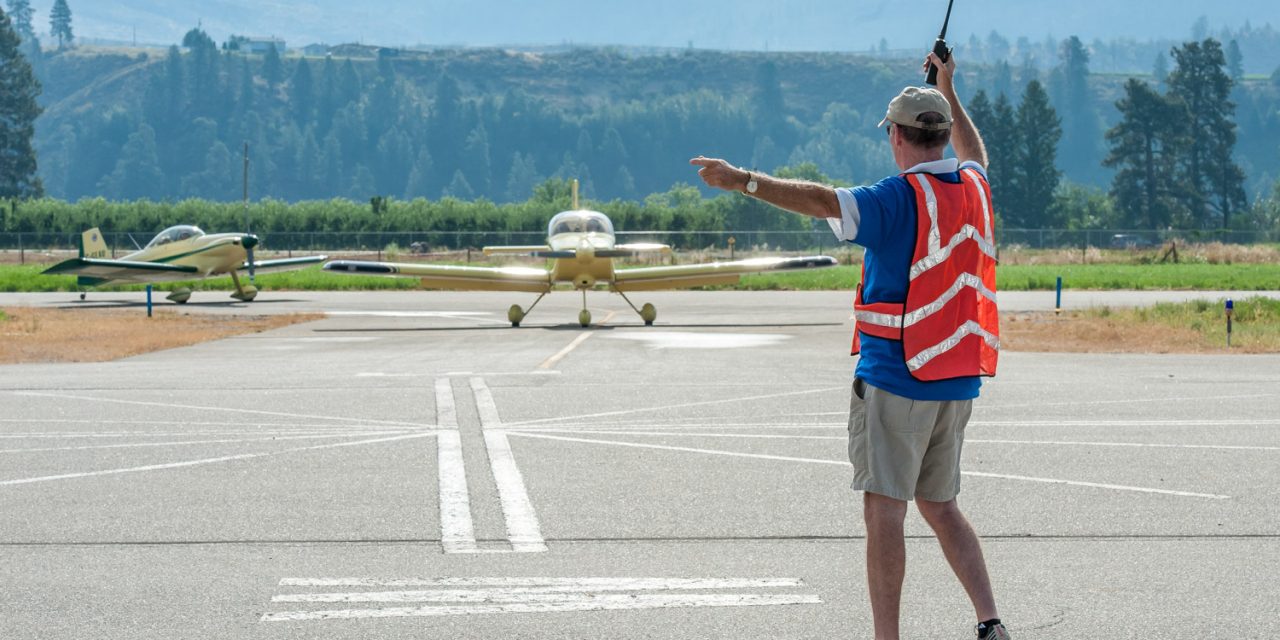
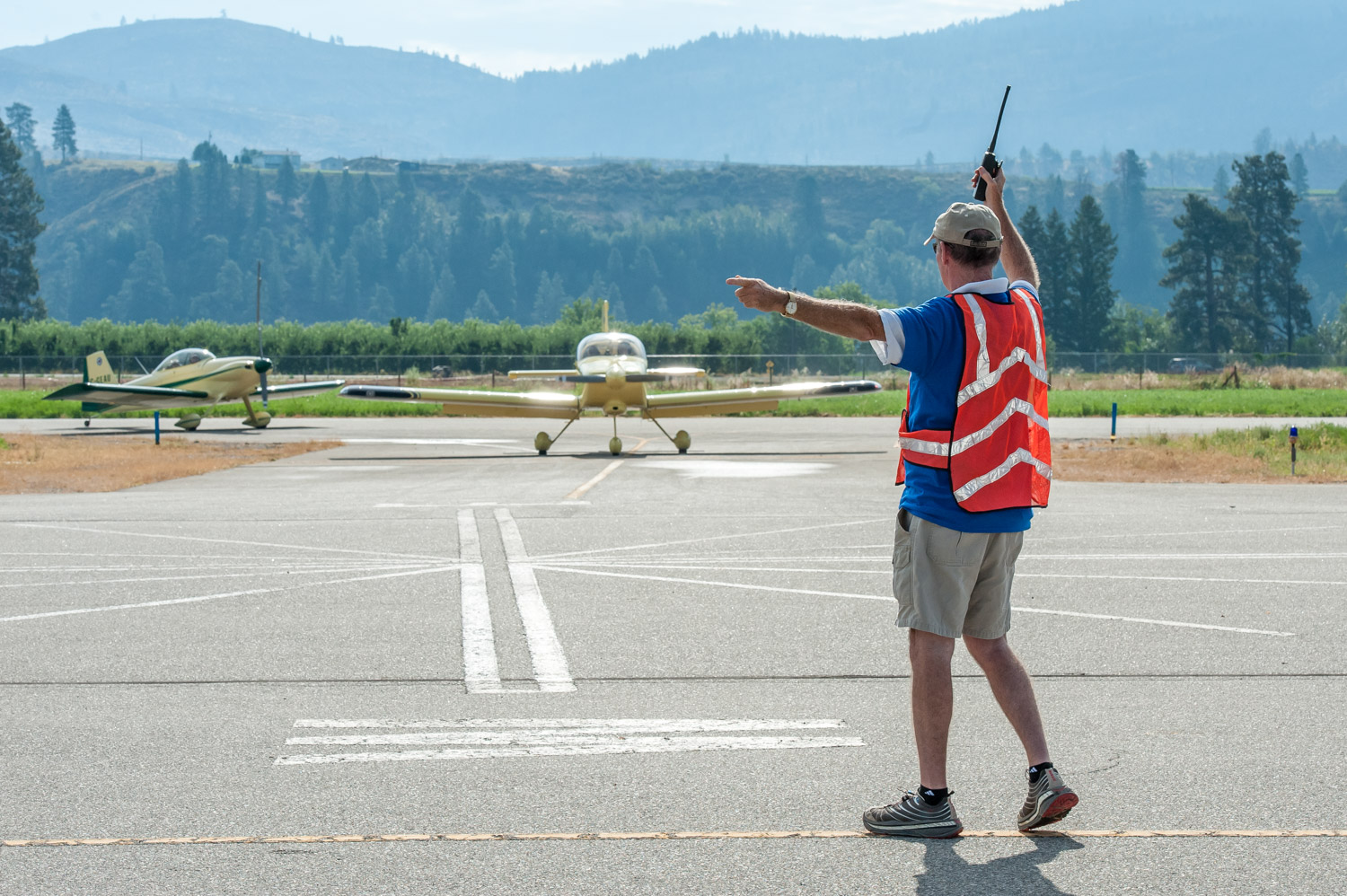
Bill Guthrie of Oliver directs traffic as one plane after another lands at Oliver Airport for the South Okanagan Flying Club’s annual fly-in breakfast on Saturday. (Richard McGuire photo)
The costs for any kind of significant expansion of a small airport like Osoyoos Airport are astronomical, says the longtime manager of the Oliver Airport.
Town of Osoyoos council is weighing all of its options, including the possible closure of the Osoyoos Airport and whether or not to turn the current airstrip into industrial land versus a proposal by the Osoyoos Airport Development Society to consider a large upgrade and expansion.
Members of town council invited Oliver Airport manager Paul Dumoret to make a presentation about the history of that airport and how it has expanded and grown into a successful business operation over the past 35 years.
Without mentioning the Osoyoos development society, Dumoret made it very clear that any airport expansion – even at a small airport like the one in Osoyoos – is very expensive and difficult.
“Expansion is a wonderful word, but it’s damn expensive,” said Dumoret.
The original airport site in Oliver was purchased way back in 1935 and officially opened in 1937 as one of the first small-town airports in all of British Columbia, he said.
The Oliver Airport opened long before airports in larger communities like Penticton, Kelowna and Vernon, he said.
Since he arrived in Oliver back in 1980, he has been part of several expansion projects that now sees Oliver Airport fully serviced with three runways.
SEE OLIVER AIRPORT, PAGE 4
A large group of dedicated volunteers are largely responsible for allowing Oliver Airport to continue to thrive without attracting regular commercial passenger flights, he said.
“We’ve done a lot of work since I got here … and it’s mostly been done with volunteers,” said Dumoret. “If we had to pay employees to look after everything we do out there, it would be a very tough business.”
Most of the expansion over the past 30 years has been paid for by accessing provincial and federal grants and the generous assistance of volunteers to build many of the projects, he said.
The cost to fence the entire property was so expensive that it was conducted in three phases over five years, he said.
When the longest runway was expanded from 2,500 feet to 3,300 feet in the early 1980s, it cost a significant amount of money and all costs involved with runway expansion at any airport have increased significantly since then, he said.
A new lighting system was installed around 1986 and costs were again kept under control because of volunteer assistance and his contacts in the aviation industry, said Dumoret.
“I used my numerous contacts and a lot of begging, borrowing and cajoling,” he said.
It would cost a minimum of $250,000 in today’s dollars for any kind of major runway expansion, he said.
“It’s a very expensive ordeal,” he said. “I could only take a guess at the costs today. It’s not cheap.”
Oliver Airport is now home to 35 private hangars and two commercial helicopter hangars than generate significant revenue for the airport society that helps manage the facility, said Dumoret.
One of the helicopter companies runs a successful charter and helicopter repair business that employs close to 40 people, he said.
The Oliver Airport also sells jet fuel, but it has taken eight long years for that aspect of the business to turn a profit.
“It has been eight years and we’ve just started getting into the black and that’s only with one employees and she does the books,” he said. “Contrary to what many may think, it’s not a big money maker.”
The 25,000-litre fuel tank has to be filled only three or four times per year, which means slim profit margins for this portion of the business, he said.
The clubhouse-terminal building that opened in 1981 was used solely by aircraft owners for the first few years, but was opened to the public five years later and has become a very popular and well-used facility, said Dumoret.
“It’s well used I tell you,” he said, adding many people landing from small aircraft use the washroom and restaurant facilities inside the clubhouse.
The town and airport society have never once seriously considered expanding Oliver Airport to attract regular commercial flights, said Dumoret.
The costs to undergo such an expansion would be massive and there would be direct competition with Penticton Airport, which continues to struggle financially despite daily commercial traffic, he said.
“It doesn’t make any sense with Penticton being so close,” he said.
Dumoret estimates more than 60 per cent of visitors from outside the region who land at Oliver Airport end up visiting Osoyoos.
Osoyoos has a great selection of hotels and other amenities that appeal to visitors and the economic spinoff from the Oliver Airport most certainly has a positive economic impact in Osoyoos, he said.
The Oliver Airport can now handle planes that hold up to 20 people and the number of charter airline companies using the airport continues to grow, he said.
There has been a dramatic increase in the number of people who land in Oliver and come to the South Okanagan for wine and golf tours, he said.
He estimates the number of air traffic “movements” – which includes landing and takeoffs – to be in the neighbourhood of 12,000 or an average of 1,000 per month, with the majority of that traffic during the warm weather months, he said.
Oliver Airport doesn’t charge any landing fees, nor to most small airports in this province, he said.
“Landing fees are the bane of any airport,” he said. “Those who charge them find out that traffic dries up in a hurry. There is no way to collect the fees and all it does is chase traffic away.
“There are very few small airports that impose landing fees.”
If a small aircraft owner from Alberta is looking to make a day trip to the South Okanagan, he or she will land at an airport that doesn’t impose landing fees over ones that do every single time, he said.
Oliver Airport is hoping to expand its ramp capacity to allow for increased traffic in the next couple of years, he said.
It used to cost $12,000 to $15,000 to build a small hangar at an airport like the one in Oliver, but those costs have increased substantially the past five years, said Dumoret.
When Mayor Sue McKortoff explained to Dumoret that council is struggling over what to do with Osoyoos Airport, he said the one big advantage with the facility in Osoyoos is it’s great location.
“Your facility has a great location and there is land to the north that allows for expansion,” he said.
When Coun. Carol Youngberg suggested an expanded Osoyoos Airport could pick up some of the business from the busy airport in Oliver, Dumoret said that’s possible, but reiterated airport expansion is an extremely expensive proposition.
If Osoyoos Airport would expand its runway to 5,000 feet, it could attract regular commercial traffic, but that would put it in direct competition with Penticton Airport and “Penticton is already in pretty dire straights,” he said.
KEITH LACEY
Osoyoos Times