By Times Chronicle Staff
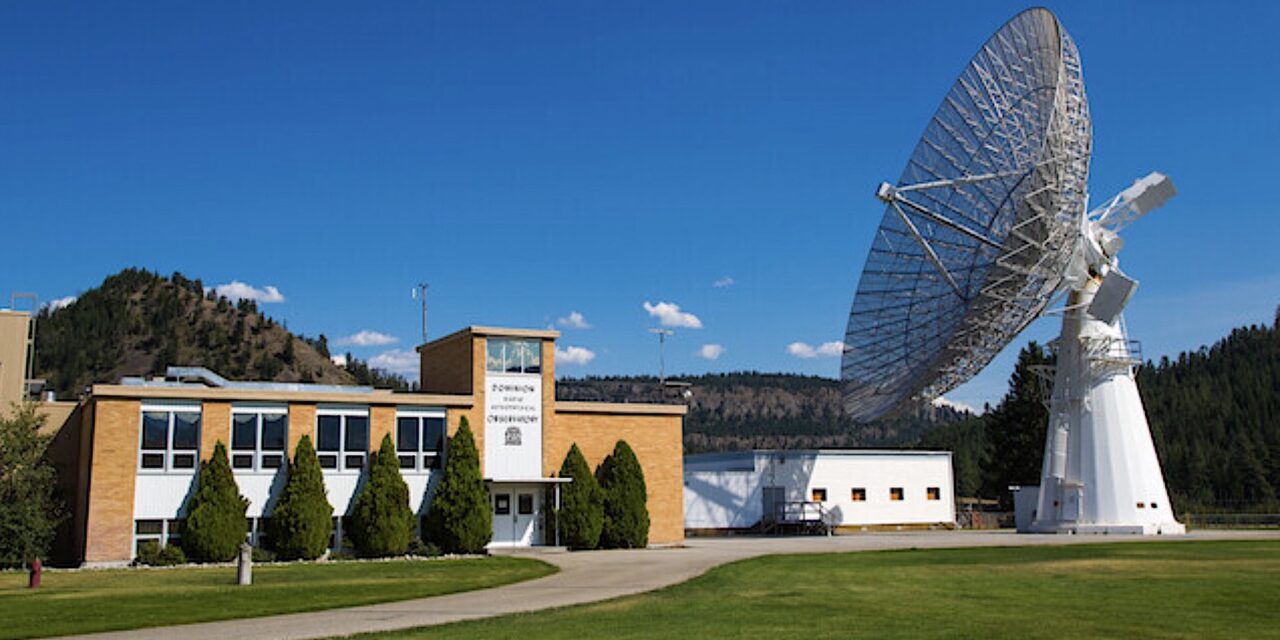
The Dominion Radio Astrophysical Observatory (DRAO) located at White Lake northwest of Oliver is hosting its annual Open House on Saturday, Sept. 7 from 10 a.m. to 5 p.m.
The internationally recognized facility for science and technology research and development related to radio astronomy is home to National Research Council of Canada astronomers, astrophysicists, engineers and technologists.
The facility also hosts visiting researchers and students from universities and astronomical observatories around the world.
The DRAO supports the design and development of leading-edge instrumentation for new and existing telescopes and operates several telescopes on its extensive radio-quiet site.
It also features laboratories and specialized equipment for design and construction of all aspects of radio-frequency instrumentation, from highly sensitive antennas and receiver systems to high speed digital signal processing hardware and software.

The Canadian Hydrogen Intensity Mapping Experiment (CHIME) – a collaboration between the Universities of BC, McGill and Toronto. CHIME is a novel radio telescope that has no moving parts and was conceived to map the most abundant element in the universe – hydrogen – over a good fraction of the observable universe. CHIME photo.
Aside from the John A. Galt Telescope, a 26 metre diameter, prime-focus, equatorially mounted telescope, the Synthesis Telescope, a 7 element array of 9 metre telescopes, and the solar radio flux monitoring facility, the DRAO is also home to Canada’s largest radio telescope.
The Canadian Hydrogen Intensity Mapping Experiment (CHIME) – a collaboration between the Universities of BC, McGill and Toronto – is a radio telescope that collects radio emissions from space between 400 and 800 MHz and is designed to survey atomic hydrogen from the largest volume of the Universe mapped to date.
This novel telescope, with no moving parts, is composed of four 100 metre by 20 metre cylinders with an array of 512 radio receivers along each focus, leading to 2,048 inputs into the high-power digital data processor system. CHIME maps the whole sky, which is visible overhead every day.
Open house schedule
- 10 am: Gates open
- 10 am to 5 pm: Partnership displays and self-guided tours
- 10 am to 4:30 pm: Astronomy and engineering presentations, demonstrations and tours
- 11 am to 4 pm: Kids’ activities
- 5 pm: Gates close
Presentations
Arthur Covington Conference Room, 1st floor, room 103
- 10:30 am: We’re made of star stuff, presented by Tom Landecker
- 11:30 am: Why is there a radio observatory at White Lake? The history of DRAO, presented by Tim Robishaw
- 1 pm: The history of radioastronomy, presented by Roland Kothes
- 2:30 pm: Radio telescope modelling for next generation astronomical observation, presented by Mohammad Islam
- 3:30 pm: Why is there a radio observatory at White Lake? The history of DRAO, presented by Tim Robishaw
Outside tent, Large tent, next to the Visitors Centre
- 10:30 am: A radio eye on the Universe, presented by Ryan Ransom
- 11:30 am: The magnetic Milky Way, presented by Anna Ordog
- 1:30 pm: A radio eye on the Universe, presented by Ryan Ransom
- 3 pm: Indigenous talk
Ongoing demonstrations and tours
- 26-metre telescope control room
- Converting cosmic signals to computer bits
- Radio frequency interferences
- Composite materials for telescopes
- Solar Flux Monitoring Program
- Radio equipment anechoic test chamber
- Observing the Universe with CHIME
- Mapping our Galaxy with CGEM
Visitors are asked to turn off (airplane mode is not sufficient) their cell phones, laptops, smartwatches, and other connected devices as it’s crucial for its operations to keep the zone around DRAO radio silent.
The Dominion Radio Astrophysical Observatory (DRAO) is located at 717 White Lake Rd, Kaleden.
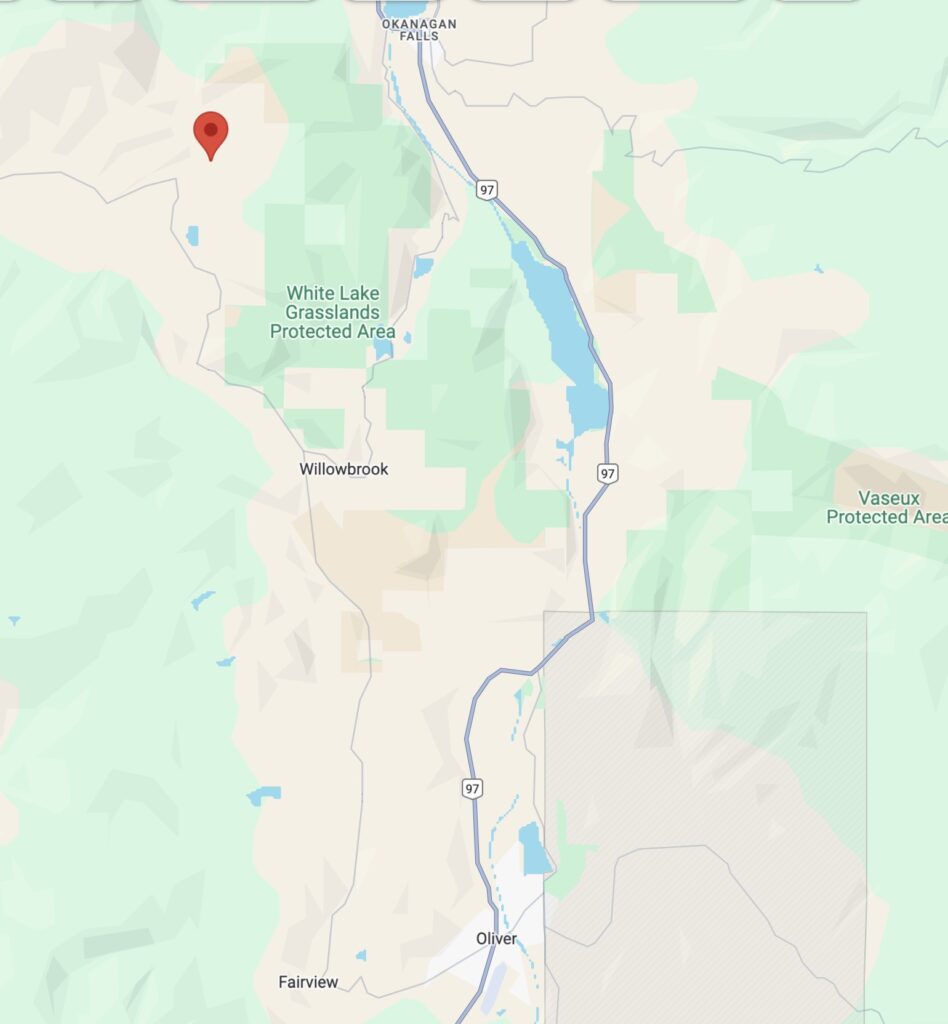
The Dominion Radio Astrophysical Observatory (DRAO) is located near White Lake. Google map image.