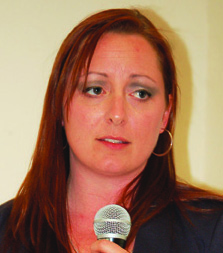

Misty Cockerill tells her story to the audience gathered at the Penticton Indian Band Hall on April 10. Cockerill, now a bereavement counsellor and victims’ rights advocate, survived a vicious attack by Terry Driver . . . the man dubbed the Abbotsford Killer in 1995.
Erin Christie photo
October 13, 1995 is a night Misty Cockerill says she will never forget. It is the night she encountered Terry Driver, the man dubbed the “Abbotsford Killer.”
Despite experiencing a brutal attack that nearly killed her, the 35-year-old single mother of two told the Chronicle she prefers to be known as a survivor rather than a victim, and refuses to let that experience define her.
She even calls herself lucky.
Ironically, she noted, the night she met Driver was Friday the 13th.
“I was walking to a party at my boyfriend’s house with my best friend Tanya (Smith), late at night. We were both 16 years old and we were talking about the superstitions that surround Friday the 13th. I made the inappropriate joke, as I often do, that ‘watch some guy is going to jump out of the bushes and try and rape us.’ We laughed it off and continued walking.”
They stopped when they heard a man’s voice behind them asking if they wanted to “party,” but quickly dismissed him and began to walk away. When he asked again, they turned. That was when they noticed the aluminum baseball bat he held in his hand. They stood, frozen in fear and Driver shoved them into the nearby hedges that lined the hospital’s intensive care unit.
He ordered the girls to remove their clothes and they complied. Cockerill began to beg for their lives, promising to keep the encounter a secret. She debated running for help but was afraid to leave her friend behind. Cockerill decided to try and “stall” him by faking an asthma attack. Unyeilding, Driver called her bluff.
“He just looked at me and laughed,” Cockerill recalled. “He said if I really had asthma I’d have one of those “puffer things” as he called it.”
By this time the girls were on their hands and knees. Driver was behind Smith fumbling with his zipper. Cockerill noticed he had put the bat down and saw her chance. She scrambled for it, shaking.
“I had so many thoughts running through my head. At first I thought maybe he’ll just rape us and let us go . . . then I thought, what if he has a disease? What if he has HIV/AIDS, we’re dead anyway. So I hit him.”
Driver quickly seized the bat and Cockerill clung on to it with all of her strength but ultimately tripped on a nearby branch and fell to the ground, screaming for Smith to run and get help.
But Smith remained frozen. She wouldn’t leave her friend behind either. Cockerill placed her arms over her head in a last attempt to save her own life.
“I looked out and I remember I saw my high school through the bushes and thought, ‘great, this is the last thing I’m going to see before I die. At that point I don’t know if I was more upset about the fact that I was about to die or the fact that the last thing I would see was my high school, a place I hated,” Cockerill added.
Driver hoisted the bat and swung. Cockerill said she felt seven blows to her head before she passed out.
She awoke hours later on the other side of the parking lot, cold and tired. As she stood up she felt a rush of hot liquid streaming from her ear. She would later learn it was a mixture of blood and spinal fluid.
Dazed, she staggered across the parking lot and into the hospital. As she entered the emergency room, the triage nurse caught sight of her and began to scream.
“I thought, man, whoever came in behind me must be in really rough shape,” Cockerill said.
As she leaned on the wall that separated the nurse’s station from the waiting area she turned to the window and was shocked to see her own bloody reflection. She passed out again.
When she awoke and asked where her friend was, the doctors told her Tanya was on another floor of the hospital. Four days into her recovery her family revealed that Smith hadn’t survived the attack. After Cockerill blacked out, Driver raped and beat Smith and dumped the girl’s body in the Vedder River. She ultimately died as a result of drowning.
Cockerill underwent surgery to repair the damage she sustained during the attack, but still suffers from the after-effects of her brain injury.
What followed was a seven-month siege of torment as Driver terrorized the Fraser Valley community. Cockerill and her family were placed into the witness protection program.
Driver boldly attended Smith’s funeral with his two preschool children and later stole the headstone from her grave, defacing it with an obscenity and the cryptic message: “She wasn’t the first, she won’t be the last.”
He left the headstone on the news cruiser of an Abbotsford radio station with a warning, “I’ll be cruising around, looking for someone else,” he taunted.
The calls were eventually released by police to the media. Driver’s mother, Audrey Tighe, recognized the voice and turned in her son, whose father, Grant Driver, had been a hero cop with the Vancouver police.
Driver was arrested in May 1996 and convicted of the first-degree murder of Smith and the attempted murder of Cockerill. He was sentenced to life in jail without parole for 25 years, thanks to Cockerill’s testimony. In 2000 he was designated a dangerous offender, for attacks on two other women in 1994 and 1995. That designation permitted his indefinite incarceration.
After the trial Cockerill finished high school and went to university. She currently resides in Abbotsford and works as a bereavement counsellor for families of homicide victims.
“When I first returned to school after the attack people didn’t know what to say,” Cockerill explained. “Then they did figure out what to say. They said it should have been me that died. Some people even said we had it coming because of the way we were dressed. I’ll be honest. It was a tough time.”
She said her experience taught her a lot about herself. She is now an advocate for victims’ rights.
Cockerill was recently invited to share her story during a speaker’s series held at the Penticton Indian Band Community Hall on April 10. The event, organized and hosted by the South Okanagan Victim Assistance Society (SOVAS) and the Okanagan Nation Transition Emergency House (ONTEH), was held in conjunction with Victims of Crime Awareness Week. The national initiative is geared toward educating the public about issues facing victims of crime and the services, programs and laws in place to help victims and their families.
“We were victimized by Terry Driver,” Cockerill told the audience last Thursday evening.“But as long as the focus stayed on him we remained victims. It was hard to speak out at first but as I did it more frequently I realized I could give people a voice, people like Tanya.”
Her outlook is shared by Rod Gehl, a retired police inspector from Abbotsford who took the first police call from Driver in 1995. Gehl published a book, titled “Through the Valley of the Shadow: The Search for the Abbotsford Killer.” Proceeds from the book sales are allocated to raise funds for victims’ services.
Cockerill has read Gehl’s book and said it was cathartic. “If people say I’m a victim that’s fine. But I prefer the term survivor.”
To find out more about victims’/survivors’ services, or how you can advocate, visit SOVAS online at www.sovas.ca or contact Darryl-Jean Cerenzie at ONTEH at [email protected]
Erin Christie
Oliver Chronicle