By Don Urquhart, Times Chronicle
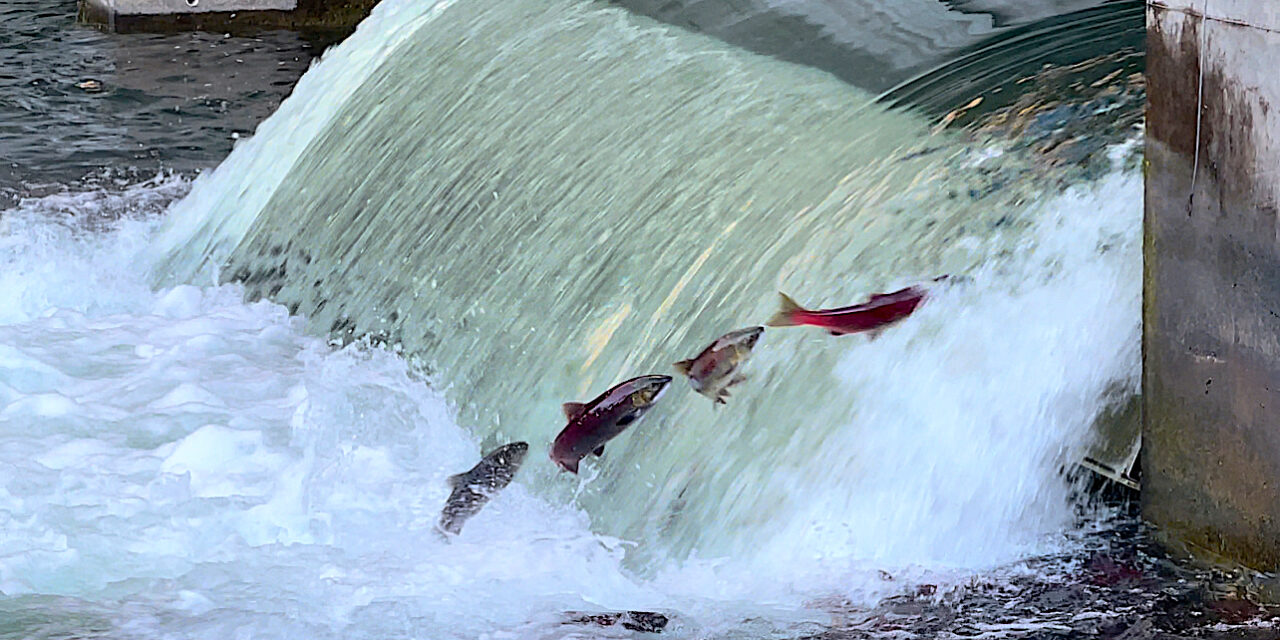
The successes of the Syilx Okanagan Nation’s sockeye salmon restoration culminating in record numbers reaching the Okanagan Basin to spawn this year are suddenly at risk in what appears to be collateral damage from a developing transborder rift with the Colville Confederated Tribes.
“Unfortunately, despite this incredible success, the work has been put at risk this year by the unilateral political decision of the Confederated Tribes of the Colville Reservation to cancel funding and walk away from joint salmon restoration projects,” the Syilx Okanagan Nation said in a statement.
The transborder issue came to light in early October around consultation within BC with First Nations on expanding Big White Ski Resort near Kelowna. The resort is located within the traditional territory of the Syilx Okanagan Nation and has fallen under Westbank First Nations’ jurisdiction.
But the Washington State-based Colville Confederated Tribes say the resort is also located in the traditional territory of the Sinixt, an Indigenous people with members and territory on both sides of the Canada-US border.
But a major point of contention is the fact both the Confederated Tribes and the Okanagan Nation say they represent the Sinixt.
“What is happening at Big White, and in the eastern part of our territory, goes far beyond anything prescribed by the courts to date, and it risks opening a Pandora’s box of transborder claims across the province,” said WFN y̓ilmixʷm (Chief) Robert Louie in an earlier statement.
The latest twist occurred when two letters were sent to the Okanagan Nation Alliance (ONA) Fisheries department by Jarred-Michael Erickson, the Chairman of the Colville Confederated Tribes, announcing the cancellation of his organization’s share of joint funding for salmon restoration projects, that had been running for over 15 years.
The Syilx Okanagan Nation said it chose to make the news of the cancellation public because “Colville has continued to pursue a unilateral agenda of reaching across the border into Canada, demanding and acting to gain involvement over Syilx Okanagan Nation Territory.
“The Syilx Okanagan Nation has never attempted to do the same in the US and has in fact been prepared to meet and discuss issues, with an extended hand that remains open to Colville,” it said.
Describing the move as short-sighted, the ONA highlighted that the decision goes against the teachings of spiritual leaders and Syilx/Sinixt Elders like Calyx (Richard Armstrong), “who have always reminded us that the work of ntytyix fish passage is bigger than all of us – a clear, stark reminder of our sacred covenants as Syilx peoples to care for our tmixʷ (all living things) and tmxʷulaxʷ (land).”
The annual funding was valued at approximately $400,000 (CAD), with the cancellation made with 15 days’ notice, and without explanation the statement said.
This has caused significant disruption to ongoing work, risking jobs, and forcing the Syilx Okanagan Nation to make emergency triage decisions on salmon restoration projects that were already underway this fiscal year, it said.
“This last-minute cancellation has left our project staff scrambling, and delayed projects,” said Chief Robert Louie of the Westbank First Nation, a Syilx Okanagan Nation community.
“The salmon are too important to play politics with, and we will take care of them, but it’s important to note this cancellation was very disruptive and sharply at odds with Chairman Erickson’s recent media comments that his tribes want to ‘live in unity and partnership’ with our Nation.
“In retrospect, the cancellation was not only an escalation of Colville’s move away from our Syilx Unity Declaration,” said Louie, “but it also appears to be a direct play for full control of Upper Columbia fish passage, salmon reintroduction and research – work that we have successfully led in all parts of our Territory.”
The Okanagan Nation said its fisheries management operations are long-established, include a sockeye salmon conservation hatchery and are “considered to be the largest inland First Nations fishery in BC, if not Canada.”
“Our partnership on salmon restoration was evidence of the success we achieve when we work together, as our people have done for thousands of years,” Louie continued.
“Our door always has been, and always will remain open to working together again with our US relatives, as we have always had one language, one land, one culture and one people.”
A further source of friction within the once unified nation involves claims to the Arrow Lakes area of the province which is part of the eastern reaches of the Syilx Okanagan Nation.
According to the Okanagan Nation, the Colville Confederacy now claims one of its 12 member tribes – the Lakes Tribe, now referred to as the “Sinixt Confederacy” – is a distinct nation, deserving separate rights and compensation.
The Syilx Okanagan Nation takes great pains to emphasize that the newly formed Sinixt Confederacy is not representative of all people of Sinixt ancestry. “There are many Sinixt people in Canada within the constituent communities of the Syilx Okanagan Nation,” it added.
This includes the Lower Similkameen Indian Band, Okanagan Indian Band, Osoyoos Indian Band, Penticton Indian Band, Upper Similkameen Indian Band, Upper Nicola Band, and Westbank First Nation.
The Syilx Okanagan Nation, represented by its Chiefs Executive Council, is the representative of Syilx people (including the Sinixt) in Canada, the Okanagan Nation said.
The stage for this dispute was set in 2021 when the Supreme Court of Canada recognized the Lakes Tribe as “one successor group of Sinixt people” who at the time of colonial contact occupied territory across what is now BC and Washington state. The court, however, expressly noted that there may be other successor groups, which in this case include the Syilx Okanagan Nation.
“The Sinixt have always been part of the Syilx Okanagan Nation, and we have continued to hunt, gather, travel and perform our ceremonies throughout our Territory including the Arrow Lakes region, to the present day,” the Okanagan Nation said.
“The Syilx Okanagan, including the Sinixt, are nsyilxcәn-speaking people and we have always been — and always will be — united by our common nsyilxcәn language, our tmxʷulaxʷ (land,) and our sqixʷɬcaʷt (culture),” it said.
“Relying on the Sinixt Confederacy and the Colville Confederated Tribes for information about Sinixt — to the exclusion of the Syilx Okanagan Nation as represented by the Chiefs Executive Council, the representative of Sinixt people in Canada — is inappropriate and perpetuates colonial injustices,” the Syilx Okanagan Nation said.
It also puts the interests of a US-based tribe above the rights and interests of members of the Syilx Okanagan Nation in Canada, it added.
Background figures:
- 80 per cent of salmon that enter the mouth of the Columbia River are Okanagan River sockeye;
- The vast majority of these salmon spawn in Canada, in the Okanagan River;
- Colville’s decision harms salmon restoration efforts that directly benefit their people by bringing salmon back and increasing fishing opportunities on the Columbia River.
The Syilx Okanagan Nation said the abrupt cancellation means an immediate loss of funding for:
- Fish habitat and passage assessments, analysis and conceptual designs;
- Stream/fish passage issues – investigation, community and public engagement;
- Meetings and project development for the Okanagan River Restoration Initiative (ORRI) and the Okanagan Basic Monitoring Evaluation Program (OBMEP);
- Traditional Environmental Knowledge (TEK) support;
- Outreach funds for projects;
- Project management and coordination during construction projects;
- Six discharge stations used for drought and water management discussions with BC, and to support special projects related to environmental flows;
- Loss of administration funds and cost sharing to support proposals to government.