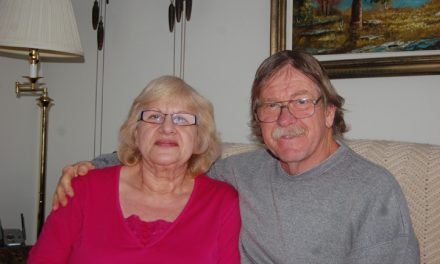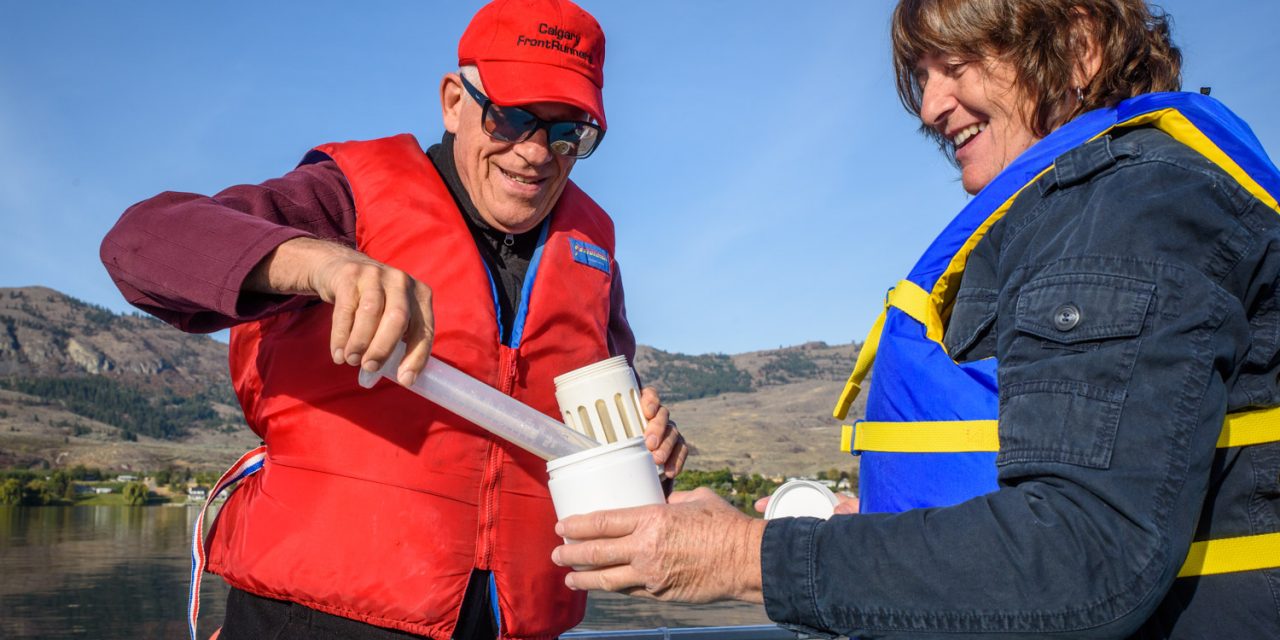

Volunteers David Smith and Marie Gibbons gather a water sample collected using a plankton net. This will be tested for veligers, the larvae that grow into invasive zebra or quagga mussels. (Richard McGuire photo)
It’s the last Wednesday in September and the final time this year that the Osoyoos Lake Water Quality Society (OLWQS) is taking its testing boat onto Osoyoos Lake.
It’s a pontoon boat, moored throughout the summer at the Walnut Beach Resort, which donates the space to the local non-profit group.
The boat is full with volunteers heading out, first to a point on the lake just north of the U.S. boundary to conduct the first series of tests.
Birgit Arnstein, the group’s president was the guest speaker at a recent lunch meeting of the Rotary Club of Osoyoos, where she talked about the group’s more recent mission – keeping Osoyoos Lake (and therefore other lakes of the Okanagan) free of the invasive zebra and quagga mussels that have destroyed beaches across much of North America and threaten billions of dollars in infrastructure.
OLWQS’s mission has evolved since the group was formed by volunteers more than 25 years ago, but it’s always been about monitoring the water quality of the lake.
When the provincial government stepped back from doing its own testing in the late 1980s, a number of local people stepped in to fill the gap.
Early volunteers included Lionel Dallas, Denis Potter, Roger Horton among others.
For years, the group conducted tests at five points on Osoyoos Lake, though this year at the suggestion of the Ministry of Environment, it was scaled back to four. They’ve also changed from testing every week to every second week.
The group tests for such indicators of the lake’s health as dissolved oxygen, pH (acidity), specific conductance, water clarity (turbidity) and temperature.
Many of these indicators are also important to healthy fish.
“Many people send us messages and call or write to ask if the lake is safe to swim in,” Arnstein told the Rotarians. “I always have to say I’m sorry, that’s not what we test. We’re testing the health of the lake. Whether the lake is healthy to swim in is a different question.”
Water for those tests, she said, is collected by the Town of Osoyoos and sent to Interior Health for analysis.
But new this year are two tests for the presence of zebra and quagga mussels.
And on that boat trip in late September, volunteers are gathering water samples for both tests.
One test measures whether calcium levels have gone down. This might indicate the presence of mussels, which suck calcium from the lake at an astronomical rate to build their shells.
The other test involves lowering a plankton net into the water at specified depths to gather any veligers, the larvae that grow into invasive mussels.
OLWQS sends out the samples for testing – they don’t do the analysis themselves.
Invasive mussels are usually spread by recreational boaters who fail to properly clean, drain and dry their boats after using them in infested waters.
But as Arnstein tells the Rotarians, other items used in the water from hip waders to floaties to kayaks can also spread these nasty beasts.
And it only takes one careless boater, driving into B.C. at night after inspection stations are closed.
In their veliger state, the mussels are not noticeable to the human eye. They may be floating in ballast water.
The rate of spread is unbelievable. One female mussel can produce a million offspring, meaning that clean lake can be choked with mussels within a couple of years.
Arnstein said the severity was driven home to her at a recent presentation by a mussel inspector who showed photos she took of mussels covering beaches.
“She had to buy shoes to go into the lake because they are very sharp, they are only about the size of my fingertip,” said Arnstein.
“They are shocking. They latch onto solid surfaces such as boat propellers, intake pipes,” she said. “They collect on lake bottoms, they produce toxins that kill fish and they contaminate drinking water. They cause irreversible harm to our ecosystem and recreational activities. If this all sounds really gloomy, I’m sorry.”
Asked by a Rotarian what would happen if mussels got into our lake, Arnstein used two words: “quarantine” and “containment.”
Both would be devastating to the way of life and economy of this community.
Meanwhile, OLWQS is doing all it can to raise awareness, Arnstein said.
RICHARD McGUIRE
Osoyoos Times

Birgit Arnstein, president of the Osoyoos Lake Water Quality Society, lowers the groups new Hydrolab 4 testing device into the water. This device electronically conducts most of the tests that were done manually previously. It does so faster and more accuately, loading the data directly onto a computer. (Richard McGuire photo)

Iain Fraser and Verla Anderson, volunteers with the Osoyoos Lake Water Quality Society, check the data recorded by the Hydrolab 4, which is directly loaded onto their computer. (Richard McGuire photo)

Birgit Arnstein and Iain Fraser lower the Hydrolab testing device to specified depths at a point on the lake just north of the U.S. border. The group used to navigate by sight, but now they use a GPS. (Richard McGuire photo)

David Smith holds up a plankton net which he’s pulled from the depths of Osoyoos Lake. This net is used to gather water samples to test for the presence of veligers, the larvae that grow into invasive mussels. (Richard McGuire photo)

Iain Fraser steers the boat back to its base at Walnut Beach Resort. The resort has donated dock and storage space to the Osoyoos Lake Water Quality Society for its lake testing. (Richard McGuire photo)