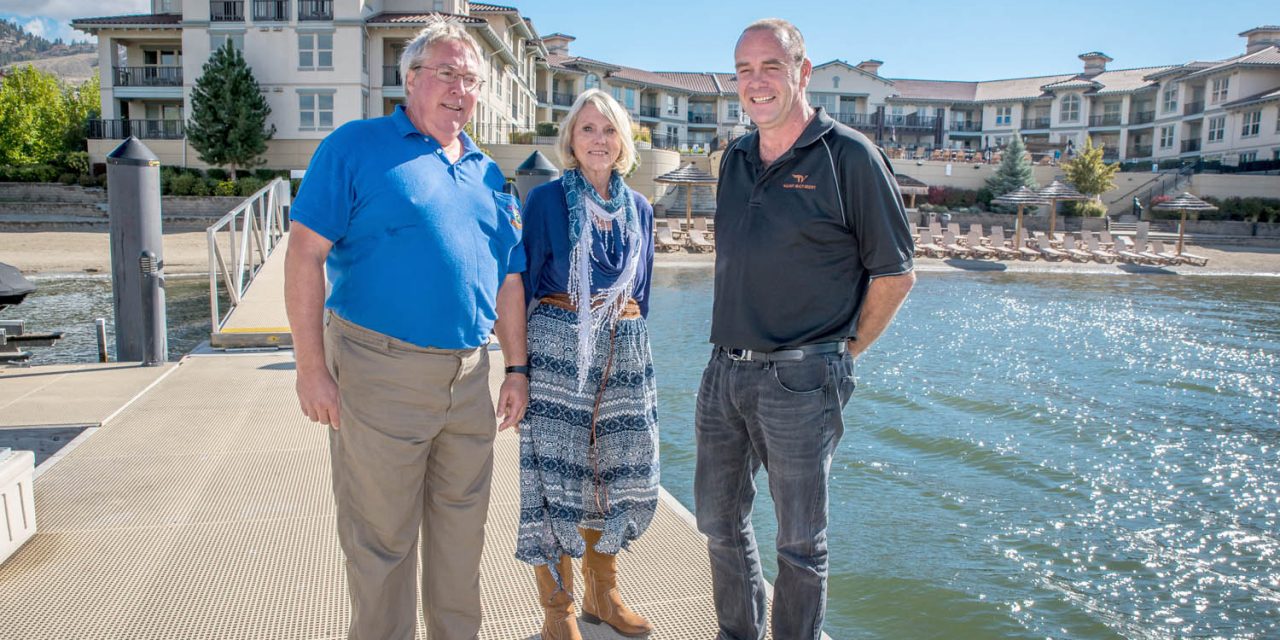
OLWQS President Birgit Arnstein (centre) is pictured with Brian Faltinson (left) and Don Brogan, general manager of Walnut Beach Resort. Faltinson was involved in OLWQS testing for years and is a past president. (Richard McGuire file photo)
Every week in the summer months, volunteers with the Osoyoos Lake Water Quality Society (OLWQS) go out on the lake to take measurements that tell them about the health of the lake.
But even some of those volunteers, let alone members of the public, don’t fully understand what those measurements say about the lake.
Now the OLWQS is holding a public meeting on Thursday, Nov. 16 to inform the public about what these tests show and how the information is used.
The meeting takes place at 6:30 p.m. at the Walnut Beach Resort and will feature guest speaker Mike Sokal, environmental impact assessment biologist with the B.C. Ministry of Environment.
“I think that it’s another way of having people become aware of the lake,” said Birgit Arnstein, OLWQS president.
She points out that Sokal is the scientist who receives the data that the OLWQS collects and he can explain how it’s used.
The talk, she said, follows on the heels of a public screening of a documentary, A River Film, which recently filled the Oliver Theatre.
One of the points explained in that film was how sockeye salmon must navigate along a shrinking layer in the lake where water temperatures are cool enough, but there is still sufficient oxygen.
If they swim too close to the surface, the temperatures are too warm. If they swim deeper, oxygen levels fall off rapidly.
The film used animated graphics to show the challenge the fish face.
Water temperatures and oxygen levels are two of the measures that OLWQS volunteers record each week at five points on the lake.
Volunteers also record turbidity – how the clarity of water is affected by suspended particles – as well as pH or acidity levels.
One thing that the OLWQS doesn’t test for, said Arnstein, is coliform counts or other measures of pollution.
But the measures that are taken speak to the health of the lake and the life it supports, including salmon, Arnstein said.
“I think that people in the town, whether they are tourists who enjoy the lake for all the water activities, if they are fishermen, or if they are part of the wineries and orchards, they might be interested in various aspects of the lake and learning what we do with our data,” she said. “I think it’s something that is going to appeal to a variety of people.”
Sokal has been based in Penticton and has worked for the Ministry of Environment for almost 10 years.
He assesses environmental impacts of a wide variety of human activities such as mining, municipal effluent, and agricultural and urban runoff on aquatic systems. He also monitors the water quality of aquatic habitats in the Okanagan Region.
He has a PhD in aquatic ecology and paleolimnology from the University of Waterloo. Paleolimnology is the study of ancient inland lakes from their sediments and fossils.
Arnstein, who joined the OLWQS early in 2015 and immediately became president, admits that she knew virtually nothing about the water testing when she started.
“I found it very interesting to go out and do the testing with the other volunteers,” she said. “Some of those volunteers are far more knowledgeable than I am. I’m learning more and more each time we go out.”
Arnstein said the Walnut Beach Resort has been very supportive of OLWQS. The resort provides mooring for the boat the volunteers use and it also provides year-round storage for testing equipment.
“They’ve been very accommodating,” she said. “Don Brogan (general manager) has been extremely helpful.”
For more information, visit osoyooslake.ca.
RICHARD McGUIRE
Osoyoos Times