By Roy Wood, Special to the Times Chronicle
Just as Osoyoos is struggling with contamination in its recycling program Oliver too is facing challenges with its new organics program as it contends with a 40 per cent contamination rate.
The town plans to address the serious contamination problems through education and, potentially, fines for offending homeowners.
Organics collection began in early April, when weekly pickup of the green-lidded “yard waste” bins began and garbage collection was reduced to biweekly.
Material acceptable for placement in the green bins, according to the town’s website, includes food waste, household plants and some yard waste. Food waste includes cooked food, grains, dairy, produce, meat bones and shells.
In a presentation to council at a committee meeting Monday, chief financial officer John Kurvink said the amount of inappropriate material being put in the green bins is about 40 per cent, which is too high.
This contamination is time consuming at the landfill. “The RDOS employee is spending a couple of hours a day pulling out diapers” and other contaminants, he said.
A high-tech solution is on the way to determine who the contaminators are and to encourage broader compliance.
Kurvink said the contracted collector – Waste Connections – will be installing cameras on its trucks to photograph the material as it is dumped. Then, using artificial intelligence, the system will identify contaminants by property.
Once the technology is available, “We will make homeowners aware of its existence, which may help improve compliance through education,” said Kurvink’s report.
“Procedures for ongoing non-compliance will be developed. i.e. series of warning letters followed by bylaw enforcement through fines.”
He noted the town’s solid waste bylaw will need to be updated to include the organic waste program and the associated fines.
Kurvink told the Times Chronicle it is difficult to know how many residents of Oliver are taking part in the organics collection program. All 2,094 single family residences have been issued the green-lidded bins, but some residents might be using them just for yard waste and not for food waste, he said.
He noted, however, that some 1,200 of the “kitchen catchers,” used to gather food waste in the house before putting it into the bin, have been distributed in the town. He is also encouraged by the fact that about 221.4 metric tons of organic waste has been dropped at the landfill since the program got going in April.
Kurvink’s presentation to council included a series of slides illustrating the process to turn the organic waste into saleable compost.
The steps include chopping and mulching, aeration, and maintaining consistent temperature and moisture levels so the bacteria can decompose the organic material. It typically takes between 80 and 120 days for food scraps to become compost.
The plan is for Waste Connections to eventually sell the compost. Before that can happen, the material must go through expensive testing to ensure its purity.
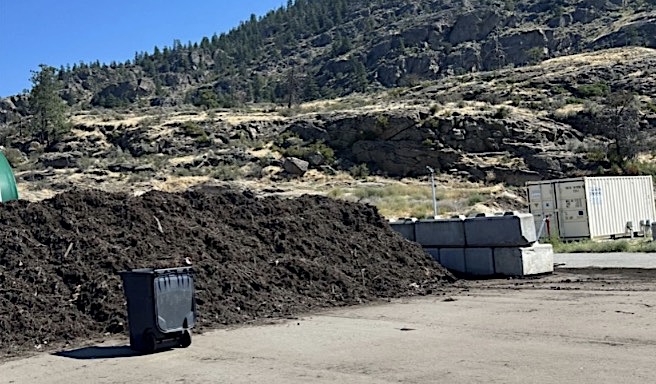
The company is waiting until it is confident of passing the test before submitting to it. Meanwhile, the compost is stockpiled at the landfill site.
Councillor Petre Vientimilla suggested using some of the material in Kurvink’s presentation to create a social media program to help educate residents.
“There may be people who are throwing things in that they think are acceptable and just don’t know,” she said. “It will take time for us to know what belongs in the green bin.”
Councillor Terry Schafer said it is council’s job to educate the public around how the system works. “It took us a long time, just as a family, to get comfortable with … separating everything out. It just takes time.”