By Sebastian Kanally, Times Chronicle
Implementing water restrictions in Oliver may soon look very different, and may possibly come far less often.
Oliver has been looking at updating its drought management system, and recently they received an in-depth report from Sean Curry, at TRUE Consulting on water conservation and what a new and improved drought management system may look like.
Oliver’s current system for observing how much water the town has access to, and when it should implement water restrictions is based on “observation wells”.
These observation wells are owned by the province and give an indication of the amount of groundwater the town has.
When asked in the council meeting whether the observation wells are effective, Curry noted that “there is minimum correlation let’s say”.
“What we found is that the observation wells are too far away to show what the domestic production wells are doing and are able to do.”
The town’s production wells on the other hand are real time monitored. “As opposed to looking at the provincial database and trying to find the observation well levels, the town is actively monitoring every single well; there are alarms in place if the water levels go too low.” Curry explained.
This is why the town worked with TRUE Consulting on a drought management strategy that is based on the real-time monitoring of the town’s domestic groundwater sources, in its own wells.
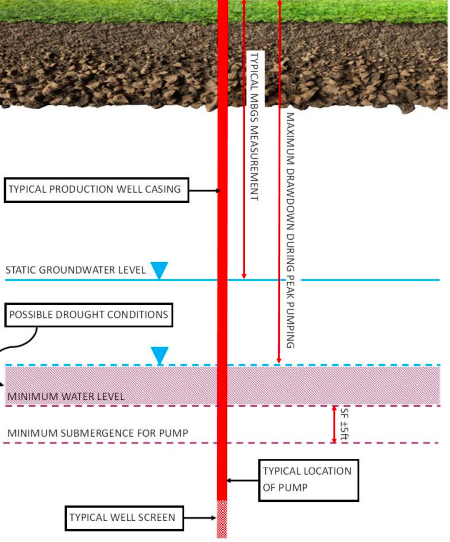
A graphic of the parts of the domestic well. The shaded pink area is just above the minimum water level for the pump to run and what the hydrogeologist must determine for each pump.
Town of Oliver graphic
The town pursued this avenue in part because at their March 10 council meeting, council expressed concern about using Okanagan Lake levels as a drought trigger in an updated drought management plan.
Currently there are multiple factors that go into triggering water restrictions, including Okanagan Lake levels, droughts, and the observation levels.
When it comes to a new drought management plan, Kelly Mercer Director of Operations explained that the goal is to ensure the long-term viability of the town’s water sources. The plan will establish new triggers in order to meet that goal, and the best practice will be to review the plan every five years.
The major update to the plan will be implementing drought triggers based on the domestic well levels. In order to do this, the town will have to hire a qualified groundwater hydrologist at a cost of between $10,000 and $15,000 to look through the town’s historical data on these well levels and determine where the trigger points should be.
These trigger points indicate at what level of water in the wells would prompt implementing water restrictions.
“If all wells are operational and demand is less than the identified threshold, it’s normal operating conditions for the town’s groundwater production levels. If we exceed that threshold we have to move into some sort of restrictions and do staged restrictions as necessary to reduce our demand lower than that number.”
Curry noted that the new proposed system will be determined by whether all wells are operational, and whether they are all above the threshold.
According to the proposed rules, “if we do lose one well (such as the Rockcliffe Well which was shut down recently), we would immediately go to stage four restrictions.
He recommended changing this to only trigger stage one restrictions. “Just for the safety of the water system,” Curry commented.
But when asked by Councillor David Mattes how many times would the town have gone into water restrictions in the last few years under these new guidelines he said, “over the last five years, not many instances other than operational maintenance . . . In this case it would probably never come into play, unless you do lose a well.”
Beyond the drought management plan, when it comes to the water conservation side of the plan, Curry made recommendations that the town implement a tiered billing structure for water.
This means that the more water you use, the higher rate you pay.
“So, the idea there is, most of your water users are not using a lot of water, but there will be a number of them, in this case I think the top 10 users of domestic water within Oliver account for 31 per cent of total usage. So, we try to aim for those people and lower their demand”.
The other measure Curry recommended was conducting major use audits. He mentioned that not only were 10 users responsible for 31 per cent of water usage in the town, but that the top two are particularly noteworthy, “what we are seeing is it’s more like a top two that are very likely associated with leaks.”
Town council moved to bring in the qualified groundwater hydrogeologist to establish trigger levels to begin the process of putting together a new drought management plan.
But Councillor David Mattes explained that he was unwilling to move to accept the report from TRUE Consulting.
“I am not prepared to do that at this time, I have a whole bunch of concerns within that report, I don’t think 20 minutes will cover the discussion on a 68-page report. I would be happy to go over them with council, or go over them with the director, or whoever else may want to attend that particular meeting. But I have some serious concerns with some of the data, and some of the conclusions.”
Although he followed up by saying “there was some good stuff in there too.”
There will be a more in-depth discussion at a future Committee of the Whole meeting on the full report. But this does not stop the town from going ahead with hiring the hydrogeologist and drafting plans for the new plan.
Mercer explained the next steps the town will need to take:
- Hire a hydrogeologist to complete an evaluation of our domestic wells and create a minimum elevation for each domestic well. (April 2025 – June 2025).
- Bring forward a draft Water Conservation Plan to the Committee of the Whole for final review in summer (May or June 2025).
- Bring forward an updated Drought Management Plan to the Committee of the Whole with updated drought triggers (August or September 2025).
- Prepare Water Conservation Bylaw based on the plans above (October 2025).
- Update 2026 Town of Oliver Water and Sewer Rates Bylaw to incorporate proposed conservation-oriented rate structure (October 2025).