The Okanagan Basin Water Board (OBWB) has decried the potential cutting of funding by the federal government which supports invasive mussel inspections in BC calling it “unacceptable and unjustifiable”.
This comes after the alarm was raised following the discovery in September of quagga mussels in Idaho’s Snake River, a tributary to the Columbia River which connects to the Okanagan, and only an 11-hour drive to the BC and Alberta borders.
In response to potential funding cuts, the board has sent a letter to the Ministers of Fisheries, Oceans and the Canadian Coast Guard, Environment and Climate Change, and Public Safety, Democratic Institutions and Intergovernmental Affairs, as well as the Prime Minister’s office.
“We view it as unacceptable and unjustifiable, given all the resources and responsibilities of the federal government and your departments, that no federal funding has been allocated to protect freshwater ecosystems from the extreme threat of invasive mussels in Western Canada.
“Protecting the west from these mussels is of national importance, and it will take federal leadership to meet this inter-provincial and transboundary threat,” the board expressed in its letter.
“This is critical, we are going right to the top,” explained Water Board Chair and Osoyoos Mayor Sue McKortoff.
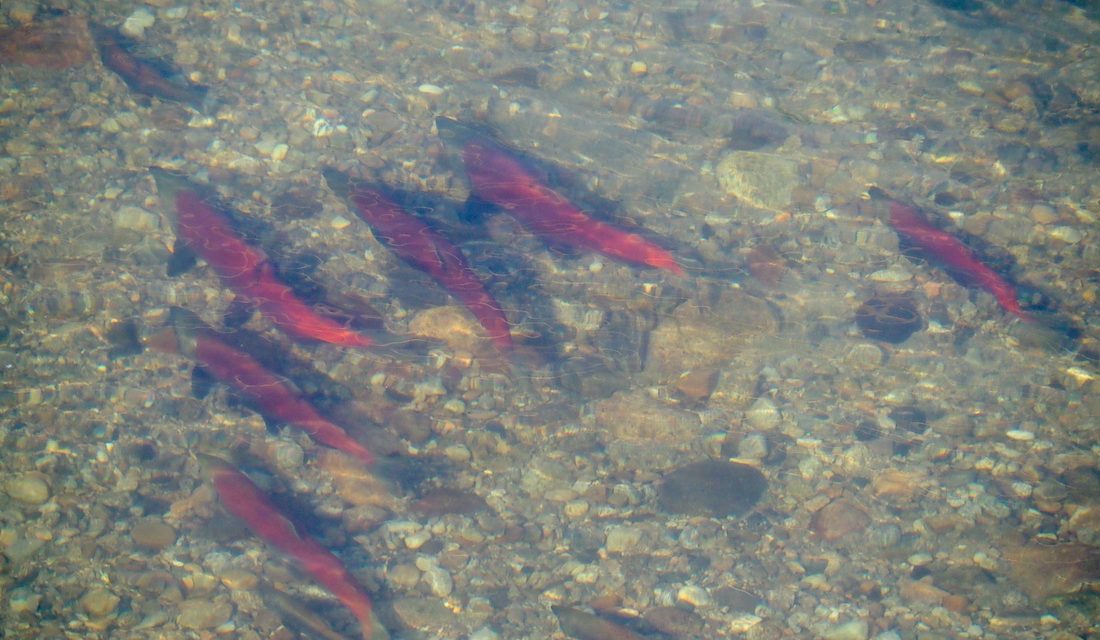
“After all the decades of work done by the Okanagan Nation Alliance and partners to bring the salmon back, it would be a crime to see the salmon population collapse because we failed to protect our freshwater ecosystem from invasive zebra and quagga mussels when we still had a chance.”
The letter calls for immediate, long-term federal funding assistance for the Province of BC to support invasive zebra and quagga mussel prevention efforts.
“The Government of Canada should provide funds to at least match provincial government efforts across the West, or plan for significant higher management costs in the near future,” the letter states.
The Canada Border Services Agency also has a responsibility to enforce the prohibition against importation of invasive mussels under the federal Aquatic Invasive Species Regulations, the OBWB added.
“While we applaud the work of border service officers to intercept infested watercraft at many land crossings, CBSA is not fulfilling its responsibility for enforcement. Instead, it relies on provincial inspectors to follow up and decontaminate high-risk watercraft once they are identified,” it said.
The federal government announced in May 2023 the creation of the Canada Water Agency, a new body to protect freshwater, which included a budget of $750 million with $420 million over 10 years earmarked to address water concerns in the Great Lakes, but none for aquatic invasive species protection in the west.
“Has the federal government given up on us?” questioned OBWB Executive Director Anna Warwick Sears. “Have they accepted defeat before we’ve even had an infestation here? That’s what it feels like.
“We appreciate there’s a Canada Water Agency, but they’re pouring money into remediation for the Great Lakes without protecting the still pristine waters in the west,” she added.
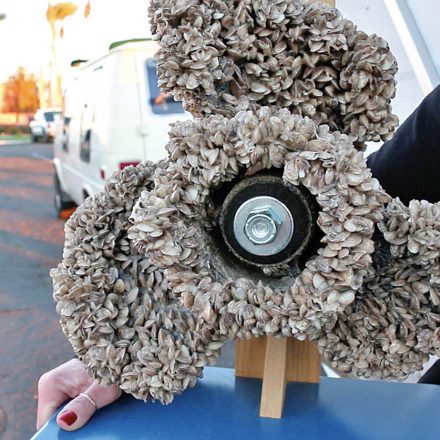
Invasive mussels cover a boat propeller.
The OBWB argues it would take only $4 million per year allocated to BC invasive mussel inspections to protect the Canadian Columbia Basin, the Fraser Basin, Peace Region, and other major western river systems. The Province of BC allocates over $1 million per year to this program, but the water board stresses that without federal and other partner funding, these efforts will likely fail.
“The government has identified the Fraser River as a priority watershed. Regardless of what they do in the Okanagan, they should be true to their word and prioritize funds for the Fraser River. By protecting the Fraser, they will help protect the rest of the province.”
The OBWB warns that if invasive mussels arrive in BC they will severely impact Pacific salmon by depleting the food web in their spawning and rearing habitats in the Fraser and Columbia River systems.
The OBWB has been stepping up its calls for action after last September’s announcement of the discovery of quagga mussels in Idaho’s Snake River of which the Columbia River is a tributary. The closest infestation prior to this finding was in Manitoba.
Idaho’s desperate response was to spread more than 116,000 litres of toxic copper chelate into the river, killing almost seven tonnes of fish, and poisoning a 26 km stretch of the river, according to the OBWB.
“Wholesale killing of fish, invertebrates, amphibians, and plants in the river was considered better than letting these mussels take hold,” the board writes, adding the effectiveness won’t be known until this spring.
Also in September, Fisheries and Oceans Canada (DFO) declared zebra mussels were discovered in New Brunswick. And then in November, Parks Canada declared zebra mussels had spread another 100 km west in Manitoba to Clear Lake in the province’s Riding Mountain National Park.
In October, the OBWB began calling for a temporary moratorium on watercraft coming into BC until results from Idaho’s efforts are known and the Province of BC has closed any gaps in its Invasive Mussel Defence Program. Support for the moratorium has been gathering steam with letters coming in from BC municipalities, chambers of commerce, the Thompson Okanagan Tourism Association, and others.
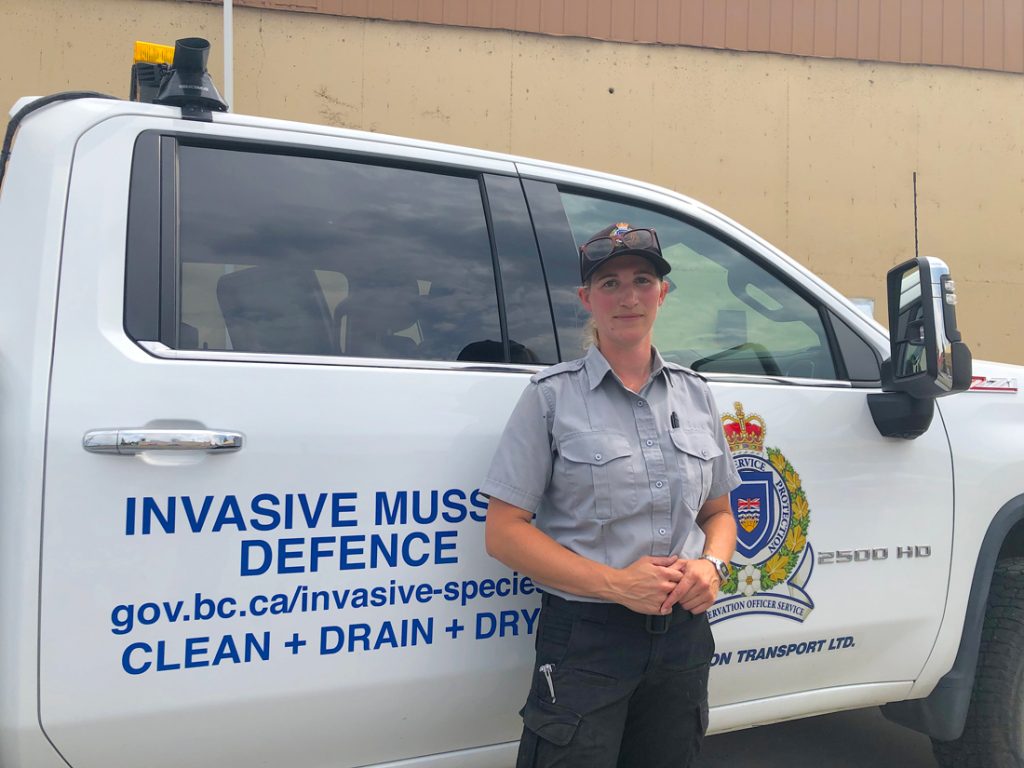
Rebecca Benham, Aquatics Invasive Species Inspector with the BC Conservation Officer Service, Ministry of the Environment and Climate Change Strategy. Don Urquhart photo
Between May and December 2023, BC’s Invasive Mussel Defence Program intercepted 155 watercraft on their way into BC that were identified as high-risk for the mussels; 79 were decontaminated; 36 were quarantined. Fourteen were confirmed to have invasive mussels.
A recent BC government economic impact report states an invasive mussel infestation would cost the province $64-129 million annually. However, in reviewing the report, the OBWB has said the costs would be higher since the report leaves out harder-to-define costs, including the impact to fisheries and quality of life.
The OBWB’s Okanagan WaterWise outreach and education program has been running the “Don’t Move A Mussel” campaign since 2013, raising awareness about the threat of the mussels and how to keep them out of the Okanagan.
In addition to the threat to Pacific salmon, these mussels are known to stimulate toxic algae blooms, killing migratory birds and contaminating drinking water. They hurt local economies, requiring ongoing maintenance to remove them from in-water infrastructure such as bridges and docks, as well as water systems used to deliver water for agriculture, domestic, industrial, and commercial use. And, they degrade the quality of the shoreline environment for human enjoyment.
The program also funds the Okanagan and Similkameen Invasive Species Society to conduct outreach to boaters and the public. The OBWB is also developing a mussel vulnerability guide for local governments, water purveyors, and other industrial users that rely on in-water infrastructure.
For more information on zebra and quagga mussels, the risks to the Okanagan, and how to prevent their spread visit DontMoveAMussel.ca.