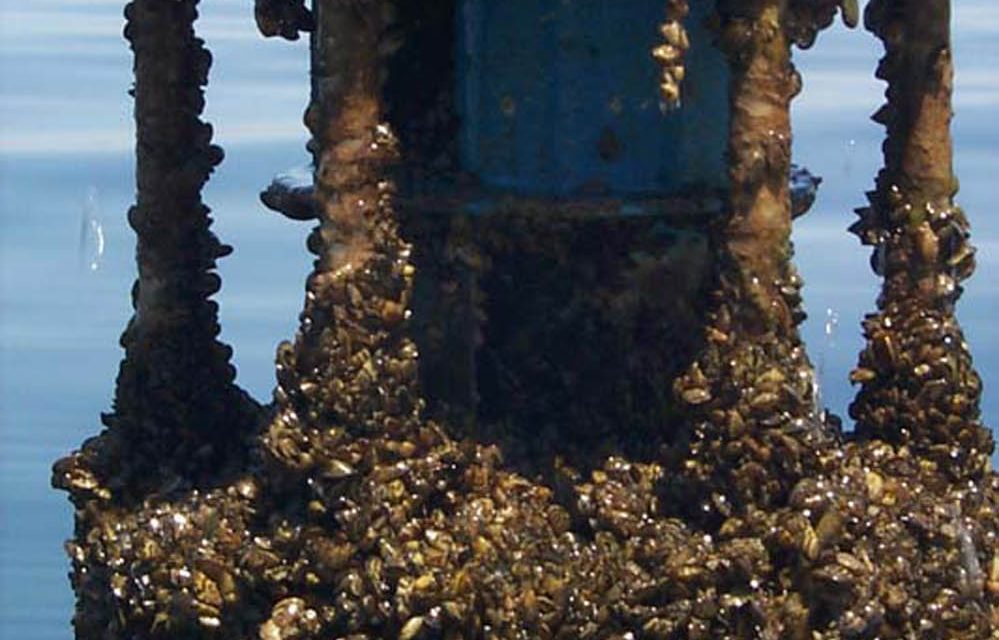
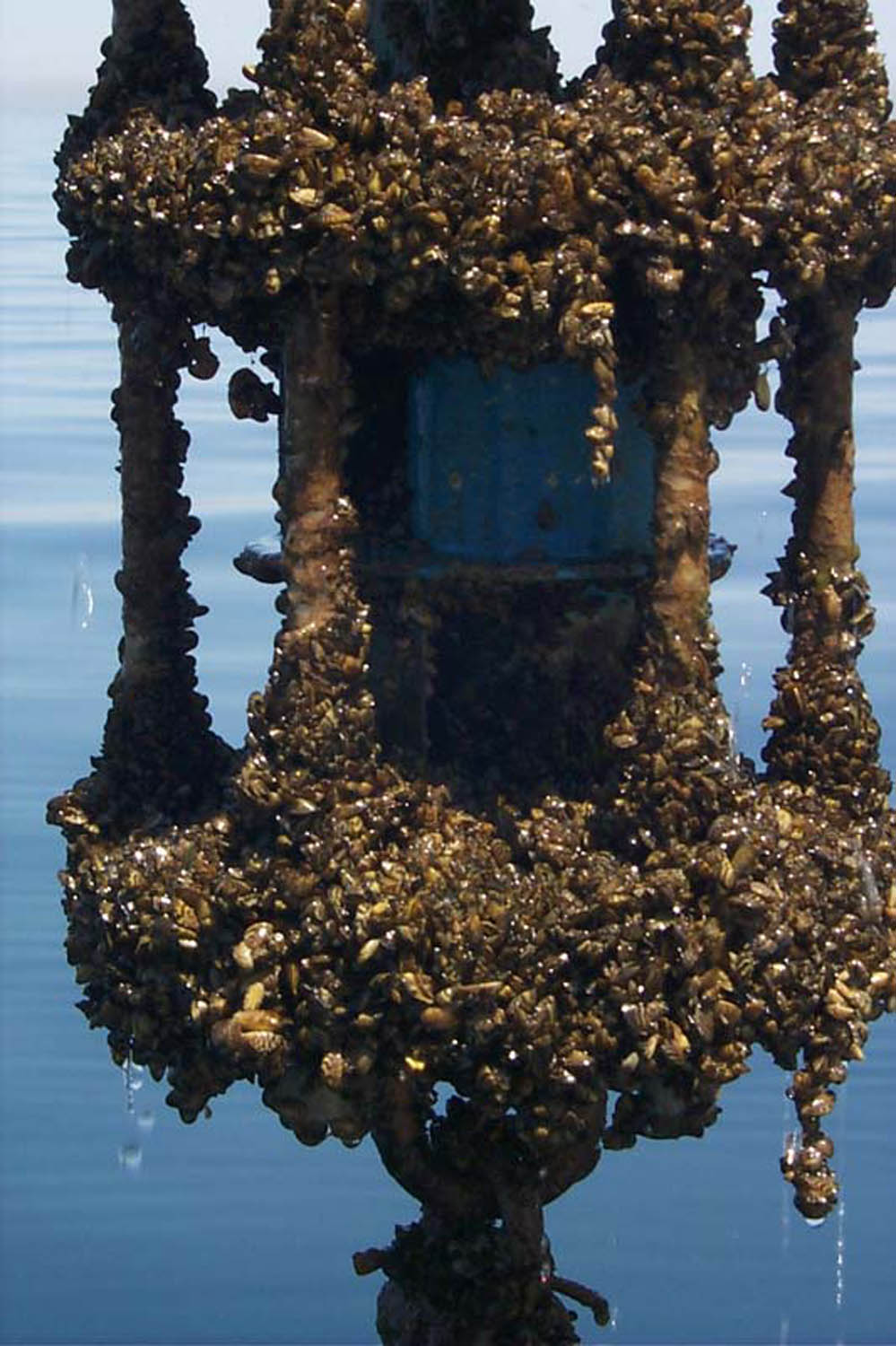
Zebra mussels encrust a current meter retrieved from Lake Michigan. Mussels cover every imaginable surface in the water once they infest a waterway. They are spread by careless boaters, but Canada lacks federal regulations needed to stop them at the border. (U.S. National Oceanic and Atmospheric Administration)
The provincial government will be hearing from representatives of Okanagan regional districts and municipalities this week about the serious threat to local lakes posed by invasive mussels.
A meeting is scheduled for Thursday with Steve Thomson, B.C. minister of Forests, Lands and Natural Resource Operations, at the 2014 convention of the Union of British Columbia Municipalities (UBCM) in Whistler, B.C.
Although the Okanagan Basin Water Board (OBWB) has been seeking such a meeting with B.C. Environment Minister Mary Polak, the Regional District of Okanagan-Similkameen (RDOS) arranged the meeting with Thomson.
Nonetheless, OBWB Chair Doug Findlater will be at the meeting where he will also represent the Regional District of Central Okanagan. Findlater is also the mayor of West Kelowna.
The OBWB has been lobbying both the provincial and federal governments to take action to prevent the spread to B.C. of zebra and quagga mussels, both invasive species from Eastern Europe that have overtaken many lakes in eastern North America and have made inroads into the southwest United States.
The mussels encrust themselves on water intakes, docks, boats and other things in lakes and rivers and they kill fish and other native aquatic species and damage water quality.
Mussels have been spread through other parts of North America mostly by recreational boaters failing to properly clean, drain and dry their boats before moving them from one water body to another.
Many jurisdictions including Alberta and some of the northwest states of the U.S. have implemented inspection stations to check if boats are carrying these mussels. B.C. has not yet implemented such an inspection program at roads coming into the province and the government has not directly responded to the OBWB’s calls for inspection stations.
The OBWB has estimated that the cost of a mussel invasion in the Okanagan would be $43 million a year just to mitigate its effects.
Representing the RDOS at the meeting will be chair Mark Pendergraft, vice-chair Garry Litke and chief administrative officer Bill Newell. Juliette Cunningham, a Vernon councillor, will represent the Regional District of North Okanagan (RDNO). Litke is also the mayor of Penticton.
Mayor Stu Wells is the only Osoyoos elected official attending the UBCM convention. The former chair of the OBWB said he would attend the mussel meeting if possible.
The RDOS says in a briefing note that the reason for the meeting is that the regional district and its member municipalities believe provincial action is required to prevent invasive zebra and quagga mussels from entering B.C. and the Okanagan and Similkameen valleys.
The note, signed by Pendergraft, says the RDOS wants the province to initiate a program to prevent the spread of zebra and quagga mussels into B.C.
It also asks the province to advise local government of the steps currently underway to attack this problem and it calls on the government to start an education program to assist with enforcement.
In June, Environment Minister Polak wrote to OBWB Chair Findlater and said: “The Provincial Zebra and Quagga Mussel Early Detection and Rapid Response Plan is currently in draft stage and will be completed over the next several weeks.”
Three months later, that plan has still not been released.
Asked about the delay, a spokesperson for the B.C. Ministry of Environment responded in a written statement: “The Early Detection and Rapid Response plan is still being drafted and we are expecting to finalize it very soon.”
The spokesperson added that conservation officers and natural resource officers’ work with the federal Canadian Border Services Agency (CBSA) in identifying boats that may be of concern.
“The province has mobile decontamination units that can be moved around the province,” the spokesperson said.
The province has also been in discussions with neighbouring jurisdictions to develop a perimeter defence plan for zebra and quagga mussels, he said.
Environment Ministry staff held an inspection blitz in the East Kootenay over the August long weekend and inspected 132 vessels, he added.
The OBWB has been actively lobbying the provincial and federal governments to take more action against the mussel threat through a website at www.DontMoveAMussel.ca. A “Speak Out” link on that site encourages the public to express their concerns to their federal and provincial elected representatives.
RICHARD McGUIRE
Osoyoos Times