By Don Urquhart, Times Chronicle
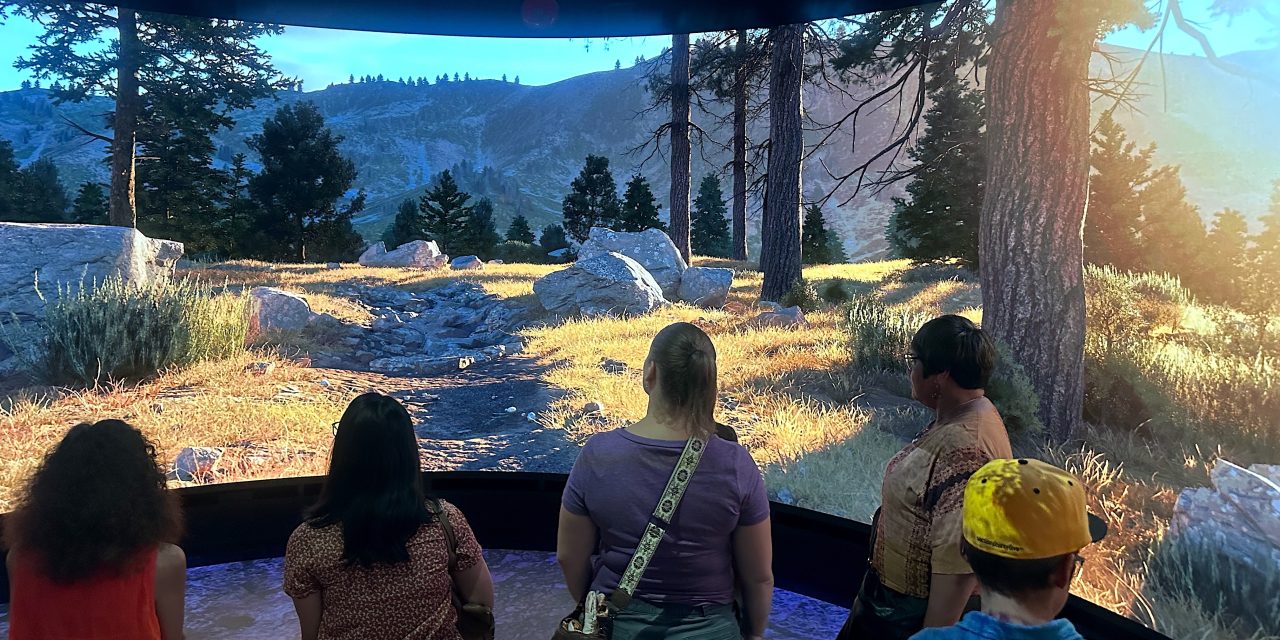
It was a double celebration for the Osoyoos Indian Band on Monday as the Nk’Mip Desert Cultural Centre held the grand opening of its new “Whispers of the Trickster” Immersive Theatre and also unveiled a recently gifted Francis Baptiste painting not seen for nearly a century.
A year in the making, and $800,000 later, the film and immersive theatre involved contributions from across the Syilx Okanagan community with elders, knowledge keepers and community members sharing and helping to guide the film to ensure its authenticity.
Speaking to the Times Chronicle at the opening, Jenna Bower, Executive Director of the Nk’Mp Desert Cultural Centre said they had been tentatively planning for a new film for a couple of years. “We knew we wanted to do a new film, something immersive, something fun,” she says.
Once they received the grant funding from the National Aboriginal Capital Corporations Association (NACCA) with the assistance of Indigenous Tourism BC last August, the wheels quickly went into motion.
This involved meetings and workshops with community members, members of their boards and council, discussing “what kind of experience do we want people to have, and what do we want them to get out of it, and what message do we want to share?”
The answer eventually coalesced around the Syilx Okanagan people’s oral stories and teachings known as captikʷł . Because they were limited in how much ground they could cover, Bower said the decision was made to not do a complete captikʷł, but rather to distill the essence of a few of them, pulling various characters from them.
“That way we can kind of hit a lot of the points that we all wanted to share and some characters that people wanted to see, like a nice big bear on the screen and eagle and coyote are a huge part of all of our stories, so we thought they would be a good collaboration.”
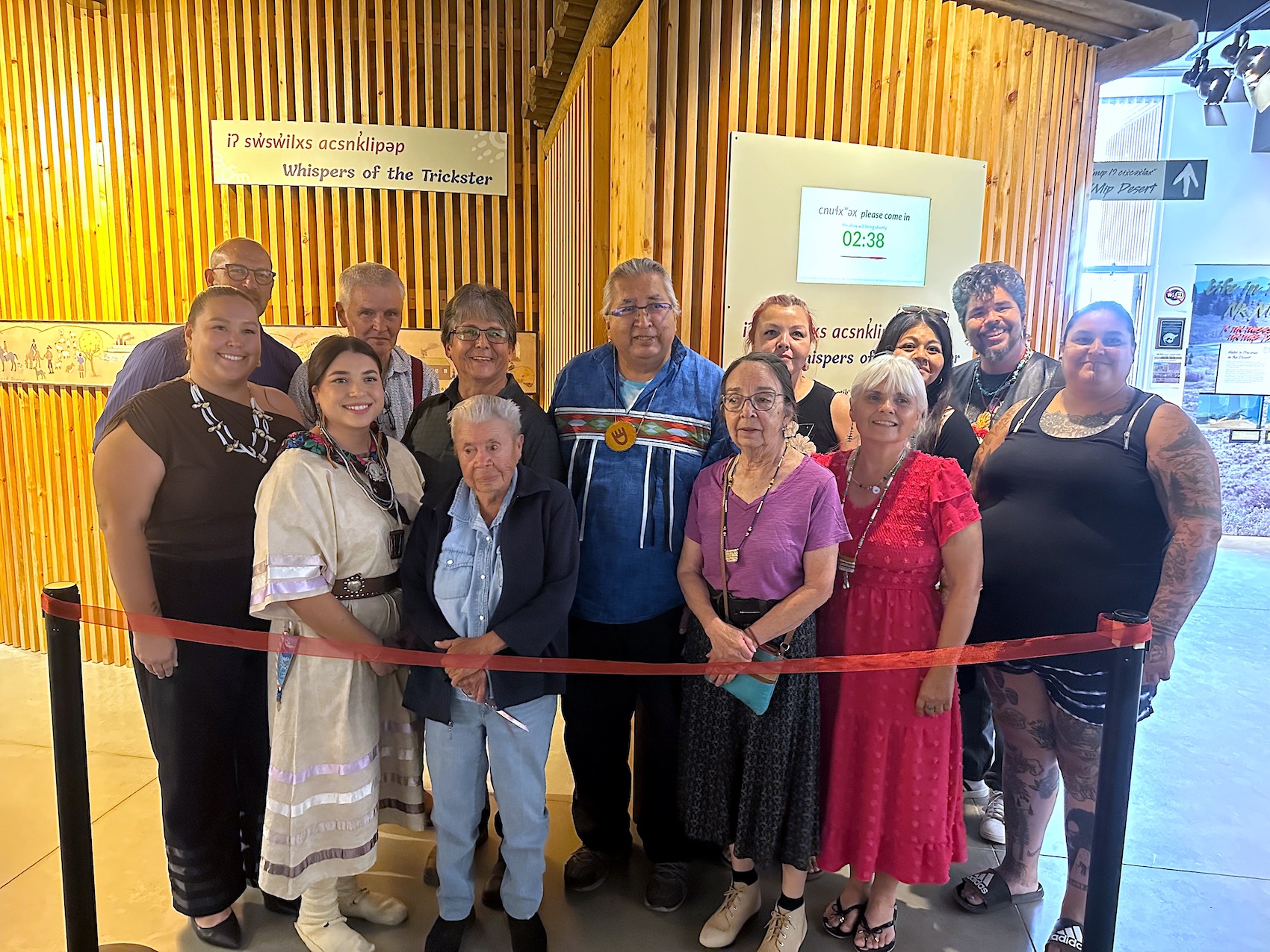
Led by the eldest elder, Jane Stelkia aged 95 (front, third from left), cuts the ribbon along with elders, council members and project contributors at the Nk’Mip Desert Cultural Centre on Monday, August 18. The theatre is open to the public from August 20.
Don Urquhart photo
Sharp eye on authenticity
Authenticity was vitally important Bower said, and having language speakers and knowledge keepers keenly involved ensured that was the case.
All three of the voice actors are language speakers – significant in itself given the small cohort of fluent speakers in existence – including Herman Edward who voiced skmxist (bear) in the film,
, and Aimee Baptiste who voiced the part of mlqnups (eagle). Sheri Stelkia who is fluent in the nsyilxcən language of the Syilx Okanagan also contributed largely, Bower said.
Because of the desire to produce something was as interesting and fun as it was authentic, meant it was a very involved process. Bower relates how Herman Edward, a knowledge keeper and story teller, helped guide the process with a deftness that reflects the culture.
“When I first sat down with him (as they did often, she says) for like three hours at a time where we just sat down, and I said this is the script, what do you think?
“And he wouldn’t say anything about it. He would just share stories from our captikʷł.” What he was actually doing was guiding Bower and the team in the right direction by sharing knowledge instead of saying this or that is incorrect.
In one particular case they had mixed up some of the attributes of the bear and eagle. Through his story telling they could see where they had gone wrong and what needed changing. “Because that’s how we do things (in our culture),” she added.
“It was a really important process that we made sure we didn’t rush, making sure that we understood. It’s something we’re all really proud of,” she adds in reference to the final product.
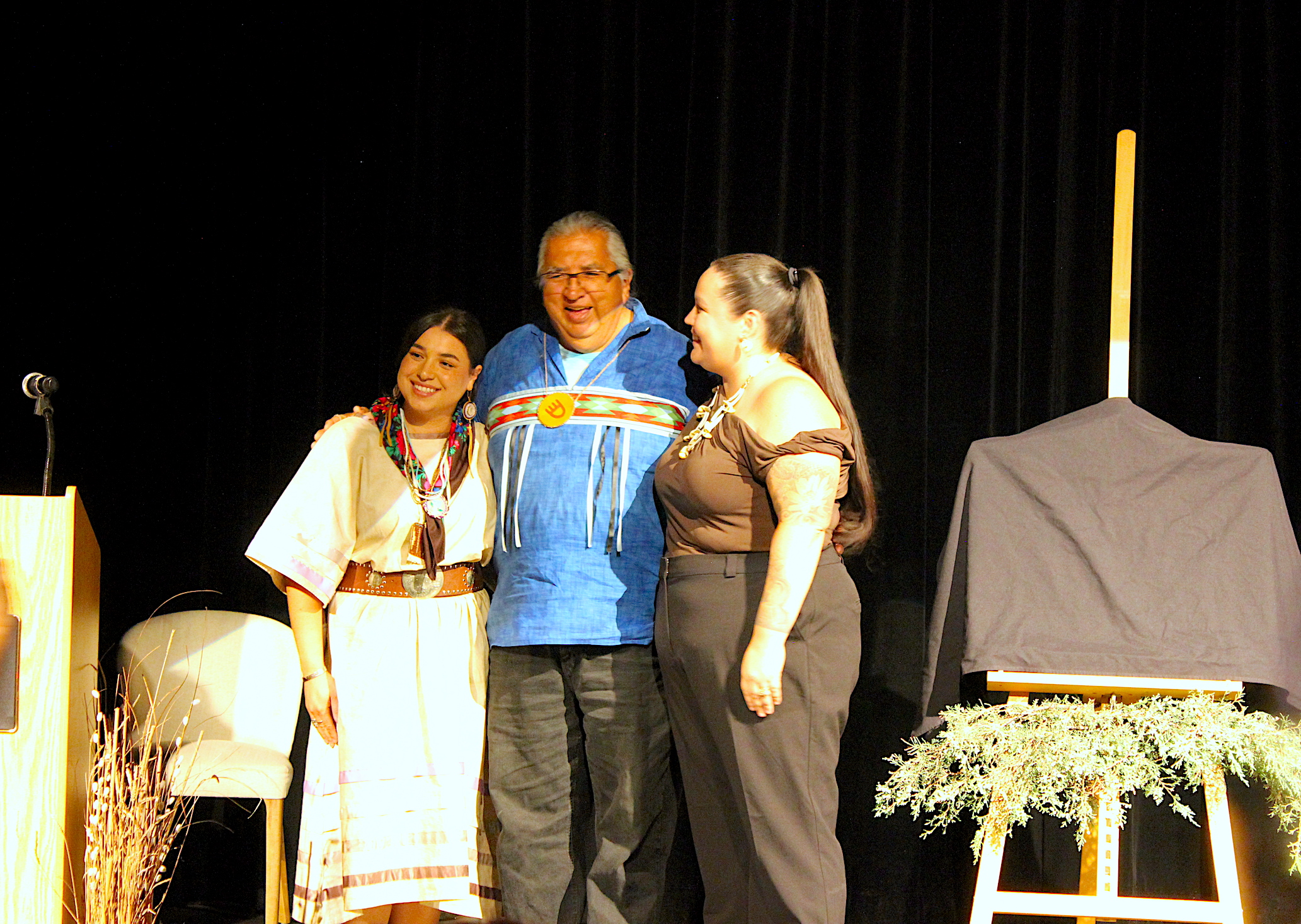
(l-r) Jenna Bower, Herman Edward the voice of skmxist (bear) and Taylor Baptiste. Don Urquhart photo
The experience is a happy marriage of high tech – where you can kick up virtual dust on the ground and splash water from the creek as you are surrounded by a stunningly realistic natural Okanagan setting both visually and aurally – with thousands of years of cultural knowledge soothingly communicated through story telling.
Bower who led the project acknowledged that, “When I was deep in this project, navigating this whole production, I was also doing my first year of my masters, and I was starting to feel a little bit overwhelmed, and I knew I needed another strong Okanagan by my side.”
The large art component of the film created the need for “someone who was really creative, who understood that world and who also understood our ways and our people.” And serendipity struck as Taylor Baptiste had just completed her studies at Emily Carr University of Art + Design in Vancouver.
She was brought on first as an art and cultural consultant but that role quickly grew to her co-writing the script alongside Bower, with the two clearly a dynamic duo of cultural renaissance. She’s now officially onboard as Cultural Coordinator at the centre.
And while the immersive experience is aimed at entertaining and informing non-indigenous visitors to the centre, does it have a role to play in helping educate their own community as well?
“I think it definitely does something, Bower says. “There’s a lot of hidden messages within the script, within what’s happening. If you’re a community member, I think they’d be able to pinpoint those messages. But then it’s also a really great learning opportunity for those who may not know and want to learn more,” she adds.
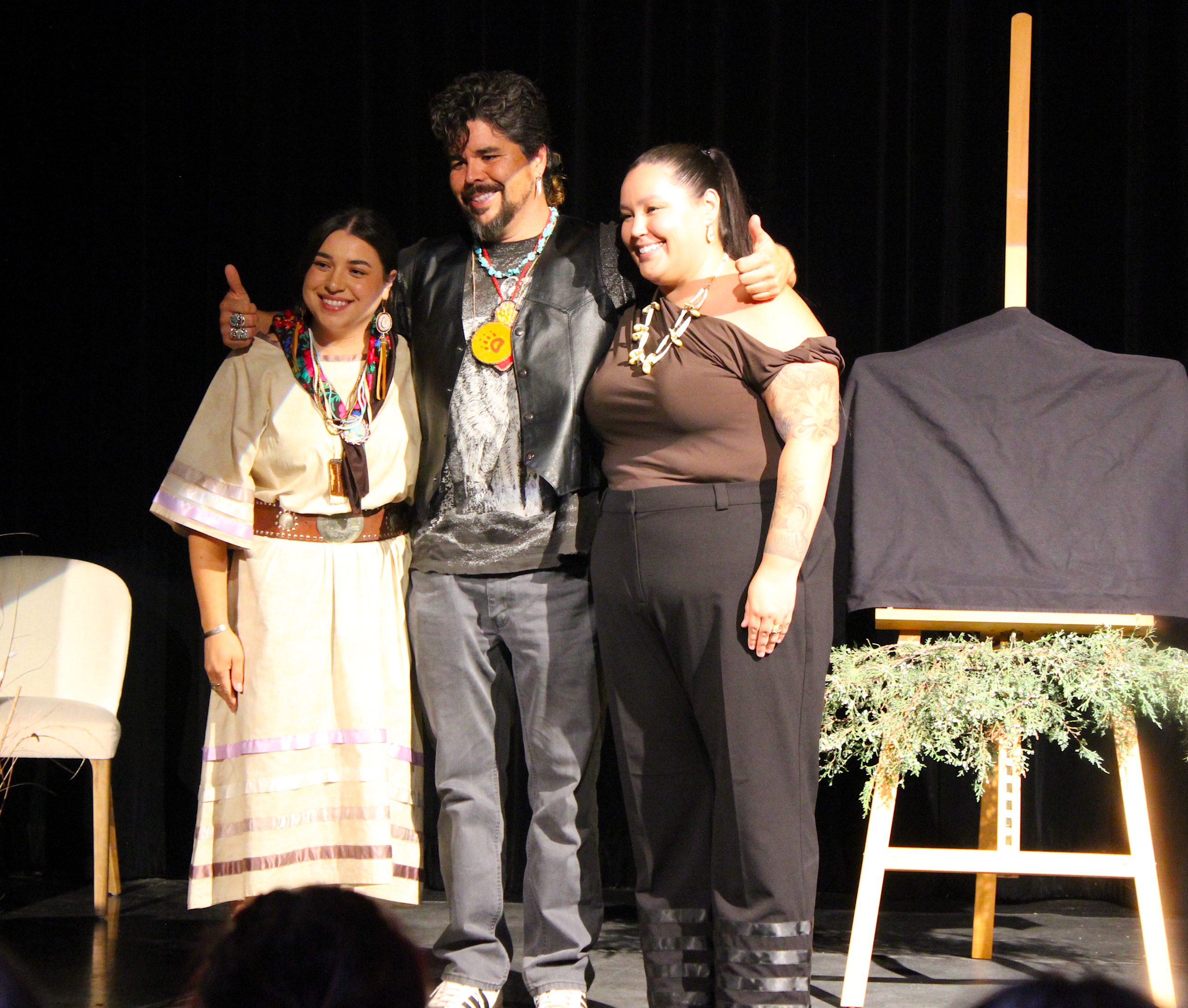
(l-r)Jenna Bower, Levi Bent who voiced the part of snk’lip (coyote which is known as the “trickster”), and Taylor Baptiste who laughed that Bent really is snk’lip.
Don Urquhart photo
A tale of two worlds
Bower observed that her journey of being involved with the centre has taken her to beautiful places out on the land, visiting pictographs, laughing and sharing with elders, but also required navigating the colonial world.
“Those moments have filled my spirit, but it’s also brought me into very colonial spaces like museums and archives where belongings are behind glass, often with vague labels like ‘Interior Salish’ or ‘Okanagan?’ and there’s no story, no voice and no connection.
“I don’t use the word artifacts. That word creates distance. These aren’t objects. They’re belongings, they’re relatives. They were created with love and purpose. They belonged to somebody. They belong with the families and the communities they come from,” she says with a growing intensity in her voice.
“It’s heartbreaking to stand before something sacred and not be able to speak to it in our language, or hold it in our hands. But now that’s changing. We have our own Class A repository, and we’ll be reaching out to get our belongings back. We’ll bring our ancestors and our belongings home where they belong, surrounded by our people, our ceremonies, and our songs in our language,” she said.
A relative returns home
That bid was given momentum on Monday with the unveiling of a painting by Taylor Baptiste’s grandfather, renown artist Francis Baptiste. As preparations were reaching a fever pitch last week to get the immersive theatre ready for the grand opening on Monday, a phone call came out of the blue from a woman in West Vancouver named Pippa Cassidy setting everything on its head.
To make a long story short Cassidy had come across a painting given to her by her grandmother who had purchased it in the 1930s when she was living on the Alkali Ranch beside the Alkali reserve, near Williams Lake.
As told by Taylor Baptiste, Cassidy was curious and began Googling the artist etc., ultimately identifying the painting as being Syilx Okanagan. Baptiste would always sign his paintings using his Indian name: Sis-hu-lk.
Baptiste continues: “So she called up the centre, and we got to talking, emailing, texting, calling, non stop all day. On Friday, I told her about the history of the Nk’Mip Day School, the children and their artwork and their teacher, Anthony Walsh, and how he encouraged the children to depict their daily life and stories through artwork.
“After learning more about it, she graciously made the decision to donate the painting.” Cassidy was invited to the grand opening and what had also become a “grand unveiling” but was unable to make it.
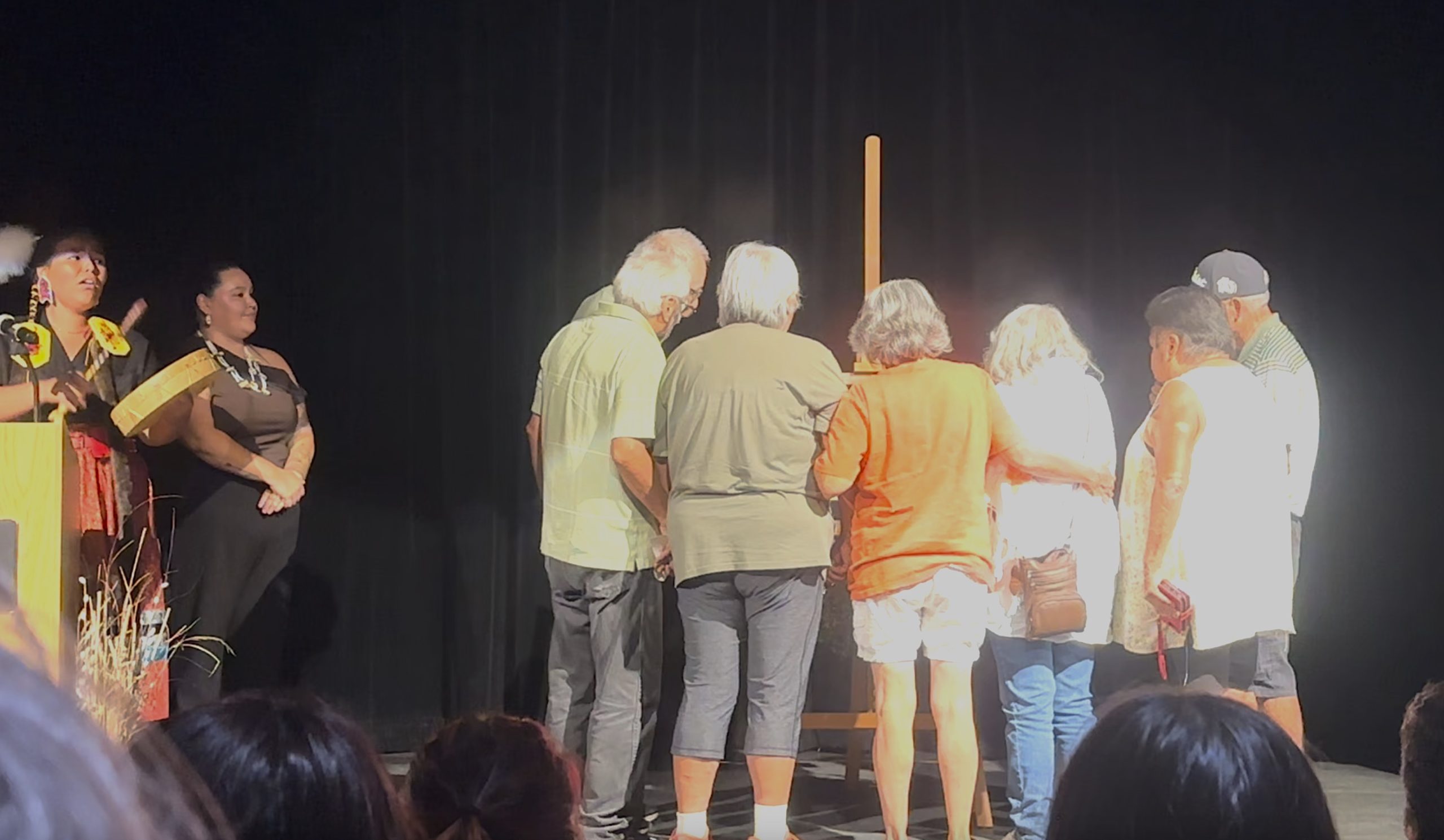
Relatives of Francis Baptiste get the first look at the returned painting. Respecting the OIB community’s wishes, the Times Chronicle did not capture any digital images of the painting.
Don Urquhart photo
Her voice cracking with emotion, Baptiste said, “We are welcoming more than just an artwork. In our way of seeing art is never just decoration. It’s a living presence, a direct connection and bridge between generations, a doorway into memory.
“This is a relative . . . When my grandpa painted this, he wasn’t simply creating an image, he was carrying forward the stories and teachings that had been entrusted to him, and he was leaving behind a vision for his children, his grandchildren and the generations yet to come.
“His brush strokes were guided by more than his own hand. They were guided by our captikʷł (teachings), by all the living beings and relatives of the tm̓xʷúlaʔxʷ, the land itself. In that way, this artwork is not something frozen in time, but something that continues to move, breathe and teach.
“For us as Okanagan people, we understand that knowledge is carried in many forms, in stories, in songs, in dances and also in our artwork. These are not separate ways of knowing,” she said. “They are all one in the same and this painting is not just a record of my grandpa’s vision. It carries his spirit, and through it, he is still teaching us the colours, the shapes and the movements in it are another language, another way of remembering who we are and where we come from.”
She said that celebrated as the homecoming of a relative the spirit within it has been reawakened. “We are surrounding it with the same rhythms and songs that our grandpa and the children of the Nk’Mip Day School knew, the same heartbeat of this land.”
The children of Francis Baptiste, Taylor’s aunts and uncles, were then invited on stage where they formed a semi-circle around the painting to view it and welcome it home again, accompanied by drumming and song. They then moved aside to enable the larger audience to view the painting for the first time. The painting will enjoy pride of place at the centre.