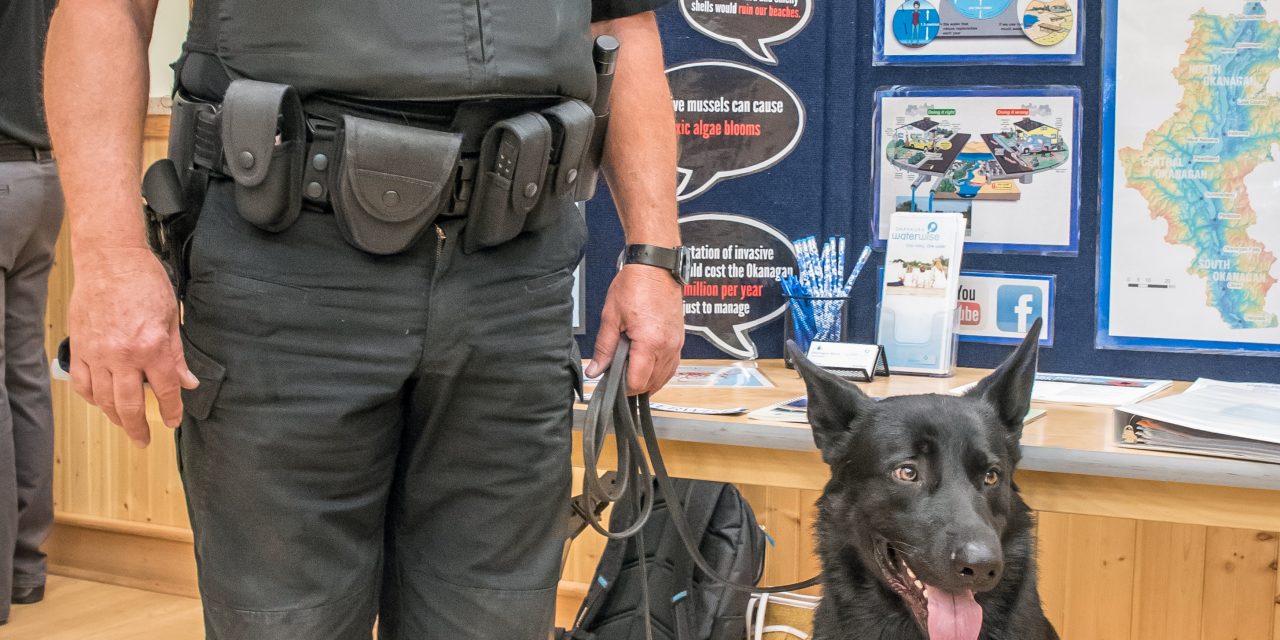

Staff Sgt. Josh Lockwood of the Conservation Officer Service introduces Kilo, the mussel-sniffing dog, at the annual general meeting of the Okanagan Basin Water Board. (Richard McGuire photo)
By Richard McGuire
Osoyoos Times
The Okanagan Basin Water Board (OBWB) has written the provincial government in its efforts to close a loophole that could lead to an infestation of invasive mussels in B.C. waters.
Anna Warwick Sears, executive director of the OBWB, last week wrote to George Heyman, B.C. minister of environment and climate change, reminding him that closing this loophole was the number one priority on a list of action items the OBWB gave to his ministry more than a year ago.
The loophole means that out-of-province boats can be launched in B.C. waters without being inspected if they enter the province without passing an open inspection station.
Invasive zebra and quagga mussels have been spread throughout many parts of North America, mainly on recreational boats that have not been properly cleaned, drained and dried.
“We are concerned that four years after the first roving inspections were conducted in B.C., there is still no legal requirement for out-of-province watercraft to be inspected prior to launching in provincial waters,” Sears wrote.
“The current legislation dictates that if a watercraft enters B.C. and if it encounters an open inspection station on route, it must stop for inspection,” Sears continued. “However, this leaves a gap for watercraft that enter outside of inspection station hours, outside of the inspection season (April to October), or through routes which are not monitored. We feel that the province’s number one priority for mussel prevention should be addressing this legislative gap.”
Sears said the OBWB believes there is still sufficient time before the 2019 boating season for the province to pass such legislation and ensure that inspections are available in centralized locations for boaters who don’t report to a roadside station.
“We recognize that this legislative change is more cost-effective than providing 24-hour inspection stations, which have been called for in the past,” Sears continued. “This change would also allow for spot-checking out-of-province watercraft for proof of an inspection at local boat launches, enhancing enforcement of the law.”
• Read more: OLWQS Now Testing Osoyoos Lake For Invasive Mussels
In this year’s inspections, a total of 25 watercraft were found to be carrying adult invasive mussels.
Mussel-fouled boats came from Ontario (16), Arizona (3), Manitoba (2), Michigan (2), Utah (1) and Nevada (1).
Three of those infested boats were destined for the Okanagan.
The inspection program received advanced notice for 20 of the 25 mussel-infested watercraft either from another jurisdiction – such as Alberta, Montana, Idaho or Washington – or from the Canada Border Services Agency.
“It’s too important to not to do everything we can,” said Sears. “It’s going to cost us millions and cause, not only hardship, but heartbreak if Okanagan Lakes are spoiled by invasive mussels.”
A 2013 study for the OBWB estimated the cost of invasive mussels entering Okanagan waterways would be $43 million a year just to manage.
Sears acknowledged that there has been progress at the provincial level with the province now providing stable funding for mussel inspections.
Inspection stations increased from 10 in 2017 to 12 in 2018 with 62 auxiliary conservation officers.
As well, it was announced that a second mussel-sniffing dog was being trained to join the effort in 2019.