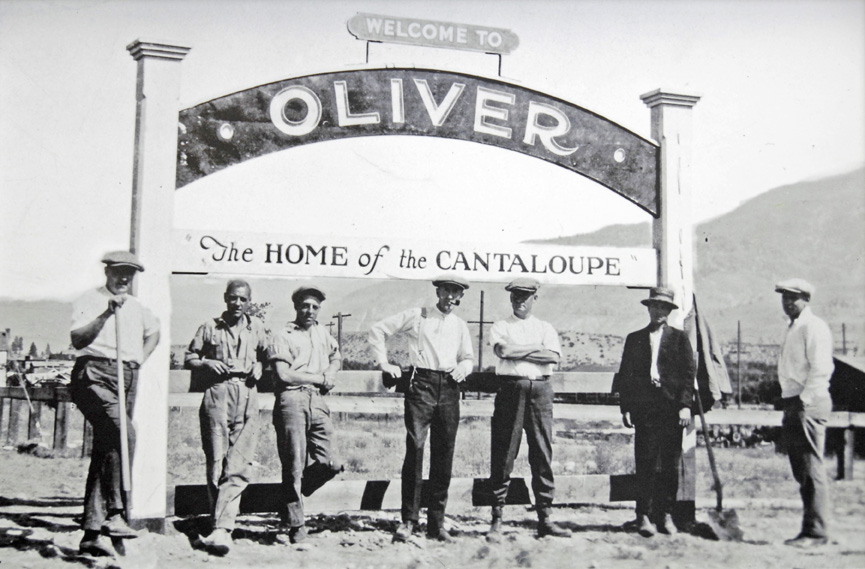

Photo courtesy of the Oliver and District Heritage Society (archives)
As soldiers began to return home from the war in early 1919, British Columbia’s Premier, “Honest” John Oliver and his cabinet realized they had a problem.
The economy had transitioned from wartime to peacetime, and in doing so, had lost its footing, and the province wasn’t exactly economically robust to begin with. But Oliver, who was a farmer, got an idea.
Agriculture, he decided, would be the method by which he would help BC meet this economic challenge.
To accomplish his goal, Oliver launched what is arguably considered to be one of the first major development projects in the province. That project became known as the “ditch.”
“The ditch carries the lifeblood of the valley, water, it is the reason the Town of Oliver exists,” said Oliver and District Heritage Society president Sue Morhun at their annual general meeting on April 16.
“Yet most people today do not realize it is right under their feet as they do business around town. Not so for Greg Norton.”
In fact, she continued, it was the ditch that initially brought Norton’s ancestors to Oliver, where they have resided for five generations.
Morhun invited Norton, who is now a well-known orchardist, to entertain society members with tales of his rambunctious youth, careening down the spillway.
“Long before it became his place of work, the concrete canal that begins its life under the shadow of McIntyre Bluff was the personal playground for Greg and his friends growing up in the 1950s and 60s,” Morhun explained.
However, well before that, the structure was what Norton’s grandfather Charles, and others wrestled to build in the early 1920s.
“You had men coming back from the war in various states of mental and physical disarray and then they decide to build a dam right by McIntyre Bluff. Can you imagine what an undertaking that was? Can you imagine what it took to pull that off?” Norton asked the audience. “They had to be way more than engineers.”
The project was called the Southern Okanagan Lands Project (SOLP). It was intended to irrigate 8000 acres of semi-arid desert land. It included the diversion dam, 20 miles of concrete ditches, 27 flumes, and a wood stave siphon.
“It was definitely daunting,” Norton said of the construction phase.
He pointed out the harsh land conditions, which were “sandy and flat.”
But the hard work of the dozens of men that put countless hours of their “blood and sweat” into the project paid off. The ditch was completed in 1927 and resulted in the development of one of the most successful tree fruit and viticulture areas in Canada. It was 25 miles long.
Norton recalled his personal experience with the ditch. For the rowdy young boy and his pals, the ditch was more than a concrete canal. It was a haven, a private bike park, a skating rink during the winter months, and occasionally even a swimming pool.
“We weren’t supposed to do any of that stuff, and I remember getting into plenty of trouble for doing the stupid stuff we did. It was dangerous, but it was worth it!”
Norton later found a way to prosper from the bounty produced as a result of the irrigation the canal allowed.
“My grandmother grew asparagus,” he said. “I remember spending my whole morning picking it and then loading as much of it as I could on to my bike and taking it into town to sell to the rich people for quite a bit of money – that was my first business.”
As Norton got older, the ditch held a more significant meaning for him. He said the ditch indirectly gave him the confidence to propose to his wife.
“I had a full-time job because of the ditch. I owe a lot to my grandfather, and the men who built it.”
To find out more about the Oliver and District Heritage Society or to become a member visit www.oliverheritage.ca
Erin Christie
with files from Sue Morhun
Oliver Chronicle