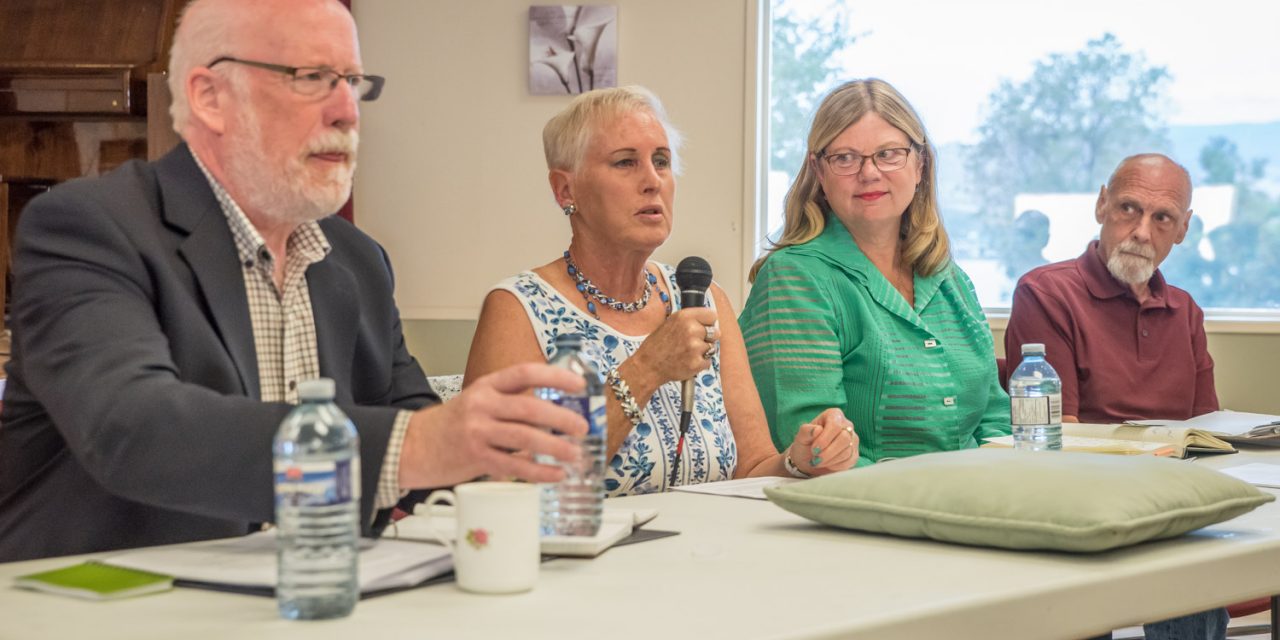
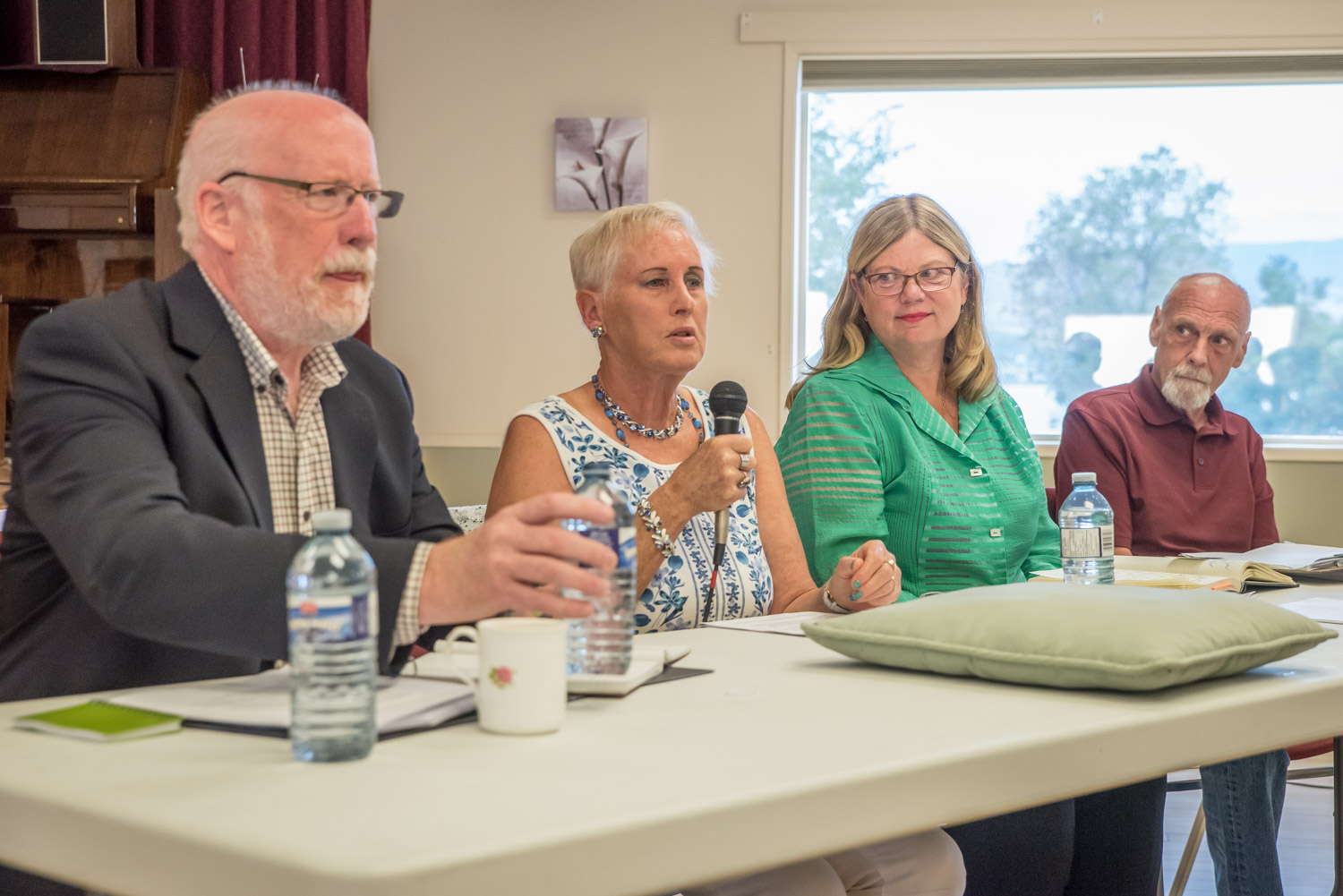
Moderator Cheryl Halsted (second from left) introduces the federal election candidates in South Okanagan-West Kootenay at an all-candidates forum Monday at the Osoyoos Seniors Centre. From left are Richard Cannings, NDP; Halsted; Connie Denesiuk, Liberal; and Brian Gray, independent. Conservative Marshall Neufeld did not attend. The meeting was sponsored by the Wine Country Retired Teachers Association. (Richard McGuire photo)
It was billed as a federal candidates forum on seniors issues, but the Conservative candidate was conspicuously absent at the Osoyoos Seniors Centre Monday afternoon.
The two major candidates who were present – Richard Cannings of the NDP and Connie Denesiuk of the Liberals – seemed to agree with each other more often than they disagreed, even favourably acknowledging each other’s arguments and campaign efforts.
Also at the table was independent candidate Brian Gray, of Penticton, who has now received the 100 signatures to become an official candidate.
The other independent candidate, Doug Pederson, of Osoyoos, only has about a third of the required signatures, so he watched from the audience.
It was the absence of Conservative Marshall Neufeld that prompted the first question – more of a statement – from Osoyoos senior Art Molenkamp.
“It’s a shame that Mr. Neufeld didn’t show because he cannot be scrutinized by this audience here,” Molenkamp said.
Organizer Stefan Cieslik, president of the Wine Country Retired Teachers Association, which sponsored the event, told the audience that Neufeld responded to the invitation by saying he had other commitments.
“He wasn’t deliberately boycotting this meeting,” said Cieslik.
Media reports from across Canada say many Conservative candidates have pulled out of all-candidates meetings and many are refusing to do interviews with national media, although they have been more willing to speak to local media.
The Osoyoos Times contacted Neufeld by email after the meeting and he sent this reply: “I will be accepting multiple debate invitations across the riding. My primary focus for this election is connecting directly with voters at their doorstep, but I also believe it is important that debates happen across this geographically large riding. I intend on accepting at least four debate requests across the riding. That will include one in the Oliver and Osoyoos area.”
Moderator Cheryl Halsted urged participants, including the audience, to be civil and to the point and not to attack other parties or leaders.
That didn’t stop a few members of the audience from taking the odd swipe at Prime Minister Stephen Harper.
When Oliver veteran and senior Glen Krisher asked the candidates what they would do for veterans and low-income seniors, he couldn’t resist a dig at the Conservatives on this issue.
“What the Conservatives have done for retired veterans is not very nice,” he said.
Cannings addressed the seniors’ side of the question, pointing out that an NDP government will increase spending on the Guaranteed Income Supplement (GIS) by $400 million.
“There’s a myth out there that seniors are wealthy,” Cannings said. “It’s just not true. Seniors are the poorest age group of any age group in Canada.”
Seniors should not live in poverty, especially veterans who have gone the extra step of putting themselves in harm’s way, he said.
Denesiuk said a Liberal government would re-open the Veterans Affairs offices closed by the Conservatives and would ensure that people are there to assist veterans with the process, since not all are comfortable applying online.
“I think it’s shameful the way we treat people who have risked their lives,” she said. “They’ve given us their back. We should be having the back of the veterans.”
Liberals would also revisit the decision to make veterans take lump-sum payments for disability benefits, instead giving veterans a choice to opt for regular payments.
Denesiuk also said the Liberals would increase the GIS by 10 per cent.
While many of the roughly 50 people attending were seniors and the event was held at the seniors centre, not all questions were on seniors’ issues.
Linda McWhinnie asked the candidates where they and their parties stand on the proposed Northern Gateway pipeline that would send oil by tanker through B.C.’s coastal waters.
First to respond was Gray, the independent, who said pipelines are the best way to transport oil, though he didn’t think Northern Gateway was needed as Asian countries such as China are turning to other sources for oil.
He also supports a future move from fossil fuels to nuclear energy.
Denesiuk reaffirmed the Liberals strong opposition to Northern Gateway, adding there doesn’t need to be a choice between the environment and the economy – you can have both.
Liberals favour putting a moratorium on tanker traffic in Hecate Strait, saying it would be just a matter of time until a tanker goes aground, said Denesiuk.
Cannings also reaffirmed the NDP’s opposition to the Northern Gateway, calling the environmental dangers “too risky to even contemplate.”
Cannings and Denesiuk said confidence in the National Energy Board must be restored and that government should look at increasing refining of bitumen in Canada rather than sending refining jobs off shore.
The NDP and Liberal candidates also agreed on other issues, such as the need to get the federal government talking again to the provinces to deal with such issues as increased medical costs for an aging population, dementia, mental health, homelessness and working to expand public health care to include prescription drugs.
On the issue of pharmacare, Cannings pointed out 10 per cent of Canadians can’t afford to fill their prescriptions.
Studies show that such a program would more than pay for itself with savings to the health care system, he said.
Denesiuk agreed pharmacare would result in savings through bulk buying of generic drugs.
“We will do it,” both Denesiuk and Cannings said when asked a follow-up question on pharmacare.
And both major candidates agreed they support a national park in the South Okanagan, though Gray said unless he is convinced otherwise, he is against a national park.
There were differences of nuance between the two main candidates on a few issues. Asked by Katherine Smith, a harm-reduction outreach worker from Penticton, where they stood on legalization of marijuana, Denesiuk took the stronger position in support of legalization.
Admitting it has taken her time to come to that position, she said she’s heard from young people that it’s easier for them to buy marijuana on the black market than to buy cigarettes, which are legal, but regulated.
“If it’s regulated, younger people will have a harder time getting their hands on it,” she said. Decriminalization doesn’t take it out of the hands of criminals, who would continue to sell it, she added.
Cannings said the NDP would move quickly to decriminalize marijuana, but would look at how well legalization is working in other jurisdictions.
“It’s amazing when I go door knocking how many people are using marijuana in the constituency,” he said, adding that people shouldn’t be thrown in jail for possessing small quantities.
Asked by Arthur Halsted, of Okanagan Falls, what they considered the most important issue to address if elected, both Cannings and Denesiuk agreed that both the economy and environment are important. The difference between them was a matter of emphasis.
Denesiuk said it is important to kickstart the economy and pointed to the Liberals’ plan to invest more heavily in infrastructure, including green infrastructure, while interest rates are low.
“The economic horse pulls the social cart,” she said, suggesting that a stronger economy is needed to put people back to work and to afford spending on social issues. We have an infrastructure deficit in communities throughout our riding.”
Businesses come to a standstill when infrastructure breaks down, she said.
Cannings, however, said he would put the two priorities the other way around.
“My main concern is the environment and specifically climate change,” he said. “We have to let the environmental horse pull the economic cart on this one.”
He added that turning to renewable energy would drive good jobs in this sector across the entire country.
On several occasions, Gray said he agreed with the other candidates and had little to add, or he pointed out he couldn’t speak on behalf of a party with a chance of governing.
He did, however, voice strong opinions on several issues.
The most important issue that Canadians face is internationally, said Gray, who believes a future worldwide economic crash is likely, which would increase the threat of war as political unrest in the Ukraine and Middle East escalate.
In response to the question about veterans, he said Harper has given more than $600 million to a “fascist and Nazi regime in Kiev,” referring to providing assistance to Ukraine, instead of spending on Canadian veterans.
In fact, $400 million of the $602 million Canada has given to Ukraine was in the form of low-interest loans.
RICHARD McGUIRE
Osoyoos Times
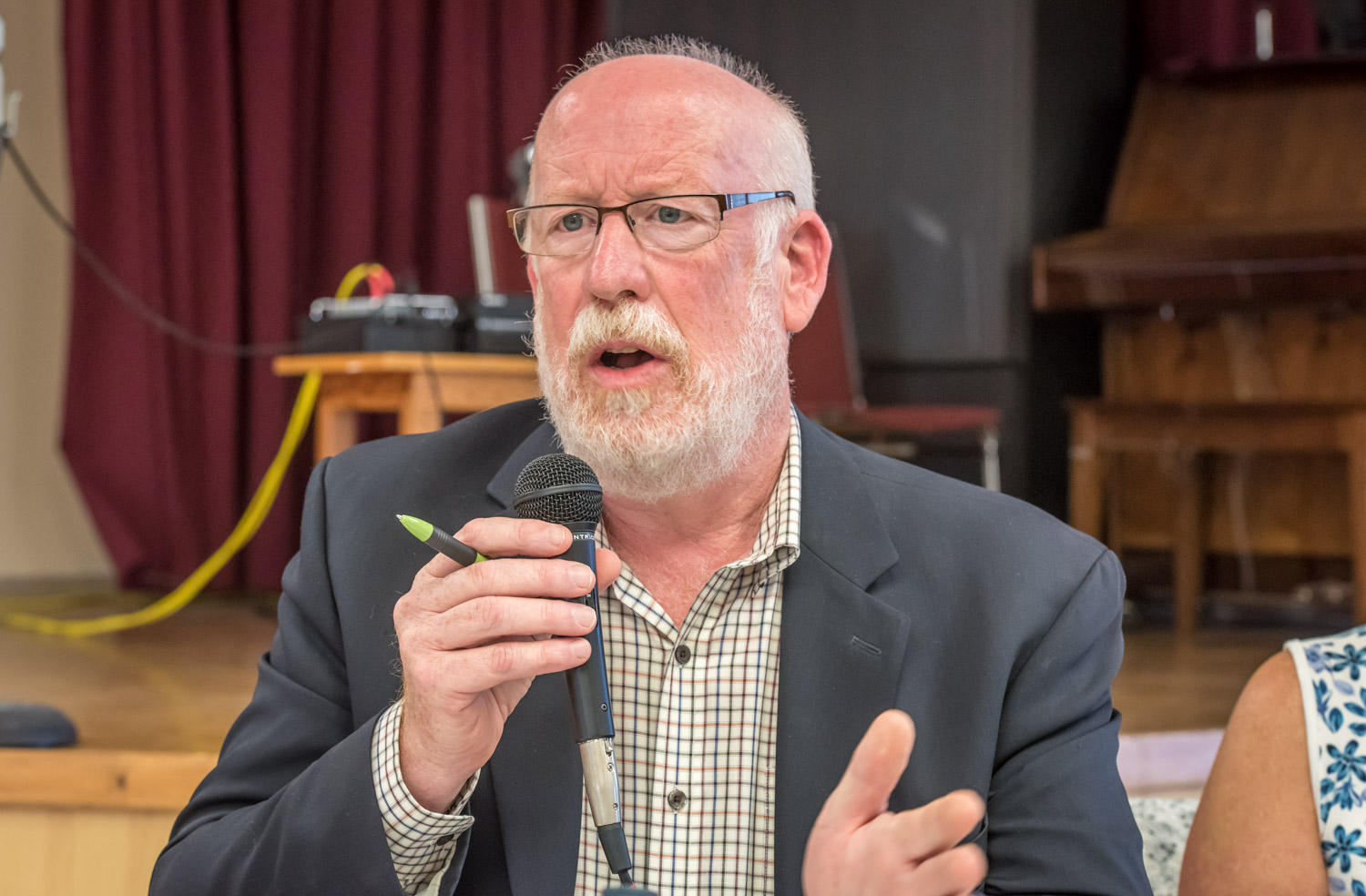
Richard Cannings, NDP candidate
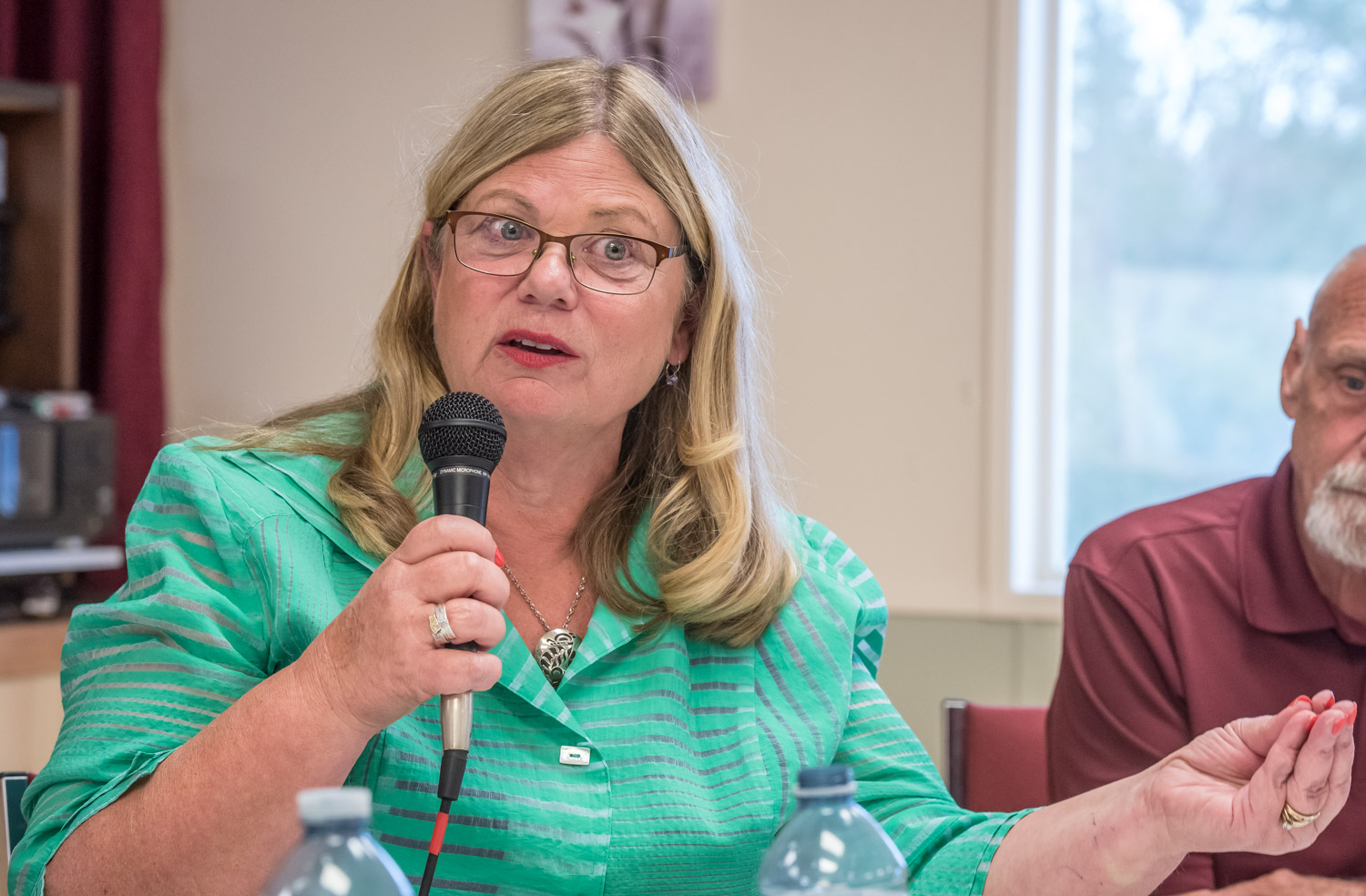
Connie Denesiuk, Liberal candidate
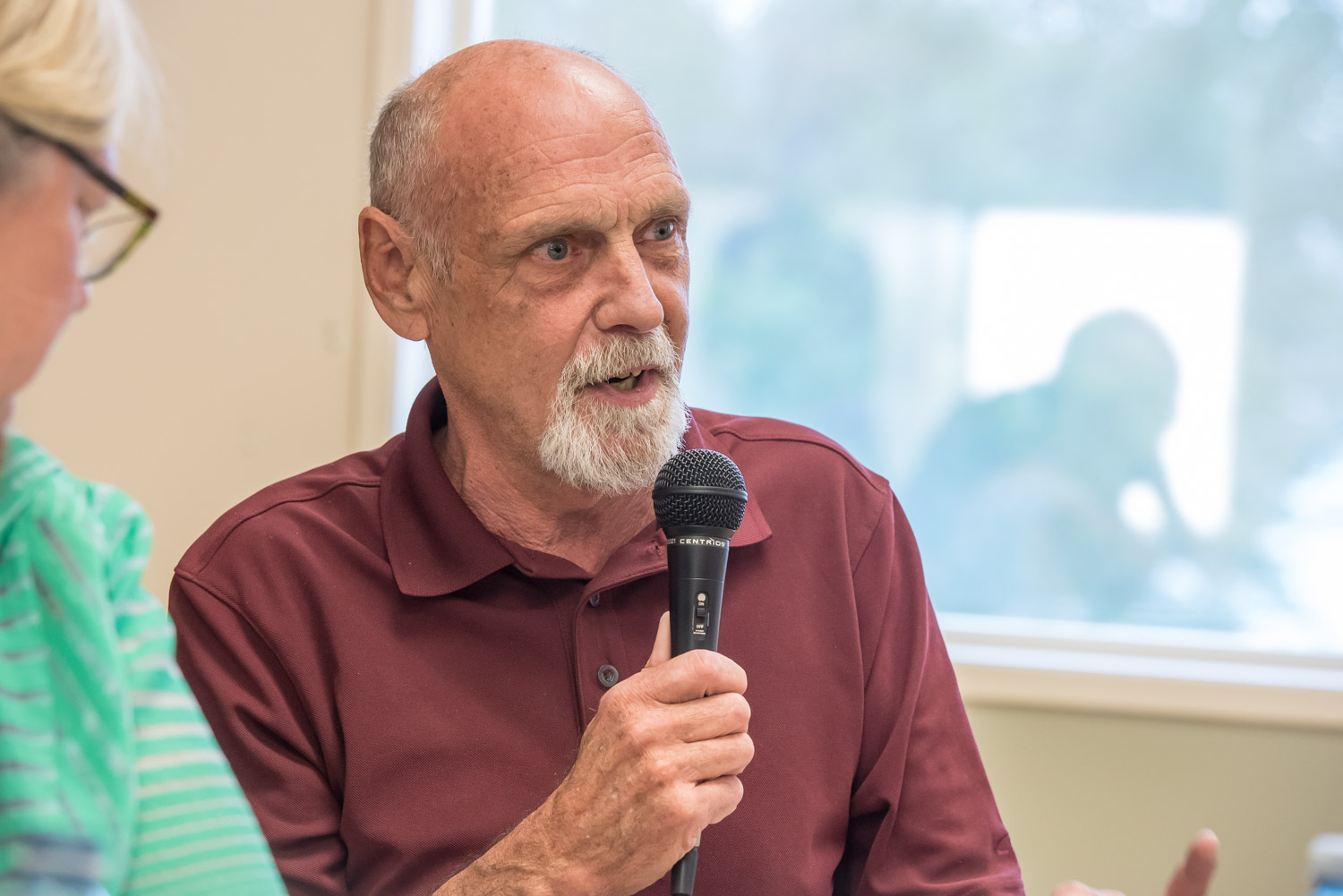
Brian Gray, independent candidate
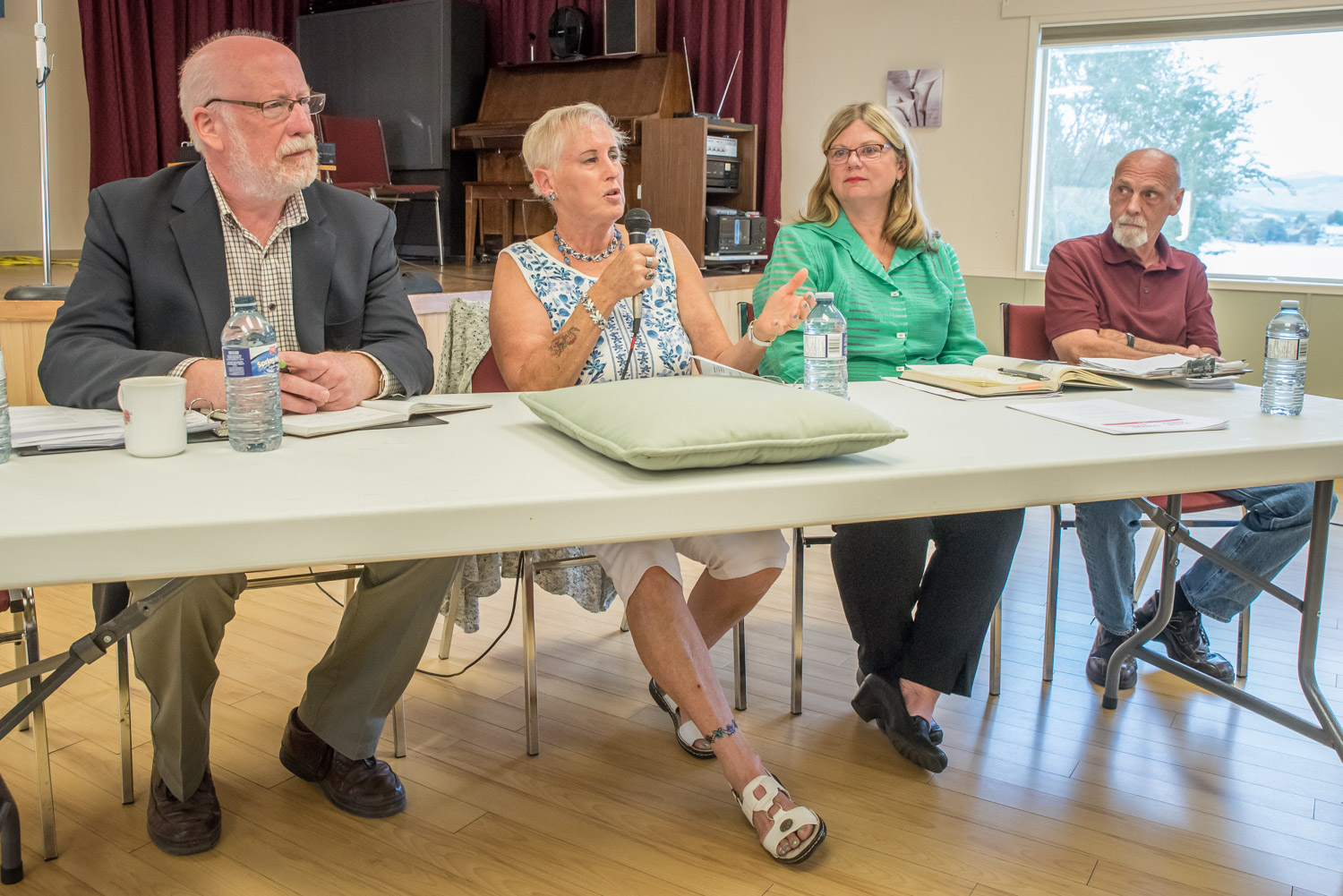
Moderator Cheryl Halsted (second from left) introduces the federal election candidates in South Okanagan-West Kootenay at an all-candidates forum Monday at the Osoyoos Seniors Centre. From left are Richard Cannings, NDP; Halsted; Connie Denesiuk, Liberal; and Brian Gray, independent. Conservative Marshall Neufeld did not attend. The meeting was sponsored by the Wine Country Retired Teachers Association. (Richard McGuire photo)