By Sebastian Kanally, Times Chronicle
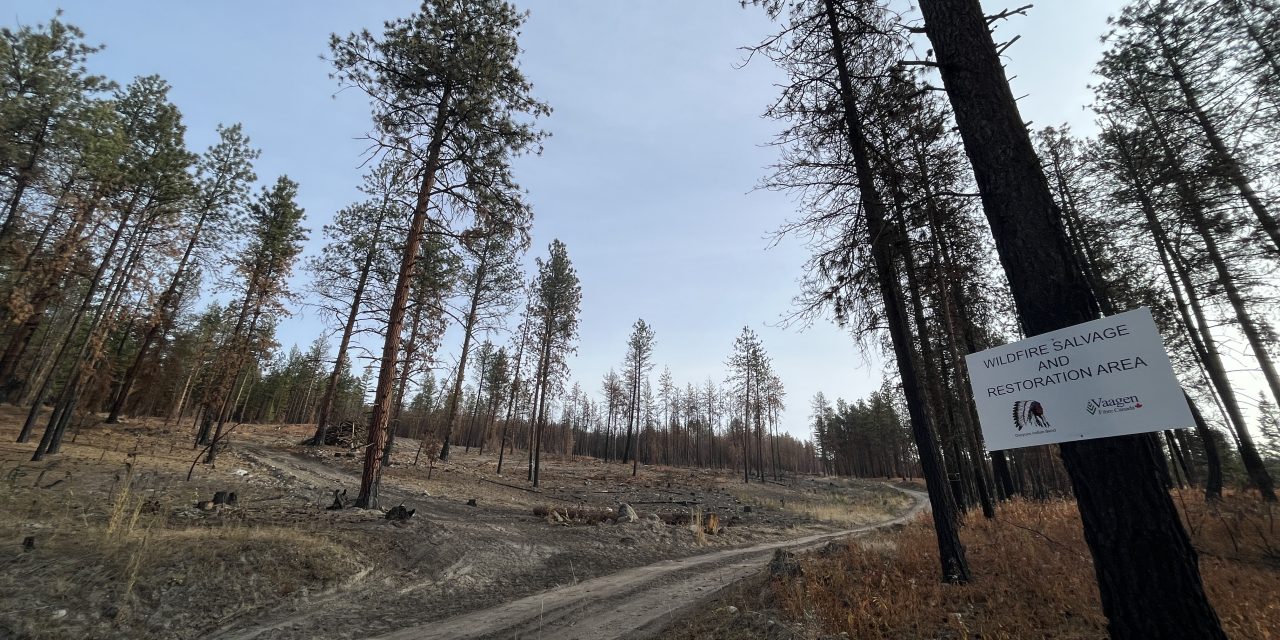
Rising from the ashes of the Nk’Mip Creek wildfire of 2021 a unique partnership between the Osoyoos Indian Band (OIB) and a forestry company is being heralded for its innovative and holistic approach to restoration.
The OIB and Vaagen Fibre Canada are being praised for their collaboration which prioritizes cultural values, historical uses of the land, and ecological recovery, according to Peter Flett, a Registered Professional Forester (RPF) who works for both Vaagen and the OIB in their forestry venture.
An estimated 20,000 hectares of forest were burned in the months-long fire, and because it also impacted the OIB’s traditional territory, “there was motivation to act quickly to give the land a better opportunity to recover,” Flett explained.
From the beginning of the project Flett says the company connected with OIB community members, ranchers, hunters, gatherers, and “made sure to incorporate their values and interests in the planning process.”
They did this by completing “field visits with many of those folks to walk the area and see which areas need to be protected, which areas were burnt severely enough that we needed to take action and restore those areas. Or which areas would be better to revegetate and recover on their own.”
Those field visits combined with the knowledge of the local community members was “key for this project because the fire was so close to the community, and the areas that have been used by community members for so long.”
Flett appreciates the fact that Vaagen has a strong connection in the area with the OIB, and were therefore able to take these steps to “make sure all the values and interests are taken into account before any actions happen out there on the land.”
All phases of planning, operations, and restoration have provided full-time, part-time, and contract employment to OIB members, the Nk’Mip Forestry crew, and local contractors.
“The restoration in this area is going to take many years. What we are focusing on right now is trying to revegetate the areas, and that can be planting trees, planting shrubs, and just trying to stabilize the soils out there,” Flett illustrated.
Flett said stabilizing the soil is their immediate focus because after the fires burn at such high temperatures in high intensity areas a lot of the organic layers on top of the soil burn off. This leads to a high risk of soil erosion, and possible slide events.
After the soils begin to stabilize, the areas will start to grow grass and revegetate over time. Flett explained that it would be impossible to restore every square foot of the forest, but there are areas that they can focus on, such as those frequented by the community and band members.
Full restoration will only occur naturally, on their own, and “that will go on for a hundred years or more, through natural processes.”
As for human management of restoration, “that will go on for at least five to ten years. We will be monitoring areas, even up to 15 years depending on how things go, so it’s an ongoing project we will just keep revisiting every year,” Flett said.
Fires are natural to the boreal forest, but there are ways to avoid the extremely devastating large fires.
Flett talked about the role wildfires play in the ecosystem: “It’s tough, it’s a double edged sword, you want to avoid impact to communities but these fires are natural to these areas and you know these areas have burned many times in the past, and will burn again.”
“So it’s just a matter of being proactive and trying to treat areas near communities, trying to reduce fuels, trying to reduce the potential for catastrophic wildfires, and that extends further up the hills and further away from communities.”
These areas have built up a lot of fuels over the last few decades, and fire suppression efforts have been a big focus over the last 30 years, he notes. Flett further explained that,”these fuel accumulations can build up and then what you get is far more intense and more severe fires.”
“Trying to strike that balance between keeping communities safe and not having the intense wildfires that really burn hot and burn right down to mineral soil,” is a challenge he says. These types of fires “really hinder the recovery,” he adds.
Flett says it’s preferential to have more moderate fires that burn off the fuels and maybe some vegetation, because “you get regeneration of plants and trees and you still have the ground cover which is not damaged.” This is an important part of forest management, he adds.
The project has attracted the industry’s attention and will be featured in the spring edition of the Association of British Columbia Forest Professionals (ABCFP) magazine.
“We are grateful for the opportunity to share this local story in a provincial magazine as we hope it inspires others in the forest industry to prioritize collaboration during planning and implementation in their recovery efforts too,” Flett said.