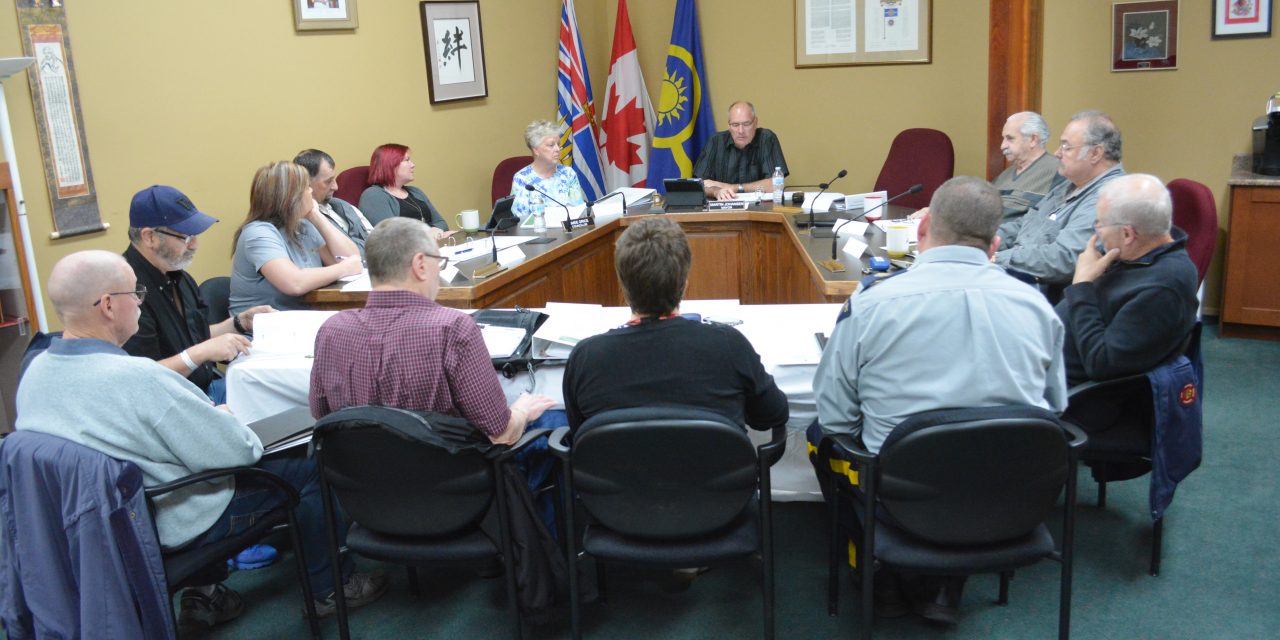
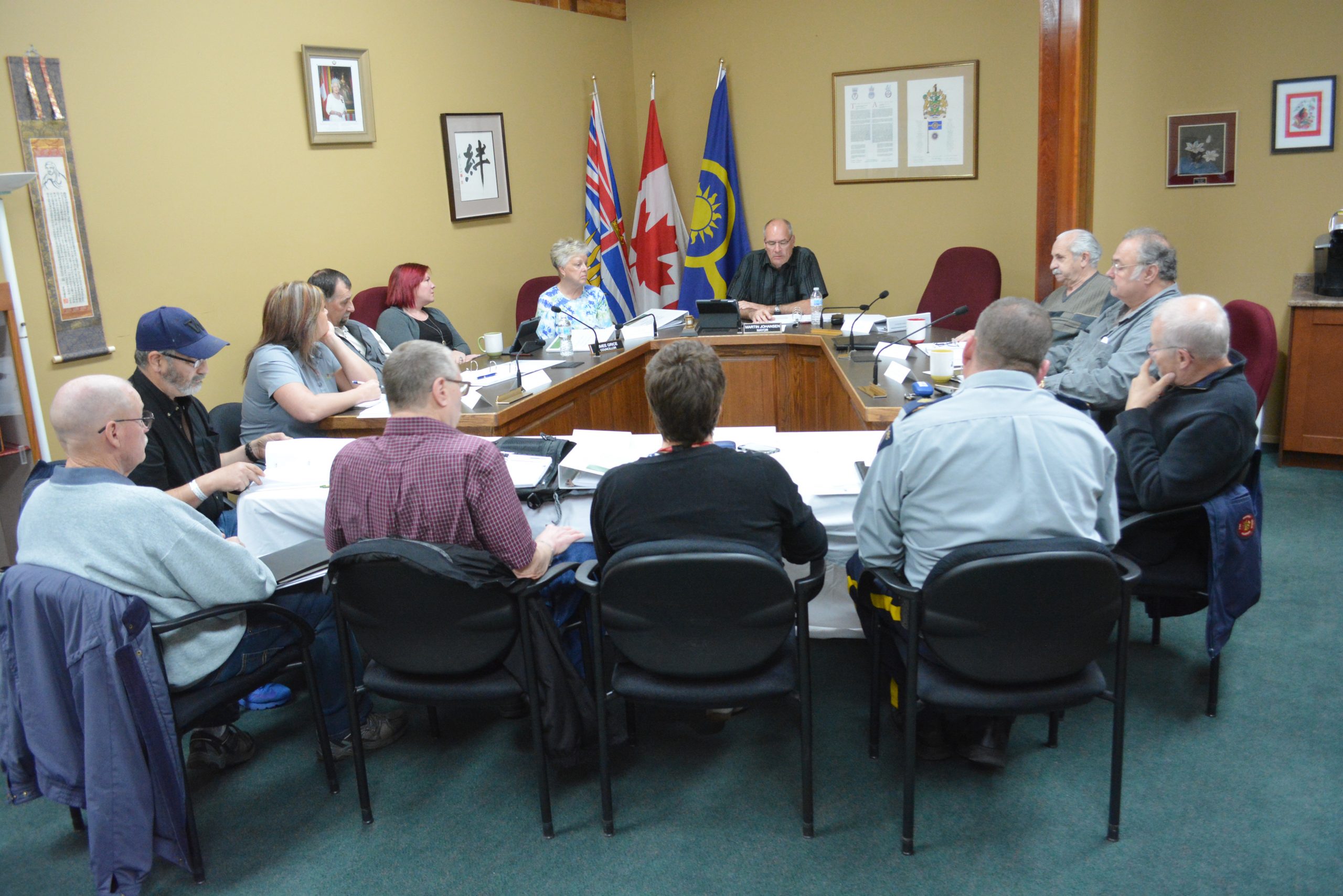
The Public Safety and Crime Prevention Committee met for the first time in Oliver on Monday. Members include Osoyoos Mayor Sue McKortoff, Town councillor Jim King and Area A director Mark Pendergraft. (Lyonel Doherty / Aberdeen Publishing)
By Lyonel Doherty
Aberdeen Publishing
The commanding officer of the Oliver RCMP says social issues must be addressed in order to reduce crime in the community.
Sergeant Blaine Gervais made this statement at the inaugural meeting of the new Public Safety and Crime Prevention Committee on Monday.
“We do deal a lot with mental health. Most of our calls are either mental health or addictions.”
And getting these people to accept services to help them with their addiction is very difficult, Gervais pointed out.
But he noted that Cpl. Christina Tarasoff has volunteered to work with local paramedics and the hospital to talk to people who are addicted and get help for them.
The commander was joined by 12 other committee members who also had their say on some of the problems plaguing the community.
Chair Martin Johansen said a lot of good work is being done by the RCMP, Crime Watch and Interior Health, but admitted the committee is not here to solve these problems, instead, it’s here to understand them and find small ways to make a difference.
“I think as a committee we need to be accountable. At the end of the day, we need to achieve something, we can’t just talk about the problem.”
Johansen said part of the committee’s mandate is intervention, but that doesn’t mean arresting your way out of conflict.
He noted that crime is driven by homelessness and drug addiction, so they have to figure a way to connect people to the resources that will help these individuals break the cycle.
“Getting released from the Okanagan Correctional Centre and being put back on the street with no connections to resources . . . what do think is going to happen? They’re going to end up back in there.”
• Read more: Osoyoos getting voice on Oliver’s new crime committee
Member at large Pat Hampson said his focus is traffic/pedestrian safety, noting a lot of motorists “literally blow through stop signs” in Oliver. In fact, he reported one irresponsible driver doing this.
“People are not slowing down anymore,” he said.
Ron Johnson, coordinator of Oliver’s Crime Watch and Speed Watch programs, said having their new truck (from the Town) is definitely slowing people down.
Member at large Michael Guthrie, a former military man and victim of crime, expressed his confidence in closed-circuit television cameras to monitor local crime areas.
He also recommended collaborating with local youth to make them feel like part of the community.
Member Aimee Grice said she wants to deliver the tools that residents need to protect themselves against property crime.
Fellow member Robert Halishoff agreed, saying he would like to see the community more involved in crime prevention.
Member Sue McKortoff, mayor of Osoyoos, expressed the importance of sharing ideas and working together as one big community.
For example, she said neighbours can be each other’s eyes and ears.
“We can’t just depend on the RCMP or council to solve the problem.”
Johansen said the committee is forging ahead with a needs assessment to identify priorities and solutions. For example, he noted there is a problem house at 555 Earle Crescent that has “been a challenge for quite a long period of time.”
But one thing he found encouraging is the recent announcement that the provincial government has introduced new legislation to crack down on problem properties, such as drug houses.
“I think there’s a problem in a lot of communities where someone sets up a house and a bunch of people are living there, may be some drug activity, who knows, definitely creating an undesirable situation.”
Gervais said police have been at this property in question approximately 50 times since 2017.
“There’s one residence dealing with several people (flopping) there.”
• Read more: Top cop questioned about crime
The officer added there are about six houses in town taking up a lot of police time and resources.
Halishoff said there is likely going to be some apathy about crime prevention in Oliver, noting it is sometimes an uphill battle.
“People don’t see it as their problem until they are directly affected, then they see it as a problem.”
He said surveillance cameras can be installed in homes fairly cheaply.
“They may not be able to prevent a break-in per se, but they certainly have a recording of it.”
Guthrie said the biggest concern he has in Oliver is how crime has overcome some people with fear. He noted this has prompted some individuals to pack up and leave.
But Halishoff asked where are you going to go to escape crime?
“It’s everywhere. They are going to have to isolate themselves on some mountaintop.”
He said people just have to take measures to protect themselves and not be afraid because there is really nowhere to go to get away from it.
Guthrie grumbled how the Penticton courthouse is a revolving door for criminals who have dozens of convictions yet are allowed to walk the streets to commit more crimes.
“I don’t know exactly what the answer is, but in my mind, something along the lines of three strikes and you’re out.”
Bylaw enforcement officer Shilo Lyver said there are some major problems in Oliver, including the house on Earle Crescent, which has been the subject of enforcement and ticketing.
Lyver said the majority of their bylaw enforcement hours are dedicated to property issues.
“By the end of summer, I’m ready to pull my hair out.”
Area C director Rick Knodel said sending bylaw officers to deal with crime issues is dangerous because it puts them in harm’s way.
His other concern is pushing crime from the town into the rural area.
“Our farmers are getting a little battered around the edges.”
• Read more: More than 450 pack Oliver crime forum, many angry about judicial system failure
Knodel said they need to address crime by lobbying for more addiction and mental illness treatment programs.
He noted that poverty reduction is also a big part of it, adding that the working poor are starting to “fall off the end of the table.”
Housing is becoming more of an issue too, he pointed out.
“We’re seeing more and more families that are in jeopardy, housing-wise. In the rural area we’re starting to see more families living in RVs because housing is not affordable.”
The director noted that poverty is a breeding ground for criminal activity.
Rural Osoyoos director Mark Pendergraft said he had some experience with a community watch program on Anarchist Mountain several years ago.
“It was effective when there was a kind of crime spree going on up there.”
He said groups like this do make a difference, but it takes commitment from the public.
McKortoff said putting up surveillance cameras in the community is not necessarily going to solve the problem if you can’t take that evidence and prove your case.
She recently attended an RCMP workshop and heard a lot of concerns from police regarding their limitations and what they have to deal with.
“Holy smokes, it’s amazing that they get anything done at all, so I give the RCMP full marks for doing their job as well as they can. There are a ton of things that they can’t do or that they’re kept from doing.”
Gervais said the RCMP depend on people to learn how to protect themselves against property crime. This means locking their cars and ensuring no valuables are in sight.
“They (thieves) are not planning a bank robbery, they’re just going by your car and trying the door knob. And if you have something valuable in there, they’re going to come back and they’re going to come back and they’re going to come back.”
As for feeling unsafe in Oliver, Gervais said random violence against people in the community is very rare.
“It’s all targeted. It’s all, two guys in a bar having too much to drink and ending up in a fistfight. There’s nobody walking downtown punching old people.”