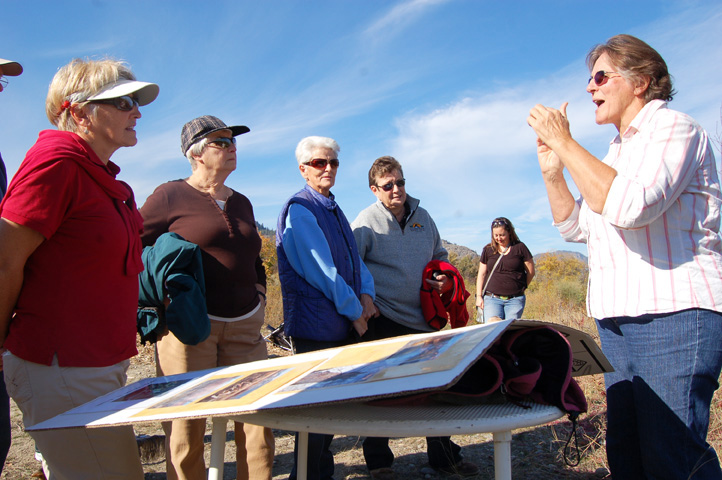

Lee McFadyen explains the salmon’s journey, while Margaret Holm (middle photo) talks about the life cycle.
Lyonel Doherty photo
It’s an incredible journey that continues to baffle biologists, and it all starts and ends near Oliver.
Approximately 80 people observed the sockeye salmon return to the Okanagan River last Saturday during a tour of the spawning site north of Oliver. The tour was led by Margaret Holm of the Okanagan Similkameen Conservation Alliance, and Lee McFadyen from the Okanagan River Restoration Initiative.
The Okanagan River sockeye population (about 55,000 this year) is one of two remaining populations in the Columbia River system.
McFadyen said numbers are down from last year, but significantly better than the recorded low of 2048 fish in 1998, when the salmon were on the brink of extinction. But after river restoration work spearheaded by the Okanagan Nation Alliance, the sockeye returned.
McFadyen said phase one of the initiative gave the salmon 1.5 kilometres of spawning area. She also cited the collaboration work at McIntyre dam which allowed the sockeye to access Vaseux Lake.
McFadyen said the salmon travel more than 4,000 kilometres in their amazing journey. They are born in the Okanagan River, and at six weeks of age travel to Osoyoos Lake where they spend a year swimming around. Then it’s off to the Pacific Ocean via the Okanagan and Columbia River. They spend two or three years in the ocean until they mature, then come back through the Columbia and Okanagan River system to spawn where they were born. Somehow, they remember where to go by using a magnetic field map. McFadyen calls it a “miracle of nature.”
But Eric Berg from Willowbrook said it “sucks” to be a salmon because they make such an arduous journey only to die at the end.
Eric and his wife Gina Berg joined the tour to learn more about the phenomenon.
“It’s mind boggling,” Eric said, adding it’s nice to see the river restored to its somewhat natural state.
Gina said she was very pleased to see people care enough to make this project a success.
Sydney Folk from Penticton also praised the groups for putting the river back to where it once flourished. She brought children to the tour, including her three-year-old daughter who loved seeing the fish spawn.
Donna Stocker from Cawston said she learned a lot about the salmon’s journey, and appreciated what biologists and machine operators have accomplished here.
Stocker said she saw three carp trying to eat salmon eggs in the river.
McFadyen said the dead salmon form part of the nutrient supply in the river, adding they also feed blue herons and eagles.
Holm said the story of the salmon is remarkable.
“These fish represent an historic food resource; our province is a salmon province.”
She admitted that mankind has managed to “screw things up” with dams and pollution, but the river restoration initiative has shown how people can work together to make things better.
“How often do we get to see a species rebound (like this)?”
McFadyen said this tour could turn into a real tourist attraction in order to show off the initiative.
Lyonel Doherty
Oliver Chronicle