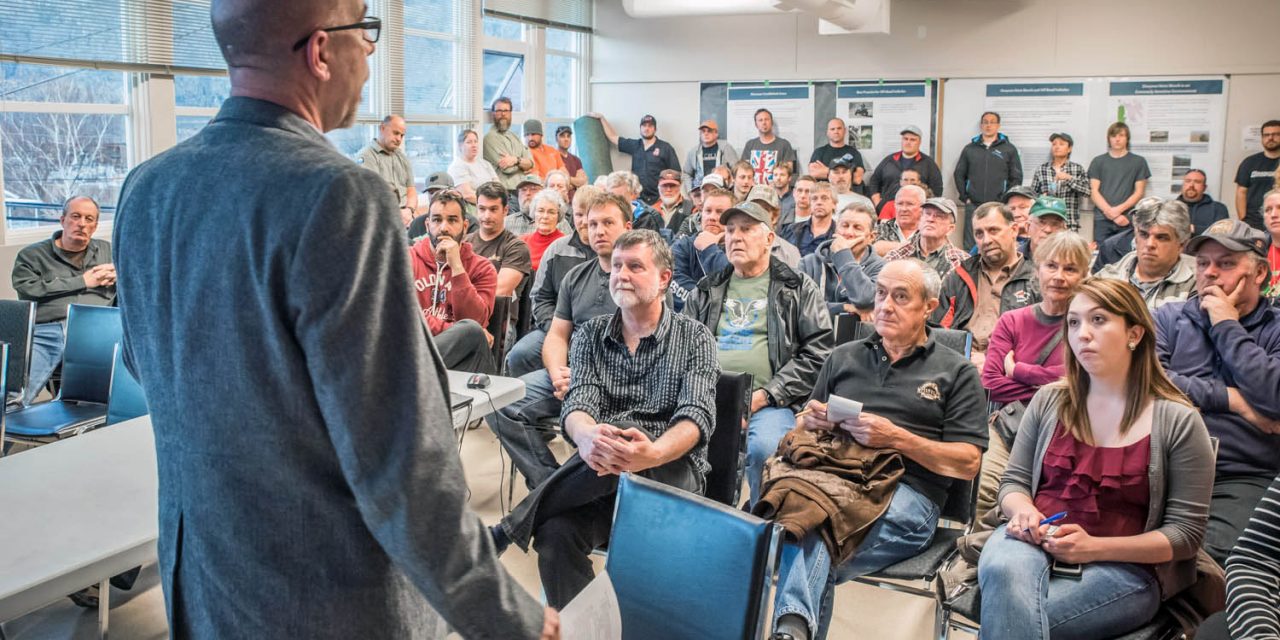
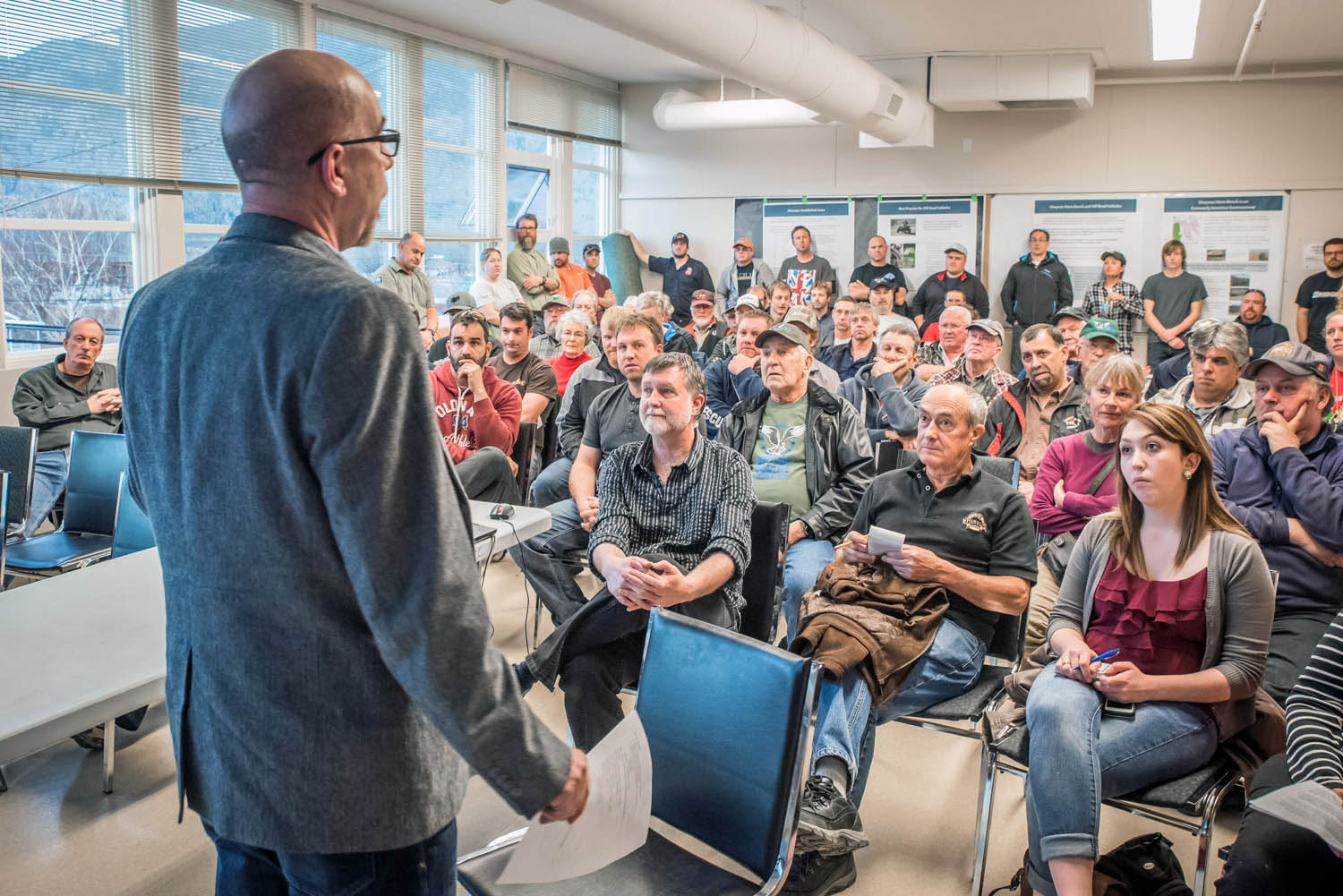
Grant Furness of the Ministry of Forests, Lands and Natural Resource Operations spoke to an audience of about 50 people in Osoyoos recently about the challenges to the environment posed by off-road vehicles on the Osoyoos West Bench. Many in the audience had their backs up, suspecting a government agenda to close areas they use for recreation, but Furness insisted he was just there to seek input. (Richard McGuire photo)
A recent meeting in Osoyoos highlighted the wide gulf that exists between some users of off-road vehicles and others who want to protect the fragile ecosystem of the South Okanagan.
The meeting was called by the B.C. Ministry of Forests, Lands and Natural Resource Operations (FLNRO) to start a dialogue on how to protect the more sensitive areas of the Osoyoos West Bench.
The March 11 meeting, however, quickly took on a hostile tone when some of the off-road vehicle people in the audience said they feared the government plans to shut down the roads and trails where they like to ride.
Although the FLNRO biologist, Grant Furness, insisted this was just the start of a dialogue and there were no plans to close any area, he was interrupted and at times even heckled during his presentation.
A handful of environmentalists – clearly in the minority at the meeting – chose mostly not to speak after a few attempts to speak were quickly shot down.
There were, in that room, extremists on both sides. There are off-road vehicle riders who completely deny that their sport causes environmental damage and who feel they should have the right to ride wherever they wish.
There were also one or two who feel that off-road vehicles should be illegal, at least on public property, because of the harm they do.
It would be a shame, however, to listen only to the extremes. When control of a meeting breaks down, it is, unfortunately often those with the loudest voices and strongest opinions who dominate.
There were also moderate voices on all sides.
One who spoke was Terry Wardrop, from Kamloops, represnting the Quad Riders Association of British Columbia.
He made a strong argument that local off-road vehicle users should organize into a club that could speak for its members.
This would give them a voice, allowing government to consult them and their views to be heard.
But it would also allow a responsible club to educate members about the sensitive ecosystem and encourage trail etiquette and best practices.
The Osoyoos West Bench may be too sensitive or maybe only parts of it are. This requires further study and consultation with those on all sides of the issue.
The more moderate environmentalists, however, acknowledge that the off-roaders must still have a place where they are permitted to ride if the more sensitive areas are closed.
Reasonable voices should be able to find a workable compromise that would preserve our most precious and rare ecosystem, while still allowing responsible riders to enjoy their sport.