You could be forgiven for thinking that the Osoyoos Airport lazily soaks up the sun, day after day, punctuated only very rarely by the occasional small private aircraft.
In reality, on certain days it becomes a beehive of activity, literally buzzing with up to a couple of dozen aircraft taxiing, taking off and landing. These aircraft range from propeller-driven planes to turbine jets, helicopters, drones and even gliders.
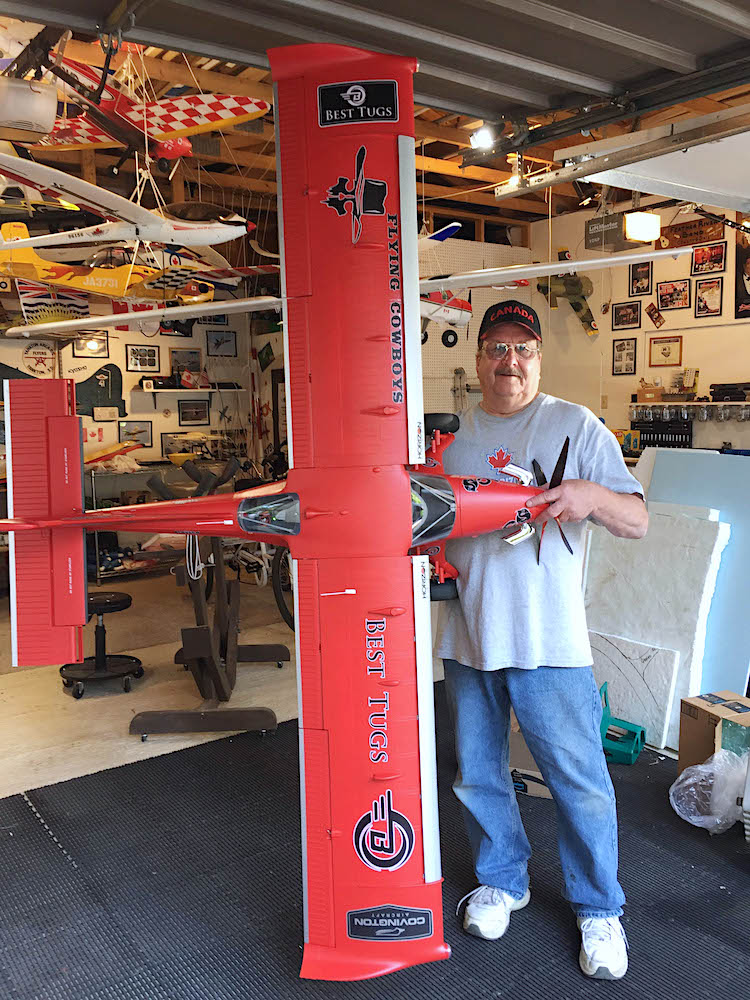
Osoyoos Model Aviation Club RC president, Cowboy Roland with his DRACO (Wilga modified) model aircraft.
The catch, of course, is that these are not ‘real’ aircraft, they are remote-controlled model aircraft, although without the context of size one could easily mistake them for the ‘real meal deal.’
But as Cowboy Rowland, president of the Osoyoos Model Aviation Club (OMAC RC Club) highlights in a conversation about this high-flying hobby, it may be tonnes of fun, but it’s taken very seriously in terms of training, certification, and safety.
The club, formed only this past spring, currently has 20 members, made up of all walks of life, Rowland says. The club has a sharp focus on education and training and offers courses including basics like ground and flight school and more specialized courses on glider flying for instance. “We basically have school from the ground up,” he says.
Rowland, who has real-life pilot experience, has been flying model aircraft since 1968 and has been an instructor for nearly 20 years. The OMAC is fortunate he notes because aside from him as chief instructor there is another certified instructor in the club.
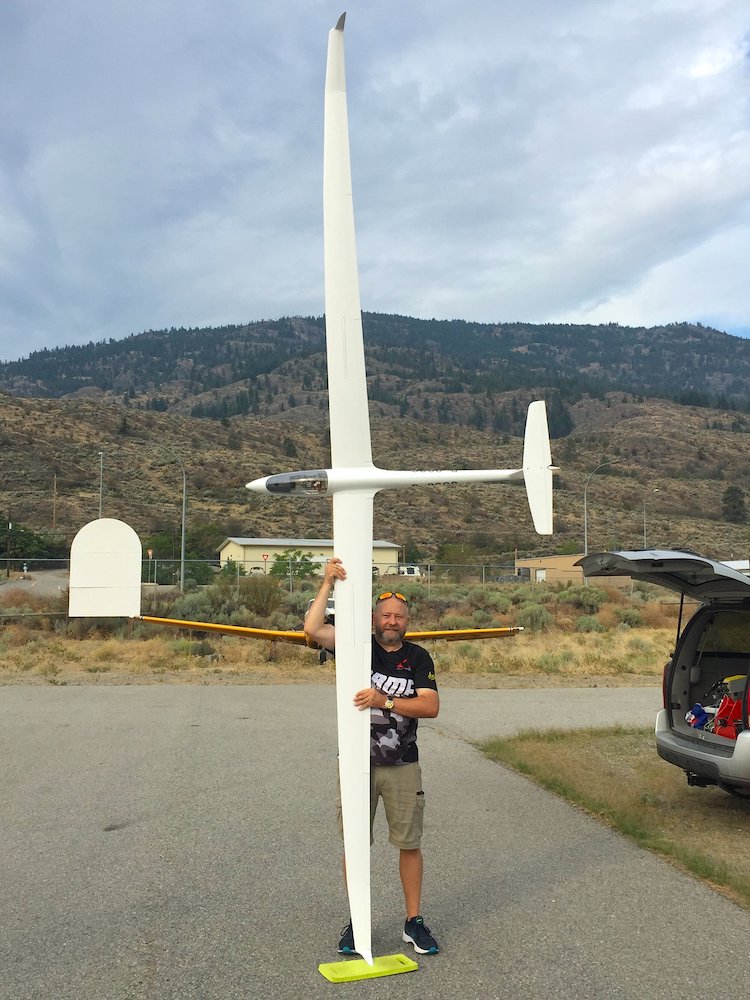
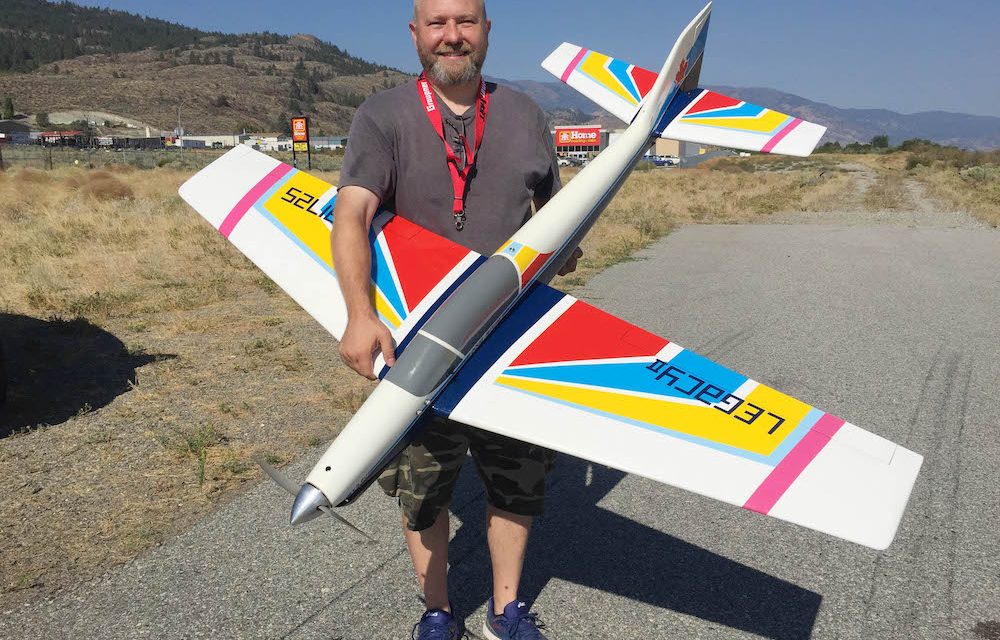
Shawn Zacharias with his 15′ Ventus cx2 glider.
The club flies out of Osoyoos Airport on Fridays and Saturdays, and Wednesday evenings from the sports field in Okanagan Falls.
But before going any further, if you think it’s an expensive hobby you’re not entirely correct, at least in the beginning. Rowland himself has 13 aircraft in his garage and says on average club members each have around two to four aircraft. Therein lies the rub.
The barrier to entry is relatively low with Rowland noting that for as little as $200 an aircraft and transmitters/receiver package can be had. One major online retailer offers some starting at around $120, while some even build their own from foam core board from the dollar store, he says.
Others build more expensive balsa wood kits – sometimes taking a few months – bought from hobby stores, or purchase fully built models which can cost thousands – the sky is the limit as they say.
In the winter months, the club continues to fly using flight simulators in the classroom as well as online flight simulators which members access from their home computers.
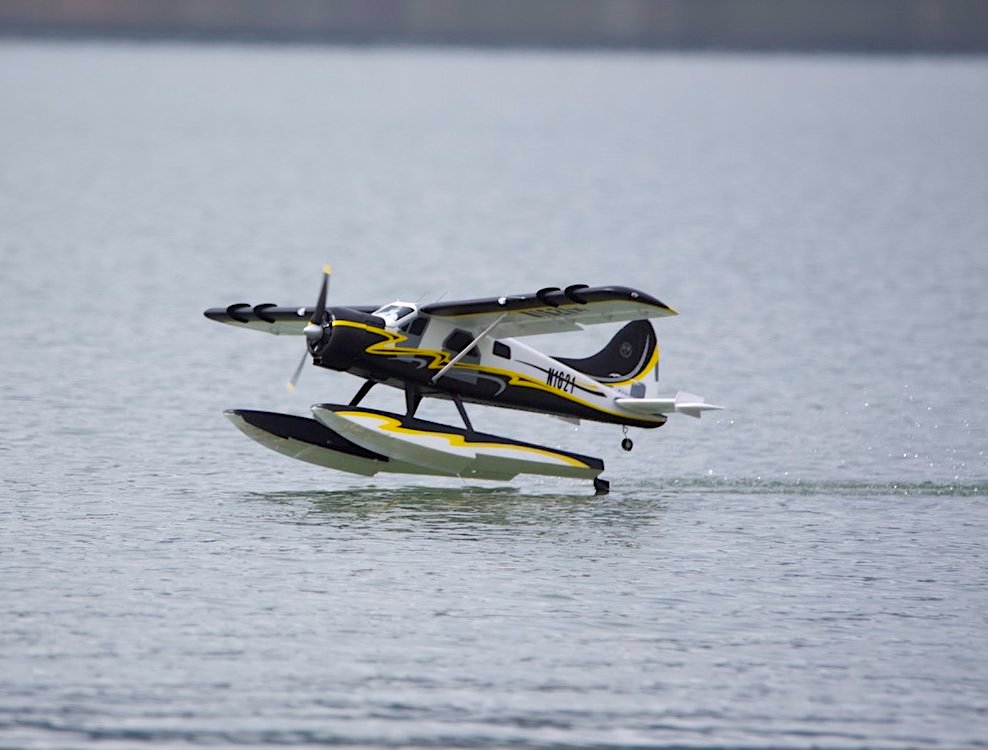
A DHC-2 Beaver floatplane takes off from Osoyoos Lake.
The club is open to everyone and requires a $50 annual membership fee. Those who have a plane but don’t want to join can pay a $10 landing fee that can also go towards a membership later.
Rowland says membership – which is limited to 50 members – includes access to the website, free flight instruction tapping both the simulators as well as instructors in the field.
An $80 membership in the Model Aeronautics Association of Canada (MAAC) – the official organization for model aircraft hobbyists living in Canada – is required to join the OMAC. The MAAC is essentially the governing body for the hobby and ensures its members are aware of and adhere to Transport Canada regulations for remotely piloted aircraft systems. As of Sept. 18, Rowland will become the MAAC deputy director for British Columbia.
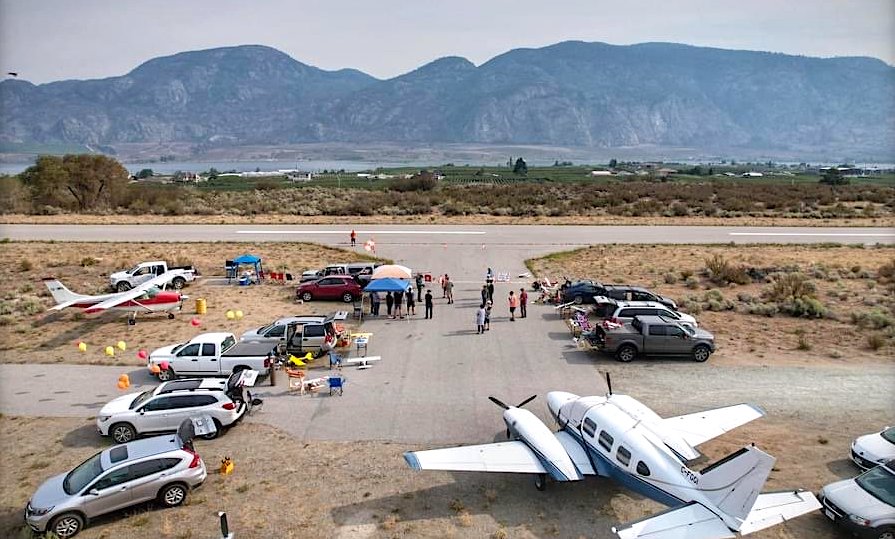
OMAC members meeting at Osoyoos Airport. Photo by Ron Hiller.
Those with an aircraft and experience need only take a flight test before they can hit the runway. “If you’re an experienced pilot you take a check flight when you come into the club and when you’re signed off as pilot status you can go out and fly.
“If you are a student status then you have to fly with one of our instructors until you reach pilot status,” Rowland says. And for those without their own aircraft, the club has two loner aircraft for its members to use.
“We also have a great youth program and they can go through and get their pilot status, we have two youth currently and in fact one of our kids who is 13 took first place in the Spot Landing Contest last week.”
The courses that OMAC offers are developed with MAAC who have the primary responsibility for setting the guidelines. The MAAC Wings Program consists of four flying proficiency levels which each carry an examination. “We are in the process of publishing our own flight manual right now which goes into more detailed things than what they have because MAAC doesn’t have to issue NOTAMS,” for instance.
A notice to airmen (NOTAM) is information filed with aviation authorities to alert aircraft pilots of potential hazards that could affect the safety of flight. In the case of OMAC the club needs to file NOTAMs with the Kamloops Flight Information Centre (FIC) which is responsible for air traffic in the B.C. region when the club is using the Osoyoos Airport.
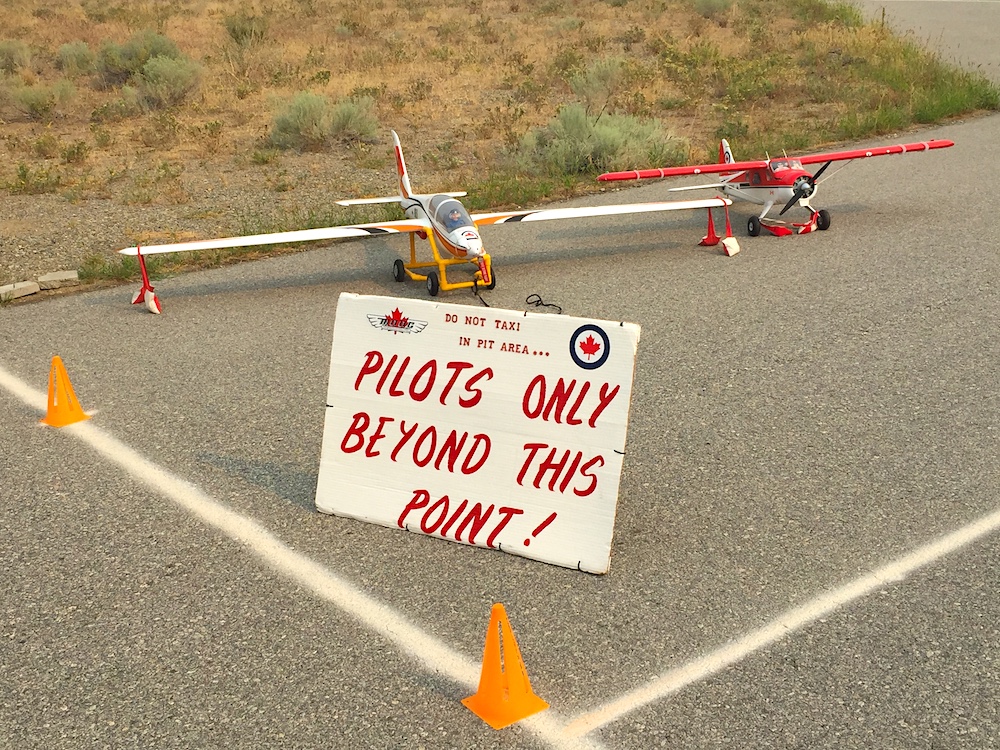
And when the club is airside they monitor the radio frequency for the airport and emergency channels as well as visual spotting for incoming aircraft. “This way we know if someone is coming in there and we have our airport assistant safety officer Mark Fernandes out there as well,” Rowland says.
The OMAC RC Club is not the only such club in the Southern Okanagan with Rowland noting there is a small club based out of Oliver and another in Penticton which has grown quite large. He notes that sometimes there can be issues within clubs over what type of aircraft is flown, what type of engine is used, how much flight time is available and so on.
“We fly everything and welcome anybody that wants to join us. We fly jets, we fly turbine jets, helicopters, drones, gliders, electric planes, nitro gas planes, and floatplanes. Sometimes we fly together, sometimes we fly alone,” he says.
One thing that’s changed from the early days of remote control model aviation is the advancement of electronics. Today’s transmitters/receivers are more powerful and more sophisticated. Using digital gigahertz bandwidth, dozens and dozens of aircraft can conceivably be flown at the same time with no interference, Roland says. Tech advances also mean that battery-powered aircraft are displacing nitro fuel-powered engines.
The club has two special event days each year – ‘fun flies’ as he describes them which also include competitions, like the one held on the weekend of Sept. 4, alongside the requisite socializing and barbecuing, of course. The next one will be held in June 2022 on Father’s Day.