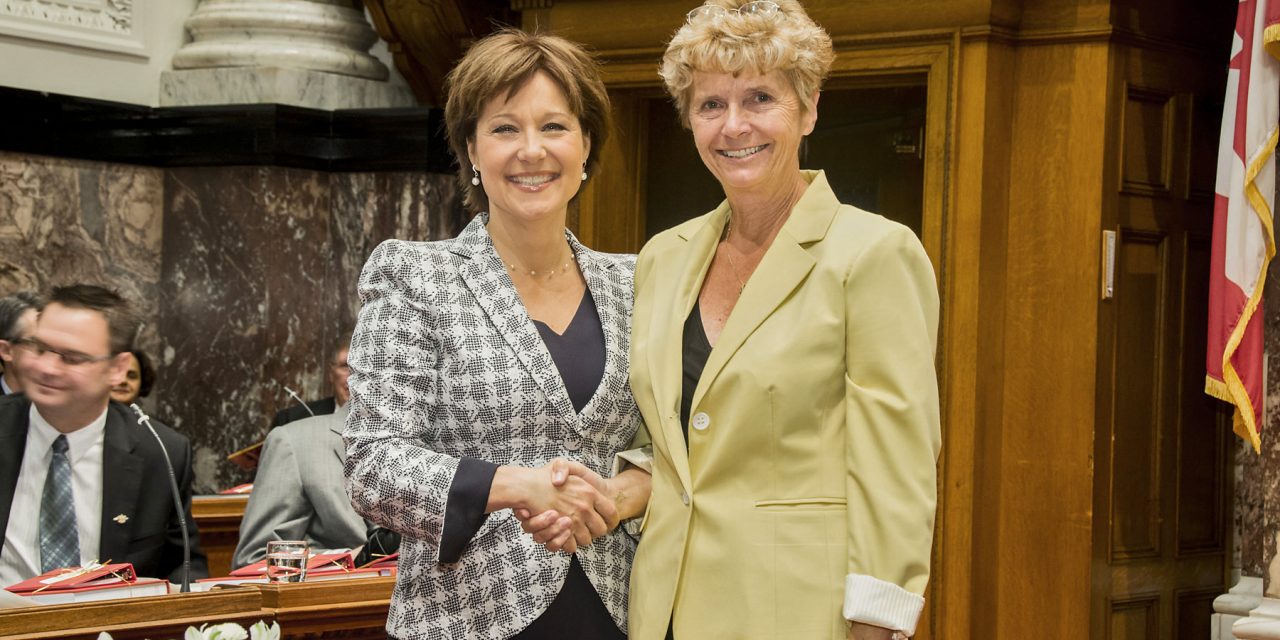

The BC NDP is calling on Premier Christy Clark (left) to demand that Boundary-Similkameen MLA Linda Larson apologize for what the NDP deems “insensitive” comments about residential schools. (File photo)
Boundary-Similkameen MLA Linda Larson is defending recent comments she made about residential schools, saying they were related to improving First Nations health care.
But BC NDP leader John Horgan said that Premier Christy Clark must demand that Larson apologize to First Nations people for her “insensitive and offensive comments” regarding the history of residential schools in British Columbia.
During a health parliamentary committee hearing late last week, Larson asked: “How long do you think before the legacy of those residential schools finally burns itself out of the First Nations people?”
Horgan said a question like that reveals remarkable insensitivity on the part of an elected representative toward the tragic experiences suffered by First Nations people in B.C. residential schools.
“We should never forget what happened, so that we can ensure nothing like that ever happens again,” Horgan said. Premier Christy Clark should immediately ask her MLA, Linda Larson, to apologize for her offensive and insensitive comments.”
But in a statement on her website, Larson said it’s disappointing the NDP would take the good work being done by the health committee and play petty partisan politics.
“My comments were in response to a thoughtful presentation by members of the First Nations Health Authority on improving care.”
Larson’s comments were made during a July 7 discussion on the Select Standing Committee on Health.
The following is part of the transcript, in which Larson was responding to Richard Jock, chief operating officer for the First Nations Health Authority.
Jock said First Nations have lower access to physicians in the Interior region, noting that dealing with rural issues is really important and demands a different approach.
He also said that First Nations were three times more likely to be diagnosed with severe mental health and substance abuse issues, but less likely to use physicians in terms of being screened for those issues.
Jock said the “legacy of residential schools is one that we really need to carefully address . . .”
After Jock finished his address, Larson asked: “How long do you think before the legacy of those residential schools finally burns itself out of the First Nations people?”
Jock replied that as long as First Nations feel uncomfortable with the system, and as long as they feel that institutions are not friendly to them, “then I think the legacy will not find its way out of the system.”
Larson responded: “What institutions now are not friendly? I mean, the residential schools were horrific. There’s no doubt about that. I have many friends and some have died too young as a result of the connection through their parents. I’m talking generationally. How many generations is it going to take before the words ‘residential school’ no longer play a part in how people feel?”
Jock said as long as people are feeling that they are being discriminated against when they present themselves at a hospital, or in any mainstream institution, we will not see an end to it.
New Democrat aboriginal relations spokesperson Scott Fraser said it is wrong to hope that the tragedies of history are forgotten a couple of generations down the line, and try and pretend that they never happened.
New Democrat MLA Melanie Mark had three out of four grandparents attend residential schools.
“Premier Christy Clark needs to make it clear that she finds these comments from her caucus MLA unacceptable. The premier has already referred to some First Nations in B.C. as ‘rag tag,’ and Larson’s remarks are even more callous, and culturally insensitive,” said Mark.
Clark responded by saying that Larson was making a comment about how residential schools have left lasting, intergenerational scars for people, and her question was how do we heal those scars, not how do we forget the past.
“How do we, as a society, political leaders like herself and all of us, help address the wounds that people have acquired in the residential school system, and that was the right question to ask.”
Clark said it was typical for the NDP to take it out of context and try to turn it into something that it wasn’t. “I think her comments were appropriate and I think the question that she asked was an important one.
In a Facebook reply to the story, Bernice Falkus, who attended a residential school in Kamloops, said the memory will never burn out of her mind.
“Just the other night I had a nightmare, a real bad one about the residential school. Why don’t you read about what happened to us . . . my brothers and sisters all went too.”
The Chronicle contacted Larson on Tuesday and she said what happened with residential schools was an absolute tragedy.
“There was and continues to be horrible consequences to people’s lives because of residential schools. I know too many people in our community who have suffered.”
Larson said every member of the health committee, regardless of their party, is interested in one thing – how can we work together to help people?
“At that committee meeting we were talking to the health authority about how we can help people. I’m surprised and disappointed that Mr. Horgan would try and use my comments for partisan purposes.”
A transcript of the meeting can be found here:
https://www.leg.bc.ca/documents-data/committees-transcripts/20160707am-Health-Vancouver-Blues