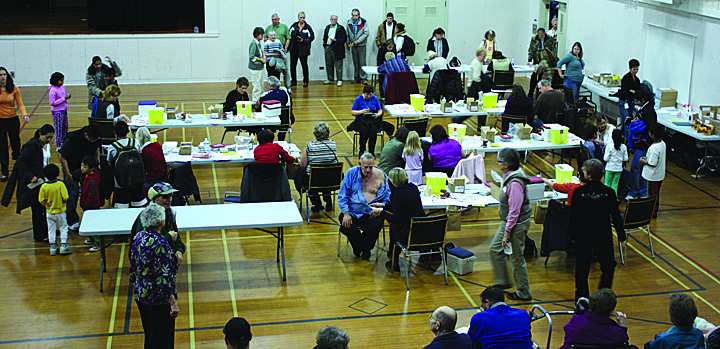
Nearly 750 doses of the H1N1 vaccine were given out at a clinic at the Sonora Community Centre on Nov. 20. Photo by Paul Everest - Click on picture for larger image
OSOYOOS TIMES-November 25, 2009
By Laurena Weninger – Osoyoos Times
Almost 750 people received their H1N1 vaccinations at a mass public health clinic in Osoyoos on Nov. 20.
“At about 7:30 p.m., which was half-an-hour before (the) clinic was scheduled to close, the nurses did run out of vaccine, so anyone left without being vaccinated was asked to return either to the Saturday clinic in Penticton, if they were able, or to a future clinic in the area,” said Lannea Parfitt, public health communications officer for Interior Health.
According to staff members at the Sonora Community Centre, where the mass vaccination clinic took place, there were people already lining up to get their shots at 1 p.m. – two hours prior to the 3 p.m. opening.
Last week, the eligibility requirements for those allowed to receive the shot were expanded, to include anyone in Canada who wanted to receive it.
According to the Public Health Agency of Canada (PHAC), as of Nov. 22, there were 12.2 million doses of the vaccine— both adjuvanted and non-adjuvanted— distributed through Canada and 1.4 million doses came to B.C.
On Nov. 19, Dr. Perry Kendall, B.C.’s provincial health officer, said by the end of November, the government is expecting to have received a total of two million vaccine doses in B.C.
As of Nov. 19, more than one million B.C. residents, or between 20 and 25 per cent of the population, had received the H1N1 shot.
The number of vaccine doses expected to be received by B.C. health officials during the week of November 23 to 30 is 634,500.
In Osoyoos, 300 H1N1 doses were given out at the last clinic on Nov. 4.
On top of that, 530 doses of the H1N1 vaccine have been given out to other healthcare providers in Osoyoos, said Parfitt.
Kendall also addressed the issue of vaccine safety during a Nov. 19 media briefing.
“Vaccines are among the safest tools of modern medicine,” he said.
But to stay on top of the possibilities of adverse reactions to the H1N1 vaccine, “post-marketing surveillance” is being carried out.
Common symptoms of a moderate reaction to the vaccine include local pain or swelling at the site or fever.
A reaction which is rarer is anaphylaxis.
That reaction happens in about one in 100,000 doses.
As of Nov. 7, the PHAC reported that 6.6 million doses of the adjuvanted vaccine had been distributed and there were 634 reports of adverse effects.
The tally of serious adverse events, including several reports of seizures brought on by high fever and anaphylaxis was 36 as of last week.
Anaphylaxis is a severe allergic reaction that can be life threatening and one of the cases in Canada as of Nov. 7 has been fatal.
More current data about adverse effects was not available on the PHAC website.
In the Interior Health region, Dr. Paul Hasselback is the medical health officer who follows up on any adverse effects after the vaccines are administered.
Parfitt said within Interior Health’s coverage area, more than 140,000 doses of the H1N1 vaccine have been distributed.
Up until the week ending Nov. 21, B.C. Ambulance has been called on 14 occasions in the Interior Health region to transport individuals to the hospital for assessment after those individuals attended mass immunization clinics.
Four of those 14 cases were unlikely to be allergic reactions, stated Hasselback’s report, but there will still be follow-up.
Six of the reactions were “significant” and require further evaluation.
The others were reactions that are still classified as anaphylaxis, but are less severe.
Three of the cases are still under investigation.
“Interior Health has a very good monitoring system for vaccine safety,” stated Parfitt.
Kendall said while the rate of serious adverse effects is one in 100,000, one particular batch of vaccine seemed to be returning a rate of three serious adverse reactions per 100,000 doses.
About 10,000 doses of this batch did come to B.C., but none were received by Interior Health.
Parfitt said Interior Health continues to track expenses for the cost of dealing with H1N1, but the numbers have not yet been tallied.
At press time, there were no upcoming mass immunization clinics for Osoyoos, but there will be one in Oliver on Nov. 26 at the Oliver Community Centre Hall from 3 to 8 p.m.
More information can be found at www.interiorhealth.ca.
According to the PHAC, a total of 219 deaths have been reported in Canada since the beginning of the H1N1 pandemic.
There have been 5,438 cases of hospitalization including 867 cases where the patient was admitted to intensive care units.
[email protected]