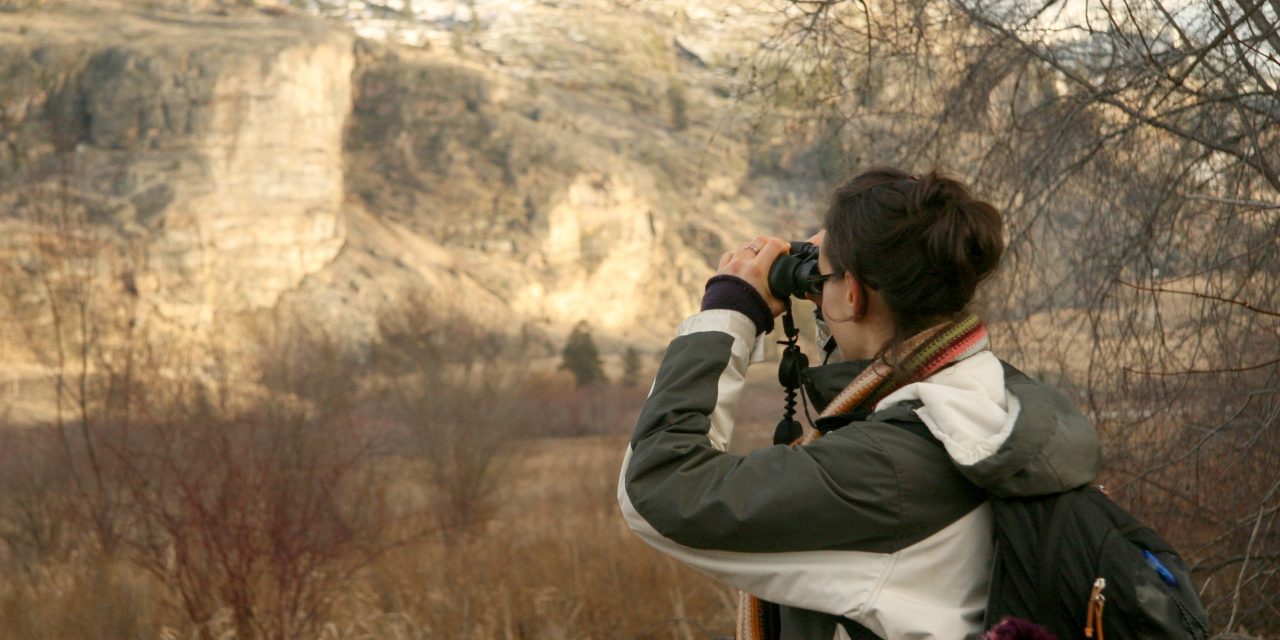
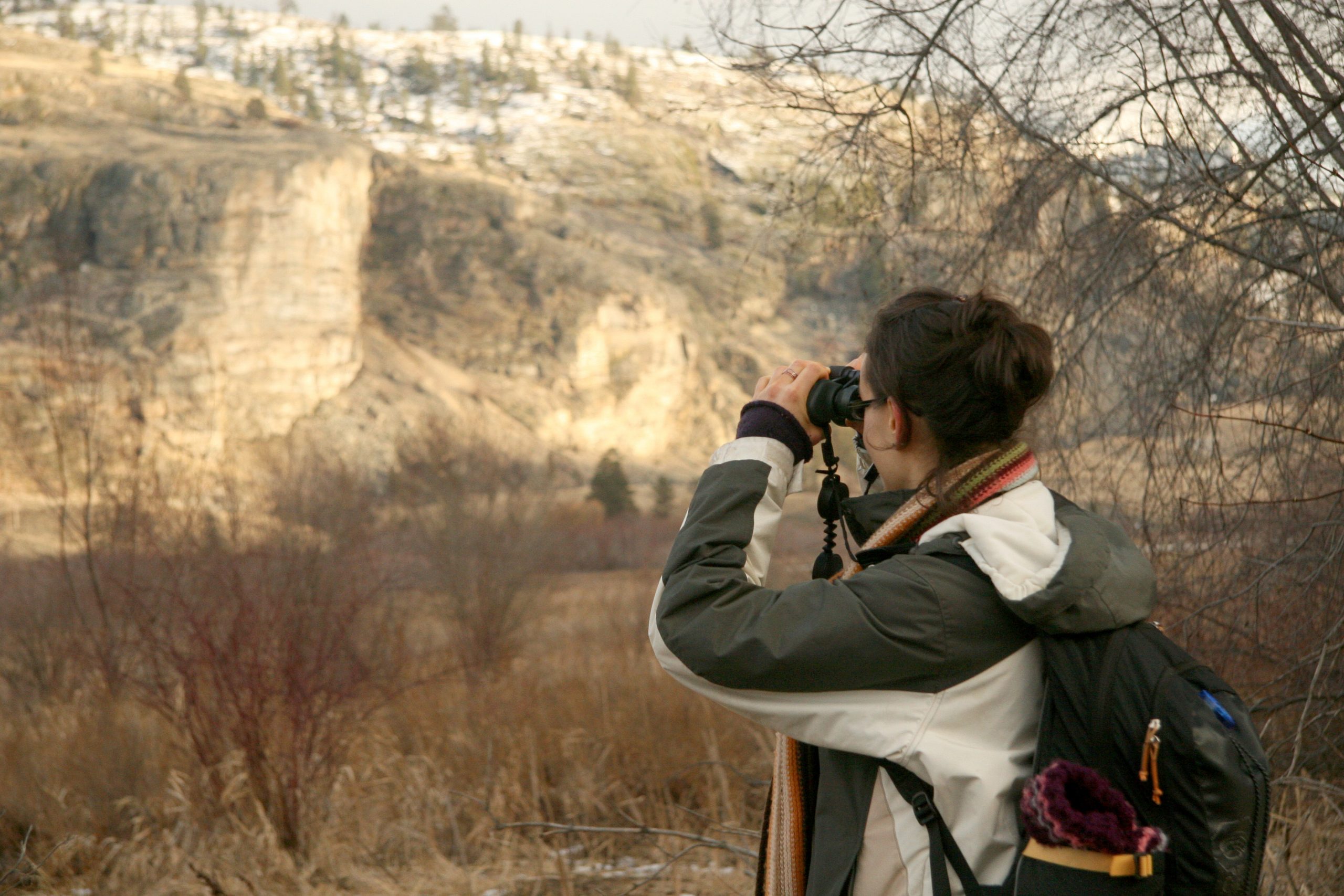
Jennifer Smith looks through binoculars for birds near Vaseux Lake during a previous Christmas Bird Count. The count is done by volunteer bird enthusiasts. (Dick Cannings file photo)
Migratory birds knew about the snowy conditions this winter long before meteorologists did, the recent Oliver-Osoyoos Christmas Bird Count suggests.
For the first time in 20 years, the 37th annual local bird census on Dec. 27 failed to spot any marsh wrens, said Doug Brown, organizer of the count.
“Canada geese numbers were the lowest in 20 years,” he added. “The reason for that is they knew the snow was coming and left because there’s no grass for them to feed on anymore. So the majority of them left.”
Brown said he was first alerted to the snow winter coming by the birds in September when he began noticing more male saw-whet owls than usual at a banding station north of Vaseux Lake.
“Normally they only migrate if there’s going to be a bad winter for them,” he said. “They are eight-inch high owls. How do you think they’re going to hunt in the snow for rodents? They can’t. They were leaving. In September they knew.”
Brown said weather is a bigger influence on numbers of birds recorded in the count than the state of the bird species more generally.
“I can’t prove that’s what it is, but they always know the weather way before we do,” he said. “I have now idea how, but they know.”
In total, the local bird count saw an estimated 22,130 birds from 110 species.
While the total is above the 36-year average, that average is skewed by lower numbers in its early years. The number is well below the average for the last 10 years.
The 110-species figure is the highest this year in the B.C. Interior, with nine species more than Kelowna and 10 more than Penticton, said Brown.
The 23 volunteers counting birds this year on the one-day local count was also the lowest since 1992, Brown said.
There were two bird species this year that have not previously been counted during the census, even though they have been seen at this time of year. A ruddy duck was seen at the sewage ponds and a Lapland longspur was also spotted at the SIBCO feedlot, Brown said.
The most common bird found in the count was the Bohemian waxwing with 3,400 of them spotted. Flocks of these birds perch at the tops of cottonwoods or poplars before descending to feast on berries such as mountain ash and juniper, Brown said.
Other rarely seen birds that were spotted included the mew gull, horned lark, American pipit and fox sparrow.
The data collected from the local Christmas bird count, along with 2,400 other counts done throughout the Americas, is part of the longest running wildlife survey in the world, said Brown.
Information is used to monitor the health of bird populations and to guide conservation actions.
Brown said there is no evidence of major declines in bird populations that winter here, but the birds facing problems are the boreal birds that migrate long distances, to Central and South America, for example.
Their declines may be attributed to use of insecticides, he said.
This was the 116th year for the count in North America.
The tradition originated as an attempt to replace an earlier tradition of the “side hunt” in which teams competed to try to kill the most birds and small animals.
Today the count helps to detect threats to habitats including those caused by climate change.
RICHARD McGUIRE
Osoyoos Times