By Vanessa Broadbent
Osoyoos Times
The Town of Osoyoos’ water supply could soon be deemed unfit for drinking if a new Health Canada legislation regarding manganese levels is passed this year.
Currently, water in the Town’s system has a manganese concentration of 0.135 parts per million, and Health Canada is proposing to lower the maximum allowable concentration to 0.12 parts, Steve Underwood of True Consulting told town council last week. The legislation is expected to be in place later this year.
As a result, water from all of the Town’s six wells, and more added in the future, will need to be treated for manganese.
Currently, manganese is only considered an aesthetic water quality issue, director of Operational Services Jim Dinwoodie said, but when in contact with chlorine, it forms into a solid, producing cloudy water which settles in reservoirs and coats the wall of the distribution piping.
• Read more: OLWQS now testing Osoyoos Lake for invasive mussels
All of Osoyoos water mains have a manganese coating, which is likely causing an environment for bacteria growth, Dinwoodie said.
Underwood presented council with three options to develop a water treatment program, ranging in cost from $12.2 million to $24 million. Grant funding could cover up to 90 per cent of the costs.
The first option, which Underwood said staff have been working towards, includes two treatment facilities, one on Spartan Drive one in Jack Shaw Gardens, and is projected to cost $12.2 million. However, a new water line would need to be constructed under Osoyoos Lake, passing through culturally-sensitive areas on the Osoyoos Indian Band.
“We’ve been working incrementally towards option one as we can afford it, but we’ve had some difficulties getting that pipeline under the lake at the bridge which has caused us to have to step back, look at what our other options might be,” Underwood said.
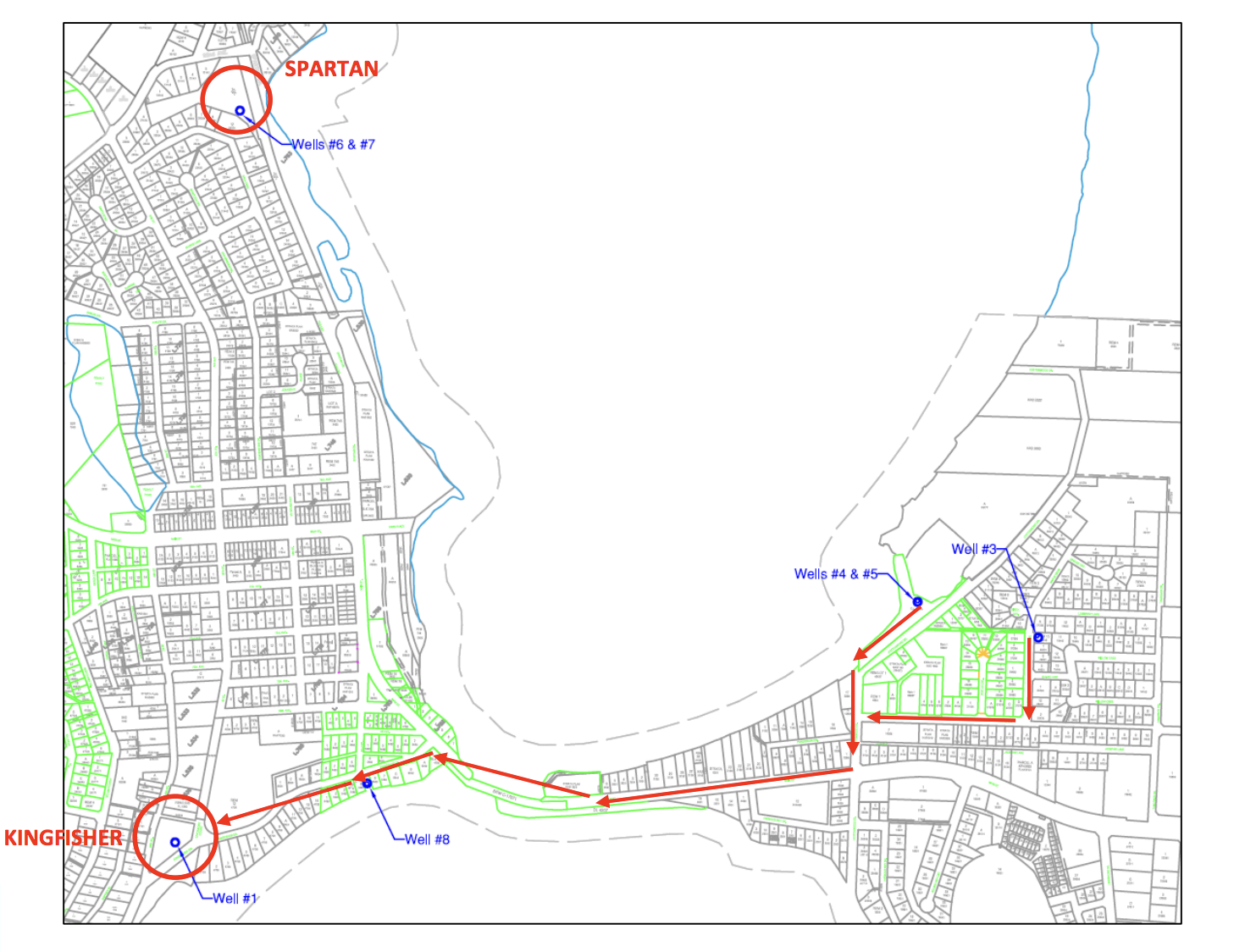
This image provided to Osoyoos Town Council shows where a waterline would need to cross under Osoyoos Lake to treat water at two water treatment facilities. (True Consulting)
Instead, for $15 million the Town can operate three treatment facilities at Spartan Drive, Jack Shaw Gardens and in Kinsmen Park, or convert its water supply to surface water obtained directly from Osoyoos Lake for $24 million.
Underwood suggested that council consider abandoning plans for the water line under Osoyoos Lake.
“We’ve looked at alternates to come around the lake in other ways and nothing seems to be economical,” he said.
While the upfront cost for three water treatment facilities is less, Underwood pointed out that as Osoyoos’ population grows and demand for water increases, new wells and treatment facilities would need to be constructed.
Using surface water from Osoyoos Lake would require only one central treatment plant, proposed to be located at either the Osoyoos airport or golf course, and manganese removal may not even be required, but it’s not considered a viable option until further testing is completed.
“As you get deeper, the water can lose oxygen and start absorbing metals out of the soil around it, and the water could just not be nice down there,” Underwood said.
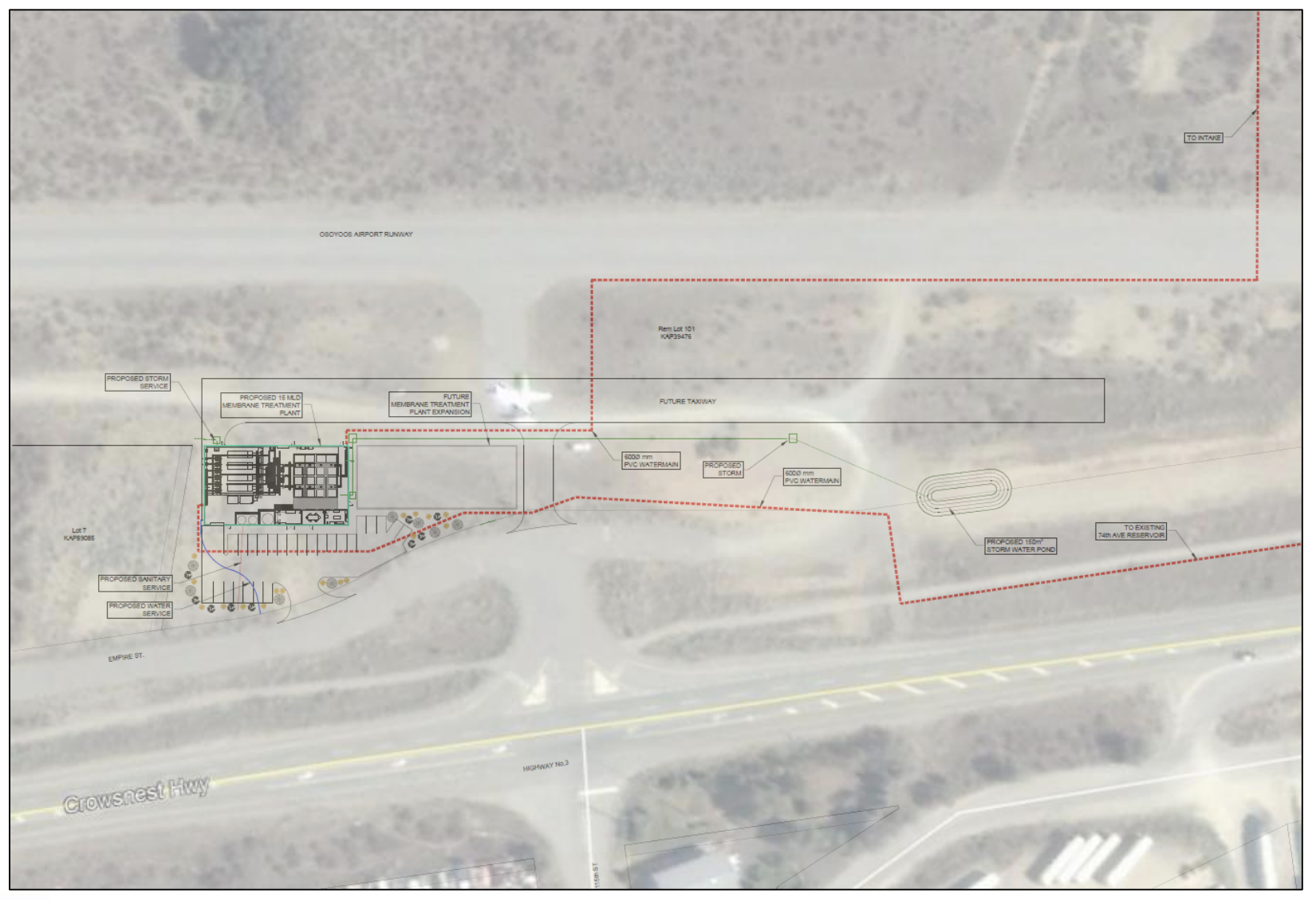
If the Town of Osoyoos decides to use water from Osoyoos Lake as its main water source, water would need to be treated at a central treatment facility, proposed to be located at either the Osoyoos airport (pictured) or golf course. (True Consulting)
Extensive watermain work would also be required in rural areas, and zebra mussels from the lake could increase operation and maintenance costs significantly.
A water quality study will need to be completed to determine if using water from Osoyoos Lake is possible, and Dinwoodie suggested council consider reallocating funds to complete the study.
“Interior Health is getting quite grumpy; they want us to do something,” he said.
Chief administrative officer Barry Romanko told council more reports would be presented in the near future.
“The quicker a decision is made, the more we can be shovel ready.”