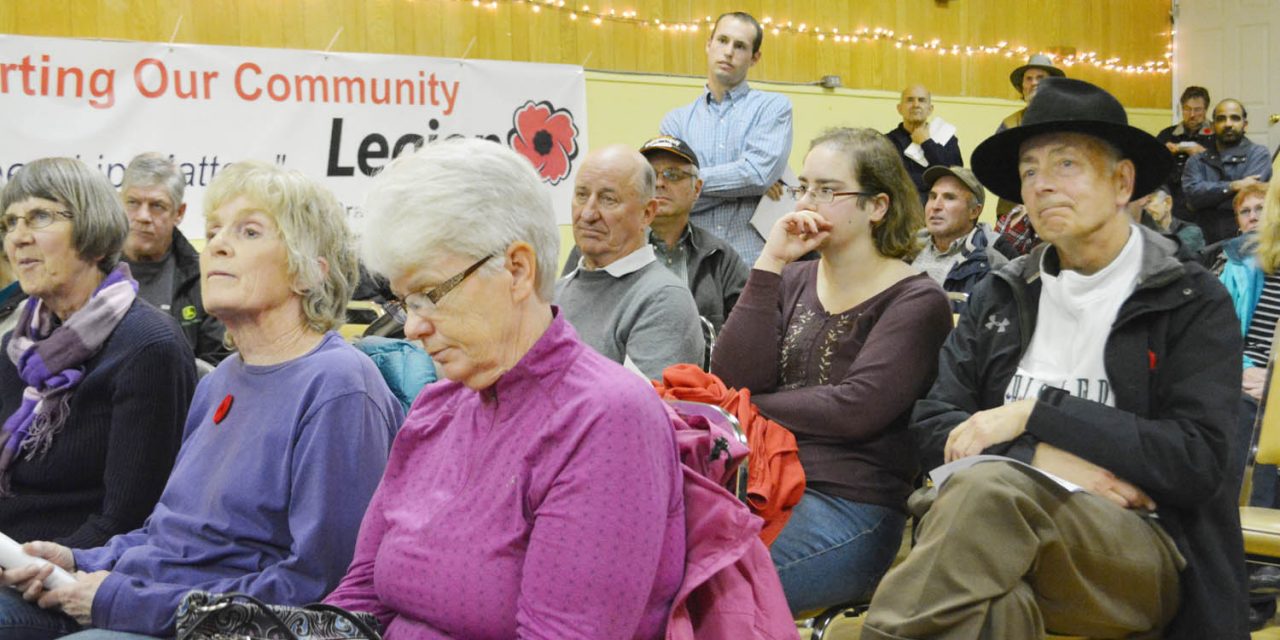
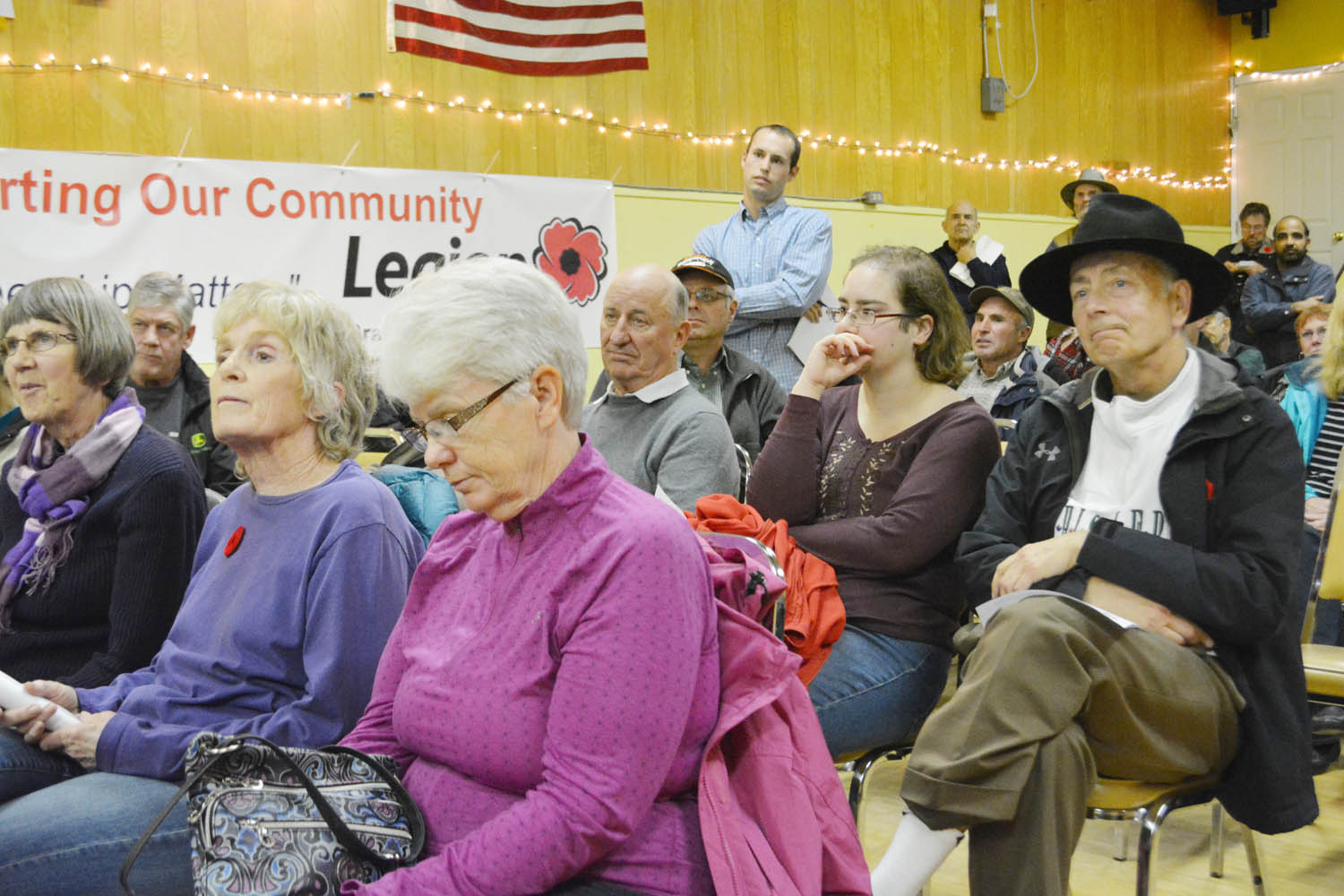
People listen while area fruit grower David Machial outlines his concerns about the KVR trail proposal during the recent meeting in the Oliver Legion hall. The majority of landowners who attended indicated they did not want the trail opened up in their backyard. (Lyonel Doherty photo)
Landowners are telling the regional district to “take a hike” over its KVR trail plan for rural Oliver and Osoyoos.
District staff faced stiff opposition during a recent public meeting in the Oliver Legion hall.
Farmers expressed concerns about liability and invasion of privacy if the KVR trail was expanded from Road 22 to rural Oliver.
Parks and facilities coordinator Justin Shuttleworth said the goal with the trail acquisition is to link communities together, and the best way to do that is to utilize this rail-trail corridor.
Shuttleworth noted that various on-site meetings have been held with affected landowners along the route.
The following is a list of concerns expressed at those meetings:
- Increase in crime (theft and vandalism)
- Loss of crop due to trail development
- Safety of trail users
- Liability of agriculture producers
- Misuse of trail (motorized traffic, illegal camping, alcohol/drugs)
- Impact on property values
The benefits identified include agri-tourism opportunities and a potential increase in business opportunities.
Area C director Terry Schafer said he cycled the Naramata section of the KVR and most of it was fenced off from properties. He noted there are signs addressing the farm safety issue and gates that can be closed when required.
“There was a lot of controversy when it (the trail) was planned, but it’s a beautiful asset now,” Schafer said.
But Sawmill Road resident Brian Davis said he expects the regional district to spend tax dollars wisely and not duplicate services.
“We expect that a second hike and bike trail be installed not in front of residences when another exists behind the same residences,” Davis said. “We expect you to not create a problem when one does not exist.”
Fruit grower Rick Machial said they are not opposed to the trail concept, but are opposed to the “terrible waste” of taxpayers’ money in developing a new trail when one already exists.
Machial said farmers don’t want the KVR opened up along Sawmill Road and Road 9 because of potential vandalism. He instead urged the regional district to seek tenure of the hike and bike trail along the river.
Fellow grower Greg Norton said the previous Agricultural Area Plan discouraged new trails without the approval of affected farmers.
Landowner Frank Barnay said the regional district is inviting “lots of problems” if it allows the KVR trail through farmland.
But avid cyclist Gail Owen strongly favoured the KVR proposal, saying it will bring a lot of tourist dollars to the area.
Owen’s opinion prompted loud booing from the audience, with someone yelling, “ It’s not in your backyard!”
Farmer Dave Evans said the KVR trail would require bridging over Testalinda Creek and encroach on sensitive swamp land and ecological habitat.
“The beauty is the (existing) ambience,” he pointed out.
Evans also said KVR trail development would obligate farmers to fence their properties to address liability issues. “Stay off our farmland. Road 9 to 18 is a very intensive farming area.”
Avid cyclist Marion Boyd said she owned a farm that bordered the river and never experienced any problems (from trail users). “The only problem we had was with hunters.”
But fruit grower David Machial reiterated the concern about building a new trail adjacent to the hike and bike path.
How much is the KVR proposal going to cost? he asked.
Shuttleworth said he couldn’t hazard a guess.
The grower said it would be more affordable to secure tenure on the existing trail than to develop a new one.
Landowner Gary Cook said there’s a growing crime rate in the area, with break-ins, etc. He also noted the “undesirable element” coming to town courtesy of the new correctional centre.
Cook said the KVR trail will bring people to within 30 feet of his kitchen window. “It may draw tourists, but what about the people who live here?”
Cook told Shuttleworth that he has an obligation to listen to the people who pay his wages.
“I get the impression this (plan) is going ahead. Why stir people up when you have no clue what it will cost?”
One visitor to the area said cyclists don’t have time to get into trouble with farmers by vandalizing or stealing property.
Local farmer Nirmal Dhaliwal lightened the mood by pointing to former Area C director Allan Patton and blaming him for everything, which prompted the whole room to erupt into laughter.
Patton agreed it was crazy to have two trails side by side, and did not favour pursuing the KVR proposal.
He said the invasion of privacy issue is a valid concern, but doesn’t believe property owners would be plagued by theft or vandalism.
Patton said he has tried to secure tenure of the hike and bike path before, but the Ministry of Environment would not cooperate. The best he could do was a year-to-year management agreement.
Another concern was raised about the endangered yellow-breasted chat and the threat to its habitat if the KVR trail is developed.
Area C alternate director Rick Knodel posed a question about the KVR route being in the Agricultural Land Reserve.
Shuttleworth confirmed that almost all of this land exists in the ALR, noting they would have to apply to remove it from the reserve.
After the meeting, Schafer said it appears his “marching orders” is to push for securing tenure on the existing river dike trail. And he did that on November 5 by asking staff to apply for tenure on the trail from Road 22 to McAlpine Bridge.
At last week’s regional district meeting, Schafer made a notice of motion that staff continue to pursue tenure on the KVR for future trail development, but the motion also directed staff to seek tenure over the existing hike and bike path.
“Obviously the river pathway is exceedingly more beautiful than behind industrial buildings and there are critical protected species habitat areas that need to be avoided, not to mention the privacy and security issues of the farmers,” Schafer said.
Greig Bethel, media relations officer for the Ministry of Forests, Lands and Resource Operations, said the RDOS recently submitted a tenure application for portions of the KVR.
The application states: “The core uses of the trail will be those that are supported by the local community, adjacent landowners and management agencies.”
It goes on to say it is anticipated the corridor preserves an atmosphere of minimum conflict and undue liability risk to users and landowners.
Bethel said a number of agricultural users have short-term licences on portions of the KVR. However, they have been advised of the possibility of a public trail being constructed in the future. He also said the province is not considering the sale of these public lands.
Shuttleworth said the RDOS will continue to gather information, while meeting with landowners as requested.
LYONEL DOHERTY
Special to the Times