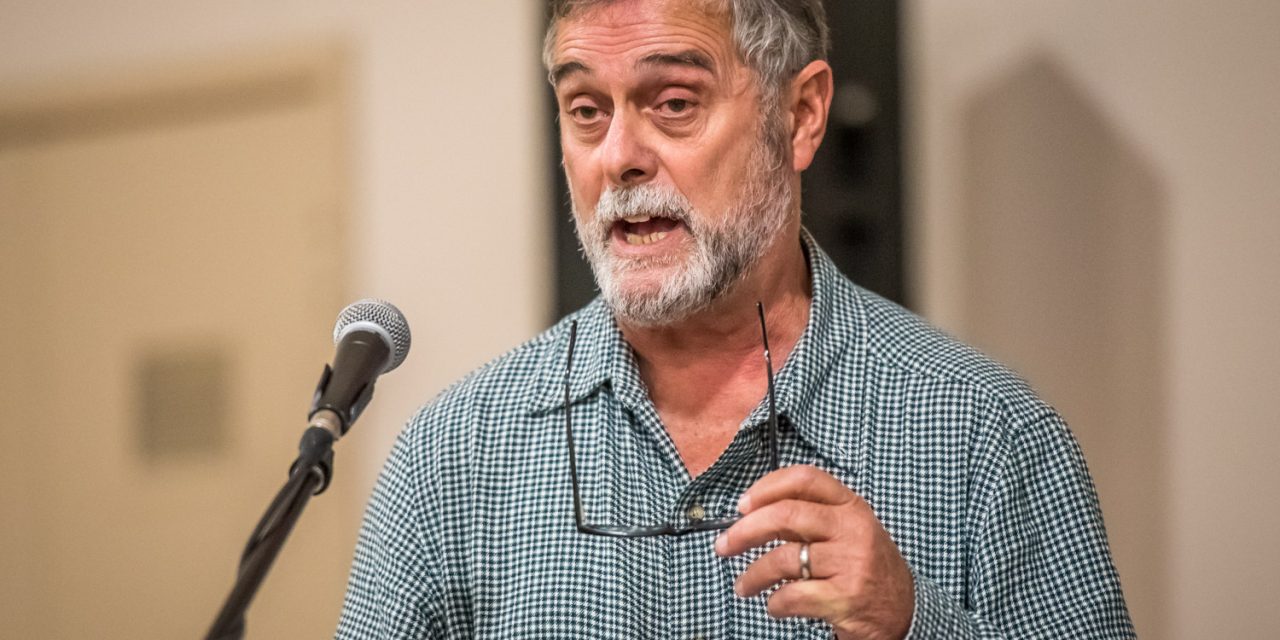
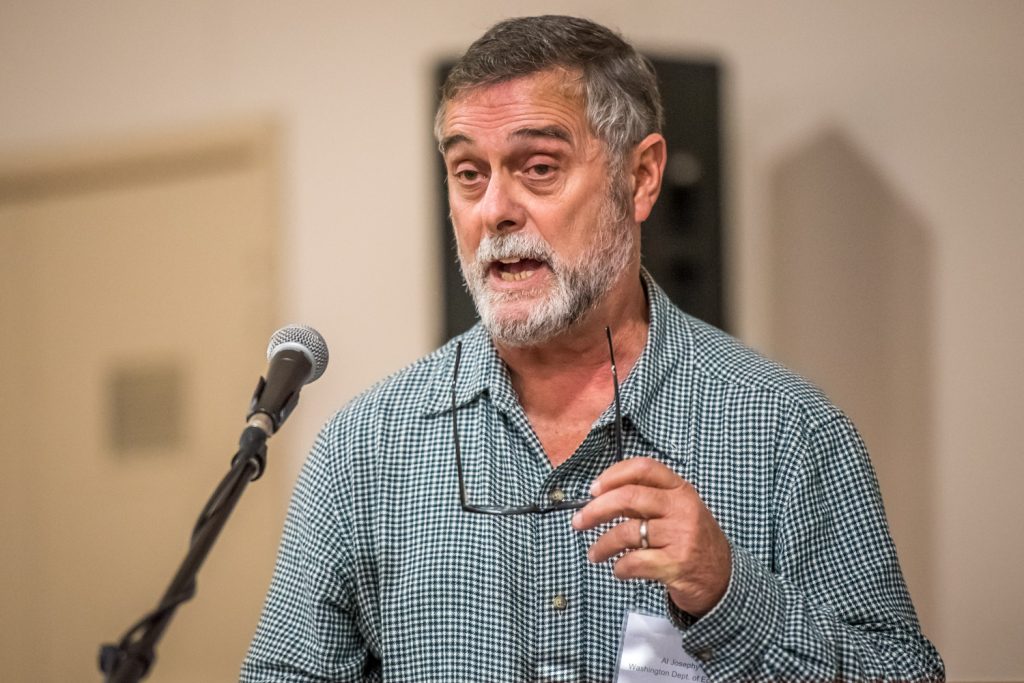
Al Josephy, the official with the Washington State Department of Ecology who oversees operation of the Zosel Dam, gave a summary of this year’s water management on Osoyoos Lake and the Okanogan River at last week’s annual public meeting of the International Osoyoos Lake Board of Control. (Richard McGuire file photo)
Despite some worries at the start of the summer, water managers dodged a bullet this year thanks to June and July rainfall.
As September draws to a close, local water users are now safely out of the woods for this year.
That’s the word from Al Josephy, the official with Washington State Department of Ecology, who oversees operation of the Zosel Dam in Oroville, WA.
Josephy was the main speaker last Tuesday at the annual public meeting of the International Osoyoos Lake Board of Control in Oroville.
“It worked out better than we anticipated early in the summer,” Josephy said in an interview following the meeting. “We really began to get nervous about what the latter part of the summer was going to look like, especially for our large water rights holders on the Okanogan in the Oroville-Tonasket Irrigation District.”
In many ways, the season began similarly to 2015 with a major early snowmelt in April.
This year, however, the snowcap was much larger than last year, and that allowed water to be held back in Okanagan Lake north of Penticton.
The peak flow normally comes in late May or June or sometimes even into July, said Josephy.
“Irrigators traditionally need water in the June, July and August period,” he said. “You don’t need it very badly in March and April.”
Another source of worry was the Similkameen River, which relies heavily on snowmelt for its flow and doesn’t have the network of dams that the Okanagan River has to regulate flow.
The Similkameen provides the majority of the water below Oroville on the Okanogan River, as the Okanagan River is called in the U.S.
The early snowmelt was especially a concern on the Similkameen, Josephy said.
In 2015, a much smaller snowpack also melted early, but unlike this year, there was little rainfall in June and July. That meant that some water rights holders in Washington State experienced rationing at the peak of the drought.
The rainfalls at the end of June and into July had another major benefit, Josephy said. They enabled a successful sockeye salmon migration up the Okanogan River into Osoyoos Lake.
When water temperatures climb above 24 C, it causes a “thermal barrier” to migrating salmon, which can’t tolerate warm temperatures.
In 2015, most of the migrating sockeye were killed when warm temperatures interrupted their migration.
This year, however, the rains helped to bring down temperatures to 22 C and lower, enabling the fish to continue upriver.
About 82 per cent of sockeye that were counted at Wells Dam near Brewster, WA, made it successfully past Zosel Dam in Oroville and into Osoyoos Lake, Josephy said. This compares to just 10 per cent in 2015.
“The fish were holding up down there around Brewster and they came in a huge run on the first week of July,” said Josephy, who noted that a successful sockeye run is a big economic boost, attracting tourism.
The Zosel Dam plays an important role in controlling the level of Osoyoos Lake during the summer, although the quantity of water released from Okanagan Lake is also a major factor.
Josephy says managers chose to be prudent and operate conservatively on a precautionary principal.
“A lot of people depend on us,” he said. “We have 600 water rights down on the Okanogan River and we have water rights throughout the state of Washington. As good managers, we need to look at the data and be prepared.”
One impact of that was that lake levels were maintained slightly higher than usual this year. Josephy said several people who expressed concerns about the higher levels this summer contacted his office.
Normally, the lake level is maintained around 911.5 feet above sea level during the summer, he said, but this summer it was held in the 911.8 to 911.85 range, which is still well within a permissible range.
“It’s not extreme, but it was apparently enough for a couple of people to notice and call us up and wonder why the lake was so high,” Josephy said. “It’s likely that people will see that in the future.”
He noted that the additional 0.3 feet on the lake can mean 2,000 extra acre-feet of water, which is enough to help irrigators as far as Tonasket make it though September.
Many people have water intakes on the river and if the river flow gets too low, the intakes suck air and pumps get damaged.
Anna Warwick Sears, executive director of the Okanagan Basin Water Board (OBWB) also sits as a board member on the International Osoyoos Lake Board of Control.
She concurs with Josephy’s assessment of the water situation this summer, and agrees the sockeye migration was a good news story.
The additional rainfall also meant vegetation didn’t get too dry and the forest fire danger was greatly reduced, she said.
Sears praised the work of the water managers and in particular the co-operation between those managing Okanagan Lake, those managing Zosel Dam, and those managing the fisheries.
“All these people co-ordinating with each other and talking to each other is really excellent,” she said.
Josephy acknowledges that management played a role, but more than that, he credits luck this year.
“I would say it was a combination of luck and good management from our perspective,” he said. “I think throughout the basin on both sides of the border, it was maybe 60 per cent luck and 40 per cent management.”
RICHARD McGUIRE
Osoyoos Times