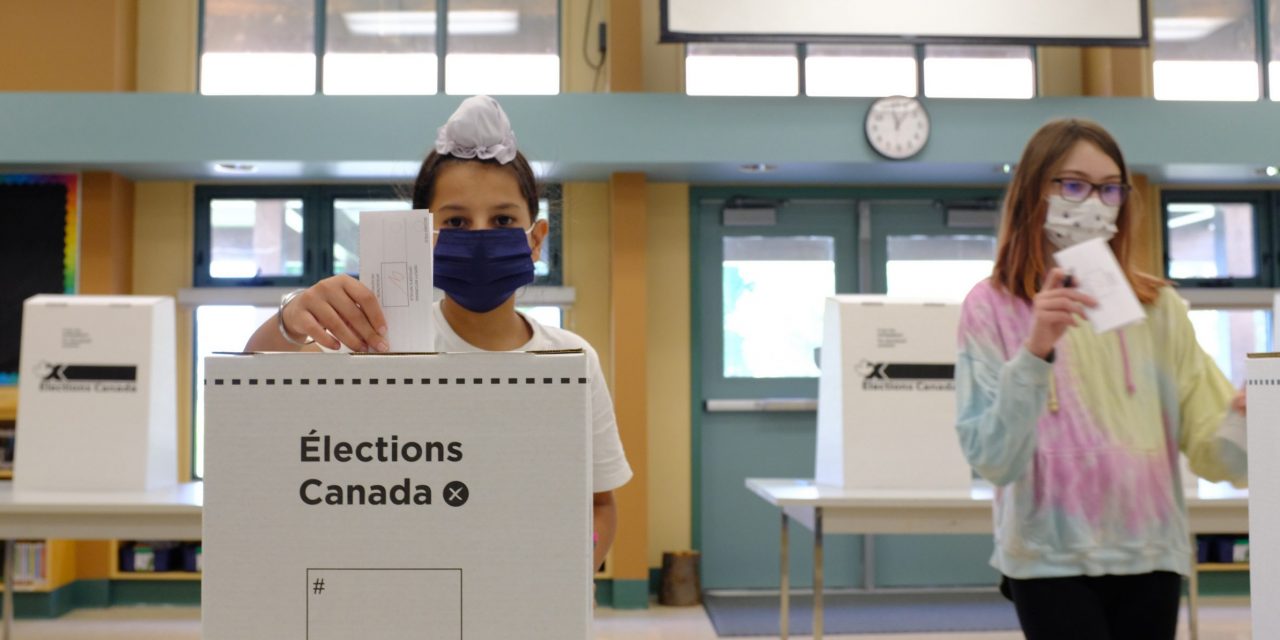
While everyone went off to their local voting stations on Sept. 20, lining up and casting their ballots, a similar buzz was alive at the Osoyoos Elementary School library where a number of classes took part in the Student Vote.
The results, which were posted up by Monday night, showed a tie with 57 votes for the NDP and 57 votes for the Green Party.
This year, more than 750,000 elementary, intermediate and secondary school students from more than 5,000 schools participated in Student Vote Canada. Votes were cast in all 338 ridings.
Local grade 6 teacher at the school, Christopher Lewis has been spearheading the Student Vote since he started working at the school seven years ago.
Students in grades 4-7 at Osoyoos Elementary participated in the Student Vote on Monday after spending a good chunk of time getting informed about the candidates.
“This is a great way to learn a little bit about elections, democracy, and exercise that right. I think a lot of people don’t learn enough about it,” said Lewis, who added that he always hears people complain that people should learn real-life responsibilities in school and wanted to proactively do that for his students.
Civics and Elections Canada has a partnership with schools which help provide students with resources for the Student Vote like ballot boxes and voting booths. Lewis has used these tools and shared it with his fellow teachers so that they can provide students with a full experience.
“Hopefully they build lifelong skills and knowledge so that when they do become 18, not that they just go cast a vote, but they’ve become informed and try to do it in a way that everybody has the opportunity,” Lewis also said that one of the scariest things about getting people to go vote is they don’t know what to expect, and so getting those barriers down at a young age should ease those fears.
Getting students informed before voting included talking about the political spectrum, going through articles from various sources, and most importantly trying to get the students to form their own opinions based on what’s most important to them.
Lewis worked with his students to come up with questions they could ask the candidates. He emailed out the questions and shared the responses with his students. The topic the students felt was most important to them this year was pollution, which they chose after doing a blind vote multiple times.
“The candidates’ responses, and formulating that question is ultimately, I think, where students get the most interested and want to know, so everybody was voting, everybody wanted their say and I tried to make sure everyone was represented,” said Lewis.
Students also attended the virtual candidate forum this year which was held at the school library where 39 students went to watch.
Lewis also mentioned that when he was 18 he didn’t go to vote (which was the only time he didn’t vote) only because he felt so nervous about what to do and what to expect. Keeping this in mind, he wants to give students all the information they need in order for them to form their own opinions and be able to confidently make their own decisions. “It’s never too early to start having those conversations. Early education is key.”