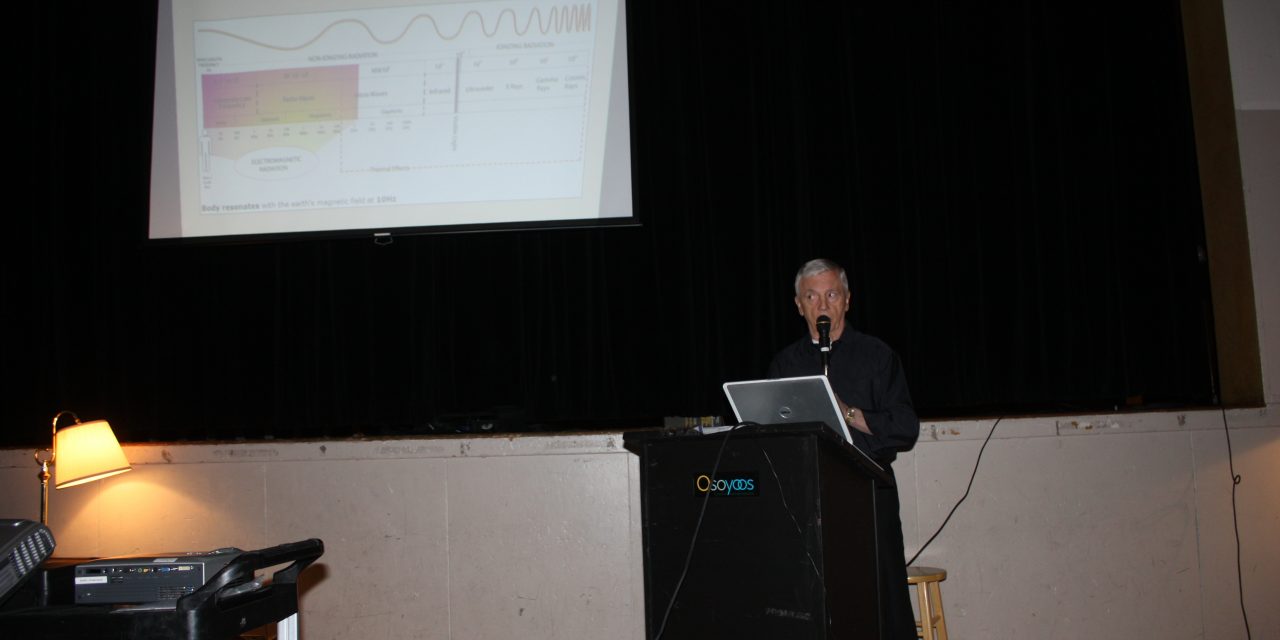
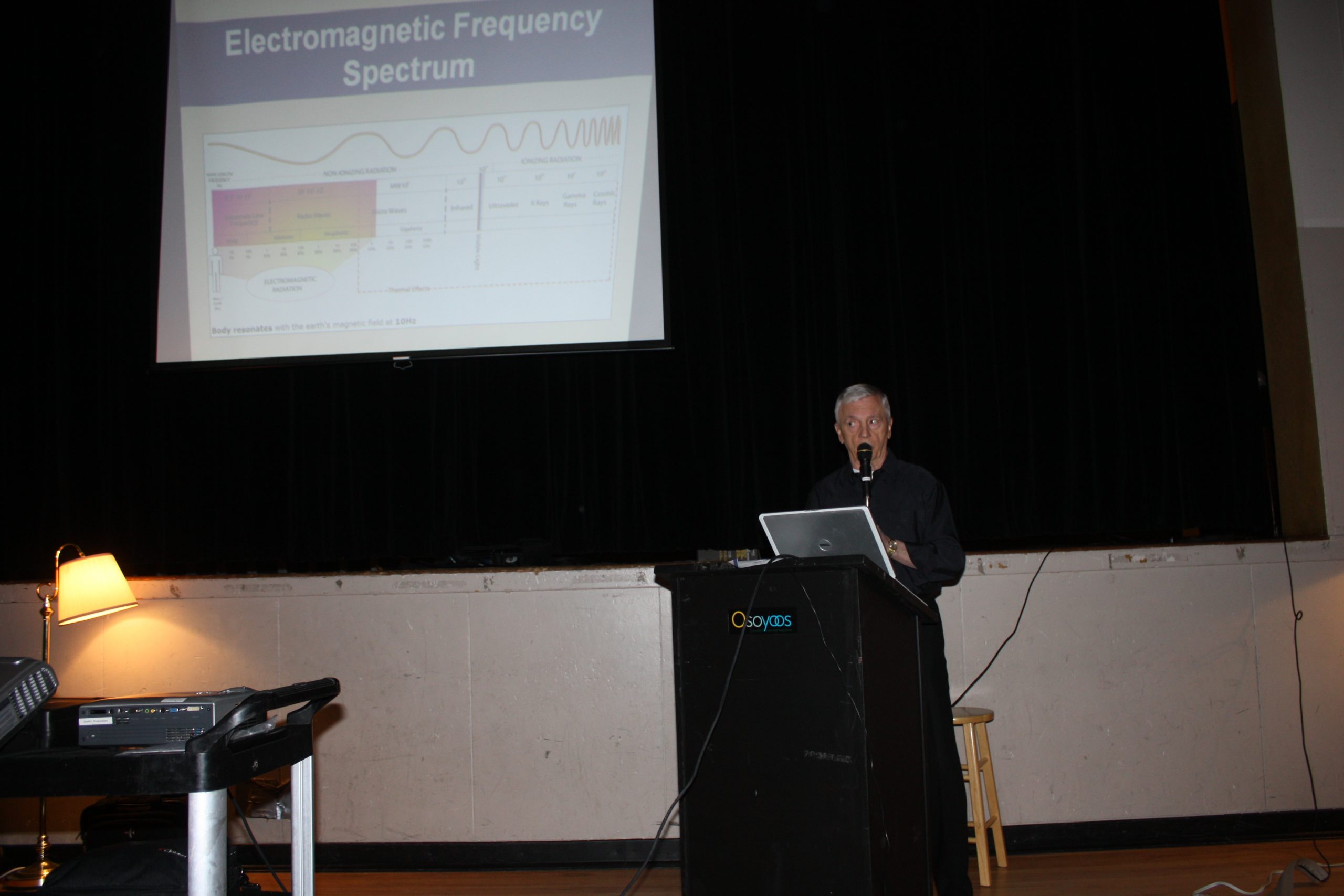
Retired Canadian Armed Forces radiation expert Jerry Flynn attracted a crowd of more than 200 area residents to the Sonora Community Centre Saturday afternoon for a presentation on the health risks posed by smart meters. Flynn urged local residents to voice their opposition to the FortisBC application to install these devices in this community. Flynn received support from local doctor Karin Kilpatrick. Photo by Keith Lacey.
Before a packed gymnasium of more than 200 local residents, a local physician has joined the growing list of area residents vehemently opposed to the potential installation of ‘smart meters’ in Osoyoos by FortisBC.
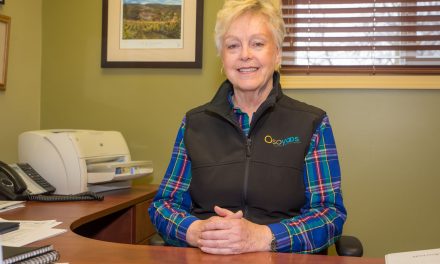
Dr. Karin Kilpatrick, who lives in Osoyoos but runs a general practice in Princeton, said she is more convinced than ever that FortisBC’s application to the British Columbia Utilities Commission (BCUC) to proceed with its Automated Metering Infrastructure (AMI) program should be denied.
Kilpatrick spoke after a two-hour presentation by retired Canadian Armed Forces electronics expert Jerry Flynn, who has spent the past several months conducting information sessions like the one held this past Saturday afternoon before a rapt audience in the gymnasium at the Sonora Community Centre.
Flynn, who worked in the upper tier of the Canadian Navy as an electronic warfare expert, presented numerous scientific studies he says are readily available on the Internet which provide clear data about the many dangers related to the installation and use of smart meters.
Flynn, who made a similar presentation to another large audience in Oliver two months ago, said many of the world’s leading scientists now believe the energy created by electro-magnetic radiation (EMR) now poses the single-largest threat to human health in the 21st Century.
After listening to Flynn’s presentation and revealing her own research into the controversial application by FortisBC, Kilpatrick said she can no longer sit silent and will start informing all of her patients about the hazards of smart meters and all devices which emit EMR.
She has been doing a lot of reading about wireless devices and EMR and is now convinced they are causing numerous ailments and complex illnesses that are now showing up in patients that she never had to deal with in the past, said Kilpatrick.
“When I see the levels of radiation we’re being exposed to, I become very concerned,” she said. “We’re seeing more and more acute diseases, more chronic fatigue, more fibromyalgia … these things are not going away and they are getting worse.”
When physicians agree to the Hippocratic Oath, a pledge historically taken by physicians and other healthcare professionals swearing to practice medicine ethically and honestly, they promise “above all else to do no harm” and the more she reads about wireless technology, EMR and smart meters, the more she is convinced it’s time to start informing her patients about the harm being caused, she said.
“There’s a lot that is worrisome,” she said. “The economics are almost irrelevant compared to the health risks. I have an integral duty to inform my patients of potential risks … it’s my duty to fully inform my patients of all risks, be it medication or surgery. I have a responsibility to inform them of even the tiniest risks and if I don’t, I can be sued.”
Physicians constantly have to balance the benefits versus risk in all medical decisions they make and that’s why she has decided to speak out against what she sees is an obvious threat to human health posed by all devices that emit EMR, said Kilpatrick.
Utility companies like FortisBC have not provided sufficient data relating to the impact on human health posed by smart meters for BCUC to consider their application, said Kilpatrick.
“I don’t know of one single health benefit, not one,” she said.
In her own personal life, Kilpatrick said she is now committed to removing as many wireless devices as possible from her daily life and she will be discussing the potential health risks posed by devices that emit EMR with her children.
The fact that utility companies have been allowed to install wireless devices like smart meters without consulting their customers and answering so many key questions relating to the impact on human health is extremely discouraging, she said.
“This is being done without any consultation or due process,” she said.
Richard Walker, an Osoyoos-based herbalist who has worked in natural medicine for more than 30 years, told the audience he’s also convinced wireless devices that emit EMR are contributing to new illnesses that didn’t exist decades ago.
“We’re dealing with more and more complex illnesses and we don’t know how they are caused,” said Walker. “Technology tends to race far ahead of our understanding of technology.”
Following a brief question and answer session, Flynn told members of the audience they can each make a difference by contacting the BCUC and their local MLA to voice their opposition to the FortisBC application.
“The worst thing you can do is nothing,” he said. “You have to stand up and be counted and contact your local MLA and MP and let Fortis know you don’t want these things in your community.”
The BCUC denied a FortisBC application to bring smart meters to the South Okanagan back in 2008 and won’t have much choice but to do it again if members of the public continue to apply pressure in the coming months, he said.