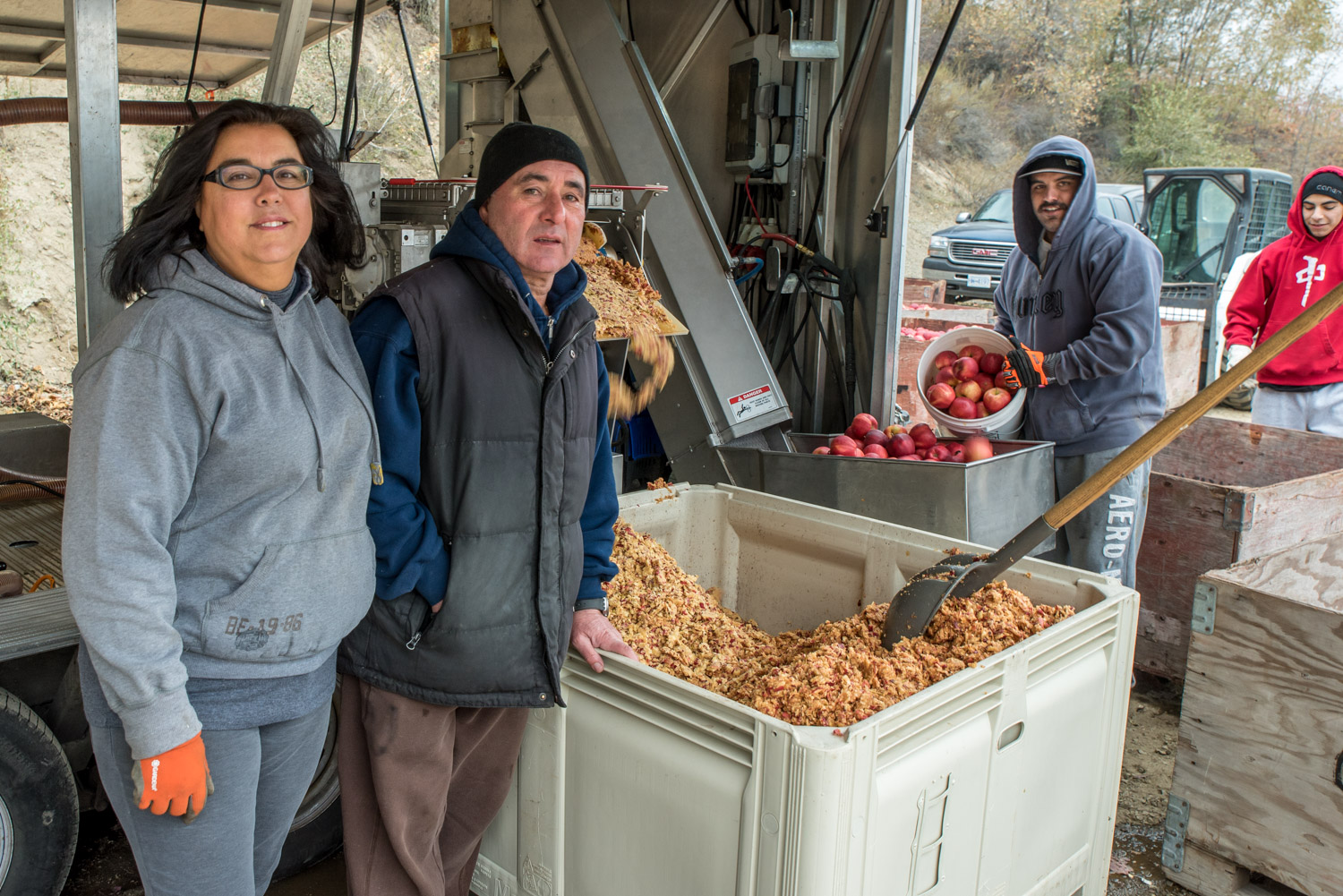
Anna and Jack Relvas were making cider last week from apples they’ve grown in their orchard. In the background, their son Jeremy pours some apples into a bin. (Richard McGuire photo)
Wine may be the beverage of choice in the South Okanagan, but a local couple hopes to profit from the growing popularity of cider.
Anna and Jack Relvas only grow a single row of grapes for personal winemaking. Most of their land just north of Osoyoos is dedicated to fruit orchards, in particular apples.
When a severe hailstorm in the spring scarred their entire crop, they began looking at options to salvage their fruit in similar situations.
“The fruit was still excellent quality on the inside,” said Anna. “But because of a few blemishes on the skin due to the hail, it was not marketable to the fresh market. So we started researching some different options and what we came up with was cider production.”
Cider is a sparkling beverage usually made from apples, but sometimes including other fruit.
The alcohol content varies, but it is roughly similar to beer. It is, however, refreshing and smoother than beer.
“I’ve been a cider lover for years,” said Relvas. “I’ve bought cider for a long time and my husband has made his own wine for more than 30 years, so we thought that the two went hand-in-hand – his winemaking technique and my love for cider was a good fit as well as using our fruit that we thought was still excellent quality aside from the blemishes on the skin.”
Late in November the couple finally began crushing their fruit, a process that was delayed by the mountains of paperwork and regulations they had to wade through.
A snap of cold weather last month delayed their crush date even further.
When they finally got going, they brought in a crushing machine and staff supplied by Mobile Juicing, a Vernon-based company that helps local orchardists produce juice.
They’ve also purchased a German-made stainless steel fermentation tank that can be used for cider or wine.
The couple plans to market their cider under the name Faustino Estate Cidery.
Faustino is Jack’s middle name, but as Anna explained, it’s more unique than the common name Jack.
They plan to produce 5,000 litres this year for their first batch and they will make a dry apple cider as well as a semi-sweet version.
“Dry cider is what a true cider drinker is going to want,” said Anna. “Somebody being introduced into the cider world probably would want something a little sweeter until they develop the palette for cider.
“Then they would probably move to a dryer cider. It’s kind of like wine where if you’re not a wine drinker, you’re going to start with white that’s easy to drink and slowly make your way over to a full-bodied red.”
They plan to put it in 750 mL bottles, the same size as a standard wine bottle, and market it to beer and wine stores and some restaurants.
When funds permit, they plan to open a small tasting room by Hwy. 97 just north of the Red Barn Fruit Market.
They hope to be able to bottle their first batch in February and have it in stores by April.
The couple has been doing lots of research into cider and have also sought advice from friends who are winemakers, Anna said.
They’ve also engaged a consultant who will come in to test the juice to make sure it’s at the proper levels to produce a good cider.
Cider production has taken off in the U.S., Anna said, and other farms in the area have also started to produce it.
Just up the road, Orchard Hill Estate Cidery produces Red Roof Cider that is sold both locally and to restaurants and bars on the Lower Mainland.
Fairview Cider recently opened in Cawston.
“It’s starting to pick up,” said Anna. “The U.S. is huge in cider production. They have been making cider and selling tons of cider for years. That’s kind of what prompted us to get into the market now, because we think this is going to take off.”
Alcohol content of cider ranges between 4.5 per cent and 7 per cent, depending on the apples and fermentation process, Anna said.
People sometimes choose to produce it with a higher alcohol content because it preserves it longer.
For Anna and Jack, the main attraction of cider production is that they see it as a way to maintain their farming lifestyle at a time when agriculture is experiencing difficulties. They’ve been farming near Osoyoos for 14 years.
Many fruit farmers have tried to survive by pulling out their orchards and switching to grapes, but the grape market now is saturated and some growers are experiencing difficulty in selling their crops, Anna said.
The couple also grows cherries, peaches and nectarines and they are looking at including some of these fruits in their ciders in future years.
“We want the lifestyle and the space,” said Anna. “We love that agricultural lifestyle where you’re not living in a cul-de-sac with a neighbour on either side. We wanted to maintain that, but we wanted to make it sustainable and in order to do that, that’s why we thought of cider.”
RICHARD McGUIRE
Osoyoos Times