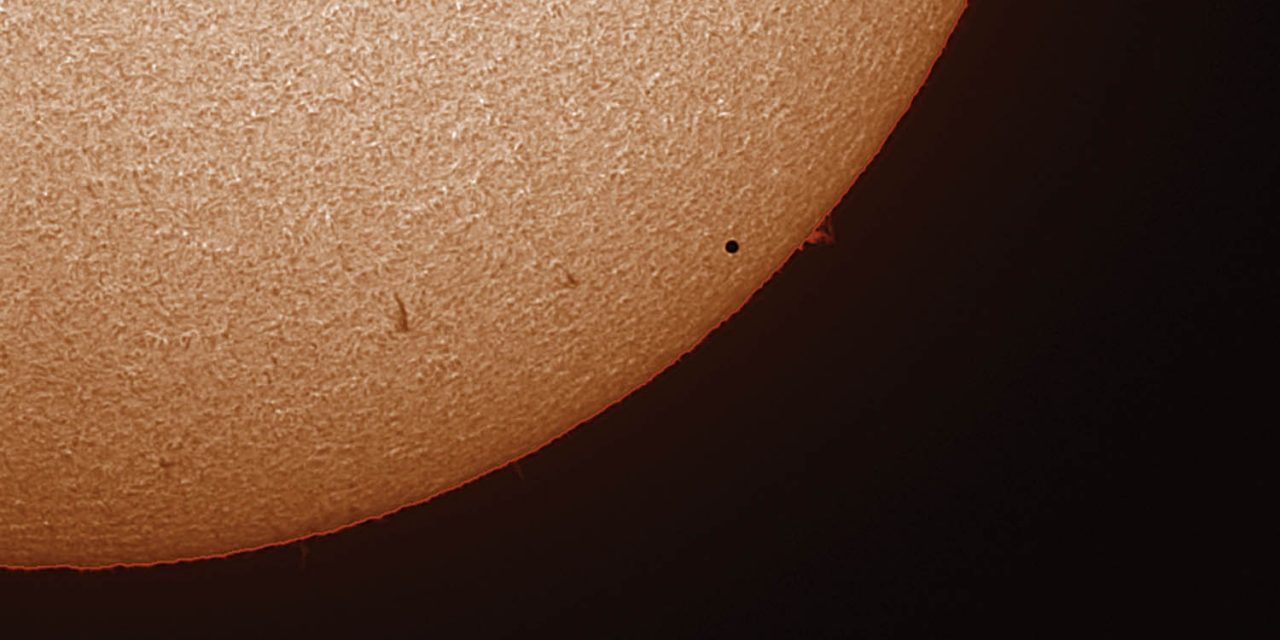
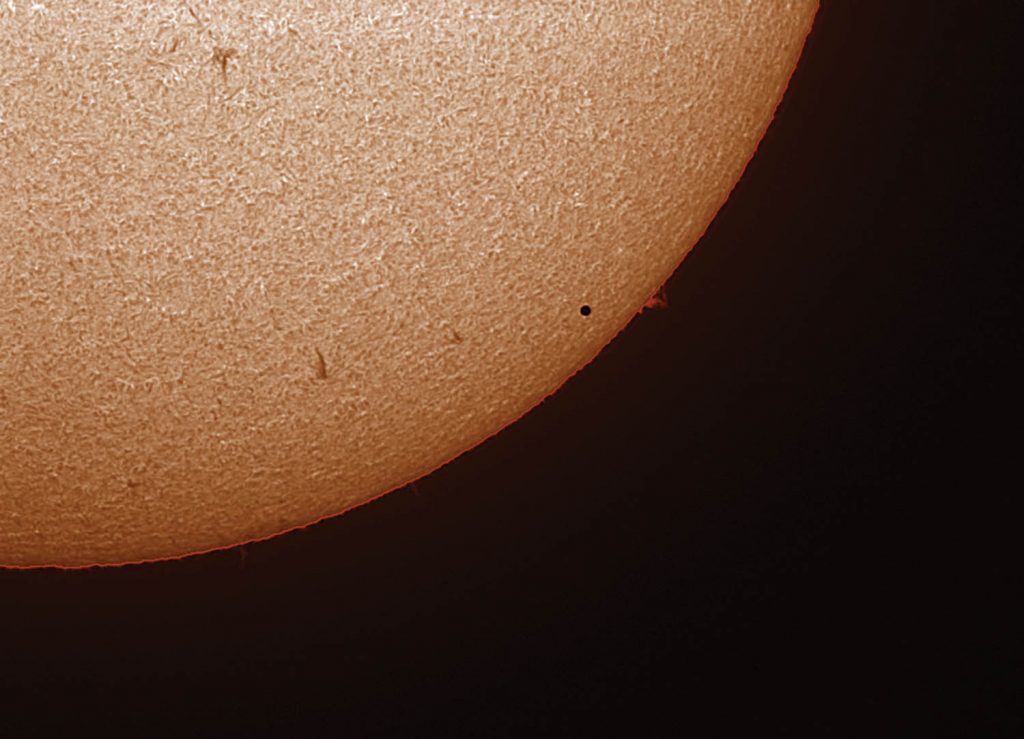
Local astronomy expert and award-winning photographer Jack Newton took this incredible photograph of the planet Mercury passing by the Sun this past weekend in a rare astronomical event called Mercury in Transit. Mercury is the tiny black dot seen at the bottom right of the sun in this photo. (Jack Newton photo)
Even by his own lofty standards, it was a very good week for local award-winning photographer and astronomy expert Jack Newton.
Newton and his wife Alice are the proud owners of the Observatory Bed and Breakfast – which they opened back in 1999 – on Anarchist Mountain in Osoyoos.
For his entire adult life, Newton has been fascinated with stars and planets located far away from Earth.
He has used his immense photography skills and state-of-the-art telescopes to shoot some of the most breathtaking photography in the world.
His work has landed him on the pages of such illustrious publications such as Time, Newsweek and National Geographic.
It was a very good couple of days for Newton as a rare Transit of Mercury took place Monday morning.
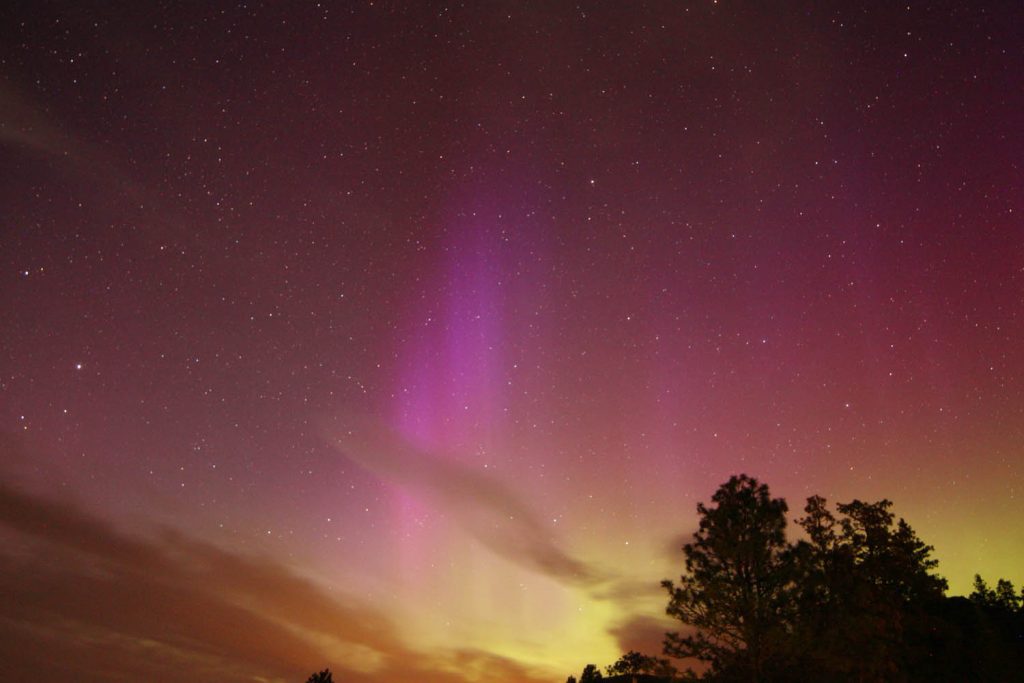
Less than two days earlier, Newton was able to shoot Aurora Borealis – more commonly known as the Northern Lights – passing through Osoyoos.
On Monday, Newton was behind the lens of his high-powered telescope to shoot numerous photographs of the rare Mercury in Transit event.
Planetary transits are amongst the rarest of astronomical events, said Newton.
Only the two innermost worlds, Mercury and Venus, can pass directly between the Earth and the sun, which is exactly what happened Monday morning with the planet Mercury crossing the sun for the first time since 2006, said Newton.
“I caught it 20 minutes before it left the sun … it took four hours to completely cross the sun,” said Newton.
Newton was using a four-inch refracting telescope with a hydrogen filter to capture the Mercury in Transit images.
Less than two days earlier on Saturday evening, Newton was entertaining guests at the bed and breakfast when one guest commented that there was an awesome display of lights going on down at the bottom of Anarchist Mountain towards the Town of Osoyoos.
“I asked him if the light show was green in colour and when he responded that it was, I knew it was the Aurora Borealis,” said Newton. “It was quite a spectacular display of lights that covered large parts of the town. I haven’t seen the Northern Lights dancing across Osoyoos like that in a very long time.”
The intensity of the Northern Lights was so strong that Newton is convinced a “geomagnetic storm” caused by molecules being released from a “solar hole” hits the atmosphere on Earth and resulted in a light show to remember.
“The Northern Lights are always spectacular, but they were especially intense and dancing on Saturday evening,” he said. “I’m glad I was able to capture some pretty amazing images.”
Transits of Mercury always occur in early May or early November, when the planet is near an ascending or descending node in its orbit – the point at which Mercury crosses the plane of the Earth’s orbit, Newton explained.
Only then do the worlds align, allowing the fast-moving inner planet to cross the solar disc instead of passing above or below as usual, he said.
November transits occur when Mercury is near perihelion, when it’s closest to the Sun and farthest from Earth. During May transits, Mercury is near aphelion, positioning it farther from the Sun, but nearer to Earth.
To view Mercury transit the Sun, Newton said he had to use the specialized filter to protect his eyes. Viewed this way, a little black dot slowly moves across the face of the Sun, he said.
The transit presents a rare opportunity to witness a planet’s orbital motion in real time, he said.
The full transit last nearly 7.5 hours, but exact times can vary slightly depending on location, with the differences amounting to mere seconds, he said.
The first Transit of Mercury was observed back in 1631, by French astronomer Pierre Gassendi only 22 years after Galileo first trained a telescope skyward, said Newton.
KEITH LACEY
Osoyoos Times
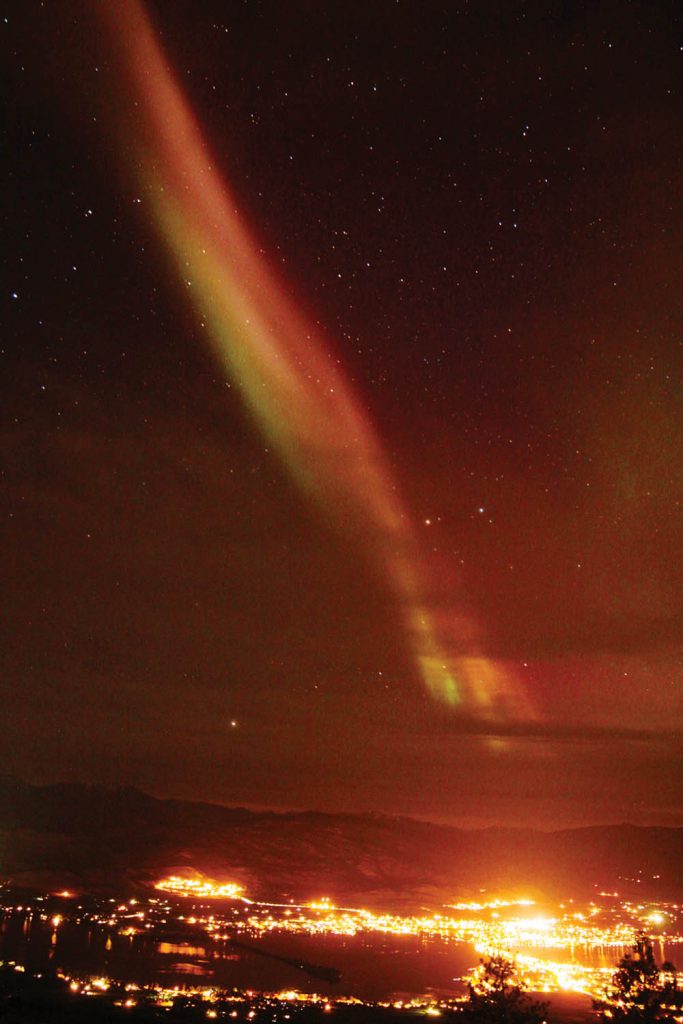
Osoyoos-based award-winning photographer and astronomy expert Jack Newton took this fabulous shot of the Aurora Borealis (Northern Lights) that flooded over the Town of Osoyoos on Saturday night. (Jack Newton photo)
Osoyoos-based award-winning photographer and astronomy expert Jack Newton took this fabulous shot of the Aurora Borealis (Northern Lights) that flooded over the Town of Osoyoos on Saturday night. (Jack Newton photo)