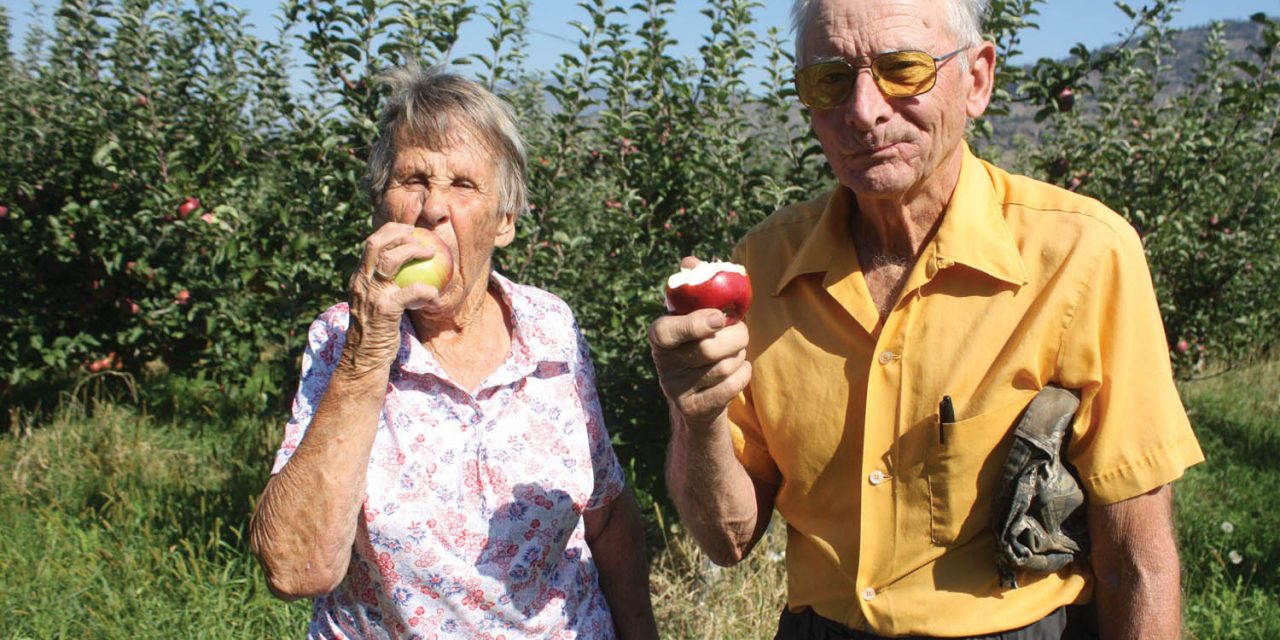

It has been just over one year since local orchardists David and Jean Evans received certification from the Canadian Food Inspection Agency to market and sell their new Okana apples to consumers across B.C. and around the world. Evans sold all of last year’s crop to the Buy-Low grocery store chain and is hoping to do the same now that this year’s harvest has just wrapped up. (Keith Lacey photo)
At age 81, David Evans is finally reaping the fruits of his labour as a South Okanagan orchardist for more than 50 years.
Just over one year ago, the Evans’ achieved a dream when he and his wife Jean gained official recognition from the Canadian Food Inspection Agency (CFIA) to introduce a new variety of apple to Canadian consumers.
The CFIA officially approved final certification and granted plant breeders rights allowing the Evans’ to officially market their new Okana apple breed to consumers across the South Okanagan and around the world.
As the Evans’ complete their annual apple harvest – it started two weeks ago and should be finished this week – their Okana breed has made a real impact with fruit lovers across the South Okanagan and much of British Columbia.
All of the apples grown on Evans’ property, located off Road 15 between Osoyoos and Oliver, are shipped to the Fernandes packinghouse facility in Osoyoos.
Last year, thousands of pounds of the new Okana breed were sold to the Buy-Low grocery food chain across British Columbia.
Tom Fernandes, who owns Fernandes Packing House, said he’s confident he will be able to sell all of the Okana apples he receives from Evans’ farm once the harvest is complete.
“We’re in the process of selling product right now, but I don’t see any reason why they won’t sell like they did last year,” he said. “It was a very popular apple last year and should be again this year.”
That’s great news to David Evans.
“I sell the Okana for 50 cents a pound, while I only get 22 cents a pound for my other apples,” he said. “I’m up to about 1,000 Okana trees this year, so we’re looking at a much bigger harvest than last year.”
He sold more than 30,000 pounds of Okana apples last year and hopes for an even better harvest this year.
It took more than 25 years of hard work to produce the Okana breed and get certification, but all of that hard work has paid off handsomely, he said.
When he walks into the local Buy-Low store and sees a large bin filled with Okana apples, it brings him great pride and joy, he said.
“I’m very proud of this apple I’ve developed,” he said. “It’s a very hearty apple and it tastes great and the response to it has just been fantastic.
“This is one of the few apples you can buy and let it sit for some time and it’s not going to bruise and it’s still going to taste great. I’m very proud of that. It tastes fantastic.”
Because he has secured the breeders rights, Evans said he’s continuing to work on partnership with other orchardists to grow more apples in the South Okanagan in the next couple of years.
“I’m in regular contact with several growers to see if they would be interested in getting a nursery going,” he said. “Some of them are very interested and hopefully we’ll be working on something very soon.”
It takes about four years to plant root stock to growing a tree that can produce apples, he said.
Not only do Okana apples taste great, which is the most important thing, but the trees that bear the fruit are among the nicest he’s ever worked with in almost 60 years in the business, said Evans.
“This is a tree that simply won’t winter kill,” he said. “It is very hearty and strong.”
Besides their large apple orchard, the Evans’ also have a large peach orchard and have been raising a small herd of cattle on their property for more than half a century.
“We’re the only farmers in this region that I know that still are ranchers and fruit growers at the same time,” said David.
Evans tasted an apple from one of the trees on his property back in 1998 and knew he had tasted something different.
“I took a bite and knew this tree was producing an apple unlike any other on our property,” he said. “That’s when I started to experiment.”
Like any new variety that is introduced to the marketplace, Evans developed the Okana variety through years of experimentation.
He used a budding program where you take the bud off of one tree and plant it on the shoot of another. Then it grows if you know what you’re doing and you move on from there.
Similar in size and shape to a Spartan apple, the Okana is sweet instead of tart, has better and more rounded colouring and offers a more appealing taste experience for the average consumer, said Evans.
KEITH LACEY
Osoyoos Times