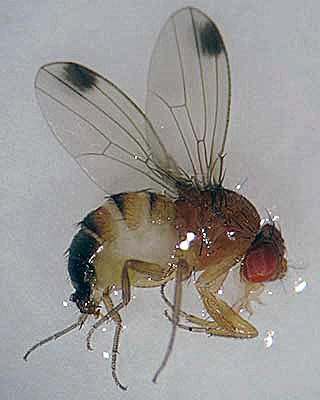
The spotted wing drosophila, a fly introduced to B.C. in 2009, caused a reported $2 million in damage to Okanagan Valley cherry crops this year. Pictured above is an adult male. Photo by Sheila Fitzpatrick, Agriculture and Agri-Food Canada, Pacific Agri-Food Research Centre, Agassiz - Click on picture for larger image
OSOYOOS TIMES-December 15, 2010
By Tasleem Mawji – Osoyoos Times
The spotted wing drosophila has been found in traps all over the Okanagan Valley, according to Sera Lean, a horticulturalist for Oliver’s Grower’s Supply South Valley.
The pest was first discovered in California, and then found in blueberries and wild blackberries on the coast of B.C. in 2009.
Earlier this week, the spotted wing was called the “mad cow disease of the cherry industry,” in a CBC article featuring Greg Norton, a cherry farmer and the chair of the Okanagan Kootenay Cherry Growers Association.
Norton declined an interview with the Osoyoos Times.
But others in the industry like Tracy Hueppelsheuser, a provincial entomologist with the B.C. Ministry of Agriculture, have said the impact of the pest is manageable.
Lean said that if growers and the rest of the community are alert to the new pest, it will help to minimize potential damage to cherries and other soft fruit.
“The (tree fruit) field service, the Ministry of Agriculture, and consultants have been watching this pest. We have been trapping it and there is an action plan in place. And being reactive about this is not a good idea,” Lean said. “Growers need to be educated and not be running on ignorance or fear. Know what it is, and go to the meetings. It’s not going away, so it’s going to be up to the growers to be educated and be mindful.”
According to the Dec. 6 CBC article, the fly caused an estimated $2 million worth of damage to B.C. cherries last summer.
But Lindsay Hainstock, a field service worker for the Okanagan Tree Fruit Cooperative, said the reported damage is speculative, as it is not always possible to pinpoint the species of invasive worm in infected fruit.
“It could have been several different types of fruit fly…a lot of the (time) we rear them out to then confirm the adult fly. But because it was a learning curve this year, we were learning how to rear them, what to do…we didn’t even know it was going to be across the whole Okanagan this year.”
The spotted wing drosophila is from Japan and is different from the common cherry fruit fly in that the female fly has a serrated ovipositor to allow it to cut through fruit and lay eggs.
The male fly has spotted wings.
What also sets it apart from other fruit flies is that the spotted wing can host itself in a large variety of fruits including, but not limited to, blueberries, blackberries, raspberries, peaches, nectarines, plums, apricots, cherries, Oregon grapes and mulberries.
But it has not been found in apples and pears.
Hainstock also said that although research is being conducted south of the border in states such as Washington, California and Oregon, the lifecycle of the bug is still unknown.
“Every insect has a different biology of how many generations you’ll see in a season. Some insects might have one lifecycle, some might have two and up from there depending on how quickly they reproduce (and) what kinds of hosts they need,” she said. “The Canadian Food Inspection Agency worked with the Japanese model to try and predict that. But we’re thinking that there’s a lot more to learn with it in this area, just with the different (weather and geographical) conditions.”
Ranbir Kambo, a local cherry farmer, said that, so far, his orchard and neighbouring orchards are clean, and that a trap on his property did not catch any of the bugs.
But he is still preparing for the new species of fly.
“It’s not going to be easy, but that’s our life,” he said. “We control one pest and another one shows up. It’s an ongoing story for us farmers.”
Kambo is going to spray a new pesticide called GF-130 this year, which he said is supposed to be effective for the fly (as opposed to GF-120, which is effective for the cherry fruit fly).
According to Lean, in Canada, the common pesticides used for cherry fruit fly will not all be effective on the spotted wing, so growers will need to know which sprays are effective.
“There are registered sprays we can use and if used correctly, being mindful of the pre-harvest interval date (the amount of time between spraying and harvesting fruit), then it should be okay.”
Lean said one of the strongest tools for growers is sanitation including burying or bagging culled or damaged fruit instead of leaving it in piles above ground or mowing culled fruit to assist in killing off potential eggs or larvae.
Lean and Hainstock said people with backyard fruit trees should keep in mind that there needs to be a community effort to keep pests from getting into nearby orchards and damaging commercial crops in the area.
[email protected]