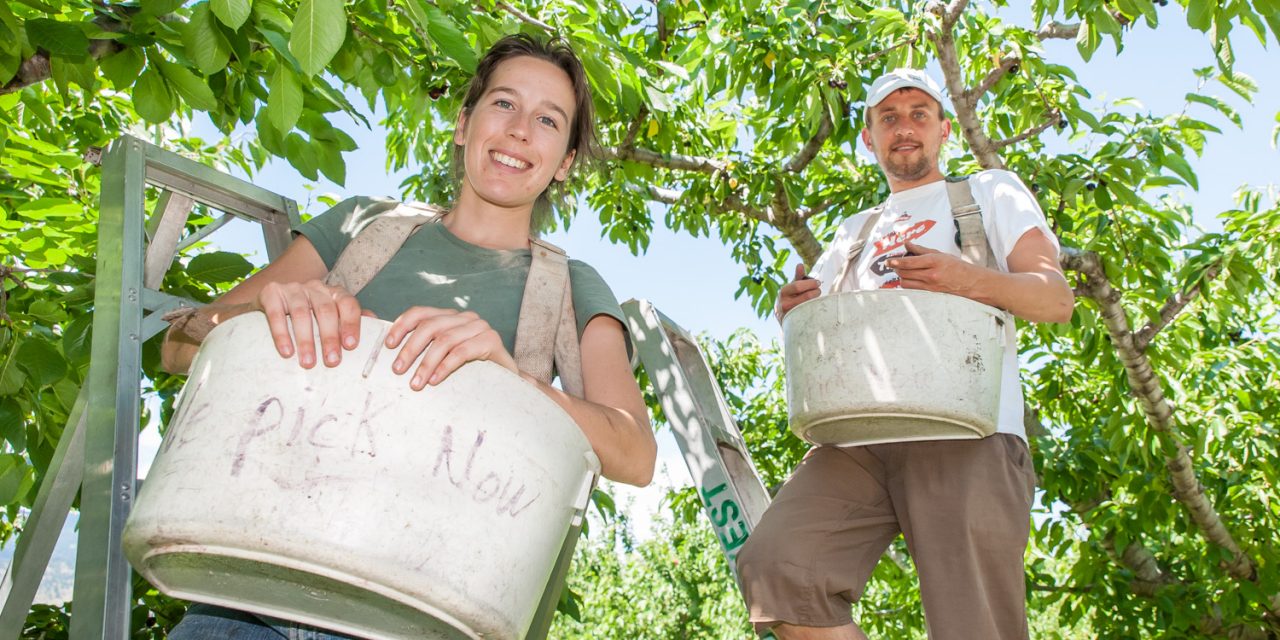

Maude St-Jean from Quebec works at an orchard outside of Oliver. Her business, We Pick Now, aims to connect growers with migrant workers.
Richard McGuire photo
A lighter cherry crop this year in the South Okanagan due to spring weather made it harder for hundreds of pickers to earn what they did in previous years and many moved elsewhere.
While some returned to Quebec in frustration, others moved on to pick in other parts of BC, including moving north in the Okanagan.
For growers, that’s not so much a problem this year, said Greg Norton, a fruit grower west of Oliver.
“There are tons of pickers,” he said. “It’s not this year that we’ll feel it. It’s next year.”
Many pickers, he said, are students from Quebec who are here to earn some school money. Many came expecting to earn a certain amount, but with the lighter crop, they didn’t earn as much.
“The problem is when they go back, they’re going to say we lost money and couldn’t find a job, and when we did find a job the picking was bad,” Norton said, suggesting fewer may come next year.
The lighter season has also had an impact on the picker placement business started last year by Laurence-Olivier Néron and his partner Maude St-Jean. The couple from Sherbrooke, Quebec has been coming to the Okanagan for almost a decade to pick cherries and last year they started a business, We Pick Now, to help growers find good workers.
“Last year we did over 300 placements through the Okanagan from Osoyoos to Vernon,” said Néron. “Some were for day jobs, others were for long-term contracts, and we helped about 50 vineyard owners and cherry growers throughout the season.”
This year, with the lighter crop and glut of pickers, the calls from growers aren’t coming in. And We Pick Now makes its income by charging a fee to growers for the placements.
Fortunately for Néron and St-Jean, We Pick Now isn’t their bread and butter. They started it more as a way to help pickers find jobs and the two have still found steady work doing picking.
As Norton explained, it was a combination of weather problems that affected the cherry crop and the conditions varied throughout the valley and its different micro-climates.
On his farm, a late frost at the beginning of May accounted for about 20 per cent of his losses. The bigger problem was that weather in early May kept the bees from pollinating the crop.
“Our bees were not able to pollinate the trees,” said Norton. “The weather was just dismal for pollination. It was either raining or it was cold and windy and the bees just did not get the flying time to do the job.”
Néron suggested later crops such as grapes weren’t affected by the pollination problems and they should do well. The problem, he said, is that many workers have become discouraged and many are moving on. And that could actually result in a shortage of workers as other crops, even late cherries, need to be picked.
Charles Tremblay, a young picker from Quebec City who is here for the first time, said he has worked at three different locations in the South Okanagan and has not had a problem finding work.
Some of his friends, however, have become discouraged and have returned to Quebec.
Ginette Langevin, who came to Osoyoos from Montreal to pick cherries in 1979 and ended up staying, now volunteers for Osoyoos Baptist Church in its efforts to help the pickers. Because she speaks French, she said she is like a friendly “grandma” to the pickers.
“When you pick, you pick by the bucket, piece work,” she said. “Because the cherries are so scarce, it seems like it hasn’t increased the wage much.”
One couple, she said, spent the day picking and only made $45 between the two of them after working many hours.
“They’re disappointed and it’s not necessarily due to the farmers,” she said. “The crop was a little bit of a disaster.”
Pastor Phil Johnston of Osoyoos Baptist Church said a number of pickers have told him they are moving on to Summerland where they hear the crop is better.
Richard McGuire
Special to the Chronicle