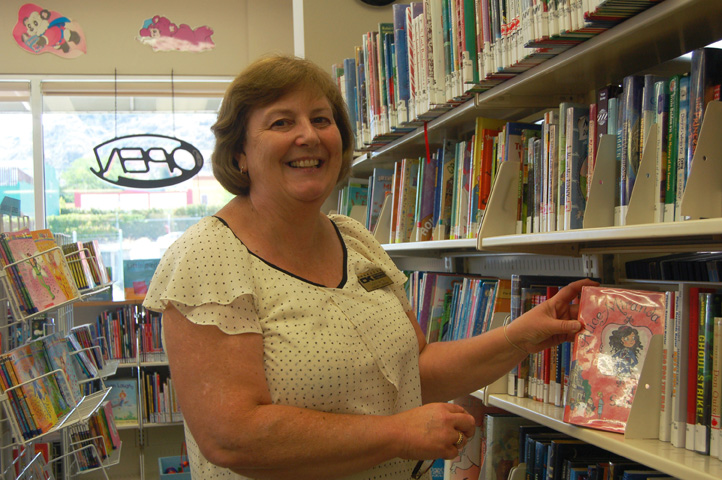

Oliver community librarian Vicky White sums up the changes she’s seen in her 27-year library career with a single word: “computerization.” Though she notes that E-circulation is still relatively small compared to print circulation at Okanagan regional libraries.
Erin Christie photo
For many people, the library is simply a place in the neighbourhood where you can go to borrow books.
In recent years though, libraries have been undergoing a revolution both in what they offer and how they deliver it.
Vicky White, community librarian at Okanagan Regional Library’s Oliver branch, sums up the changes she’s seen in her 27-year library career with a single word: “computerization.”
At first this simply meant the change from the old card catalogues to computer-based ones that patrons could access in the branches.
Recently, however, computerization has brought a vast array of new electronic products that circulate alongside traditional books.
For many of these, patrons can “borrow” at home through the internet without ever stepping into a library branch.
E-books, e-audiobooks, electronic magazines, MP3 music, language learning, talking children’s books and dozens of online databases on numerous topics, are just some of the electronic choices libraries are now offering.
E-circulation is still relatively small compared to print circulation, but it is growing rapidly at Okanagan Regional Libraries.
While e-circulation numbers are still just roughly five per cent of print circulation, the library is projecting a 50 per cent increase in 2013 over 2012 e-circulation figures.
To what extent is this electronic revolution being embraced in communities like Osoyoos and Oliver that have older populations?
The median age in Osoyoos in 2011 was 60.3 years, and in Oliver it was only slightly younger at 56.3. Are seniors adopting the new technologies?
Anecdotally, both Osoyoos and Oliver library branches report that the largest demographic using the library is people over age 50 and they are typically retired.
“I would say there’s both ends of the spectrum,” said White. “There are the seniors and there are the children and parents with young children, but not so much middle ground.”
Both White and Kathy Burton, her counterpart in Osoyoos, say that many in the teen to middle age range are so busy in their lives that they don’t have as much time for the library.
Nonetheless, there are some “hardcore readers” in the 30 to 40 age range that have always used libraries and still like the feel of a traditional bound-paper book, White said.
Currently, there’s no way to know how many Osoyoos and Oliver library patrons are “borrowing” products like e-books. That’s because people who want traditional books come into the branches, but those borrowing electronic materials typically do it from their home over the internet, explains Burton, community librarian at the Osoyoos Branch.
Protection of privacy also makes it harder to know the extent to which people in specific communities are using these electronic products, explains Michele Rule, communications manager with Okanagan Regional Library.
Librarians tell of seniors who come in with brand new e-readers, sometimes still in the box, that they’ve received as gifts from their adult children, and they want to know how to borrow e-books.
Some seniors have embraced e-books and as a result they don’t make it into the library as often.
White said she sometimes doesn’t see a long-time patron for a while, and when she finally sees them, they are almost apologetic about having switched to e-books.
Do most people, however, still consider libraries to be the local bricks and mortar branch where you go to pick up paper books in person?
“I think our patrons do,” said Burton. “We are a more senior population and definitely the majority of seniors still view it as a print material. That’s what they are interested in.”
On the other hand, she notes that a significant number of younger retirees are travelling a lot and may spend winters in Arizona or California.
“They have really taken to e-reading,” she said. “They love their e-readers and downloading books.”
“They want to take the library with them,” said Rule. “That’s exactly why we have that resource.”
Not everybody has embraced the e-book revolution and some prefer to carry traditional books even when they travel.
JoAnne James was checking out a stack of books that she said she plans to take on a plane, even though her husband has been pressing her to get an e-reader.
“He would like it because I tend to always have a lot of books going,” she said. “I know a lot of my friends have turned to e-readers and they don’t have to carry books with them. There’s some advantage there, but I do love opening the book and I have a tactile relationship with the book.”
James, 59, spends the winters in Yuma, Arizona, and she prefers to be an active member of the library in Yuma.
Jim Burton, no relation to librarian Kathy Burton, said he has not been tempted to get an e-reader.
“I like to have a book in my hand,” he said. “It’s what I’m used to. I’ve been doing it since I was a child.”
Burton, 68, has spent winters in New Mexico and also preferred to join the library there rather than use e-books.
Librarian Kathy Burton believes that most people know about e-readers and the fact that they can borrow e-books from the library, even if they don’t understand how it works.
Some, she said, are confused by the idea of “returning” an e-book. In fact, the book simply expires electronically and can no longer be read at the due date so there are no late fees. Readers can also return a book early online.
The library has information about the process on its website, as well as information about the array of electronic services available.
White said that despite the awareness of e-books, many people don’t know the range of other electronic materials the library offers.
One service that’s very popular, but that some don’t know about, is Zinio for Libraries, White said.
This allows people to access hundreds of popular magazines which can be read online with a browser or downloaded for off-line reading. Unlike the commercially available version of Zinio, however, the magazines have expiry dates.
Another popular offering, White said, is Powerspeak Languages, which offers online language training in French, German, Italian, Japanese, Mandarin, Spanish and English as a second language for Spanish speakers.
“We’ve been promoting Powerspeak a lot because we often get asked for Rosetta Stone,” White said.
Most electronic resources can be accessed from home, but there are a few exceptions that must be accessed at the library.
These include Ancestry: Library Edition, a popular genealogy service, as well as certain resources on government grants, building codes, law and vehicle inspection standards.
New services are being added continuously. In May, the library added OneClick Digital, a service providing free access to more than 4,000 audiobook titles.
There’s even a service, Freegal, which allows library members to download up to three MP3 songs a week free from Sony Music Canada. These may be kept and unlike e-books, they don’t expire.
One of the more popular services, accounting for seven per cent of e-circulation in 2012, is Tumblebooks – animated, talking picture books aimed at children.
Rule thinks demand for these kinds of services will grow rapidly as younger children are getting more electronic gadgets.
“We’re seeing children coming into the library with an iPad,” she said.
The demographic that both community librarians say is the hardest to attract to the library is pre-teens and teenagers.
“It’s just not cool, and to them it’s sort of schoolworkish,” White said.
Still, she counts it as a success when she sees teens who have first come with their class return to check out a book on their own.
Burton agrees that teenagers are also underrepresented at the library in Osoyoos, and thinks it’s partly because they’re busy with school work.
Both libraries, however, reach out to the elementary schools with regular programs including the summer reading program.
With the proliferation of electronic materials, and the growth of the internet more generally, it’s easy to forget that many in the community don’t have computers of their own or internet access.
As White notes, government agencies are increasingly putting their information and forms on the internet. When citizens call for the information, they are told to look online. And that’s a problem for those without internet access.
The libraries then are often the only way these people have of accessing the internet. As Burton points out, aside from businesses offering Wi-Fi to customers, the library offers the only public internet access in Osoyoos.
The library provides free internet access to local residents and travellers alike.
“We help those people that are falling through sometimes,” said White, noting that the Oliver branch has provided a place for children to do homework or for seniors to obtain online forms.
Books and traditional library branches may still be with us for many years to come, and they continue to adapt their role as the community meeting space and village green.
But the computerization of information and literature is growing at a phenomenal pace and the way libraries fulfill their role is rapidly changing.
“It’s really within the last few years that this has become a focus for the library,” Rule pointed out.
If present trends continue – and there’s no reason why they won’t – changes in the next few years should be even more dramatic.
Richard McGuire
Special to the Chronicle