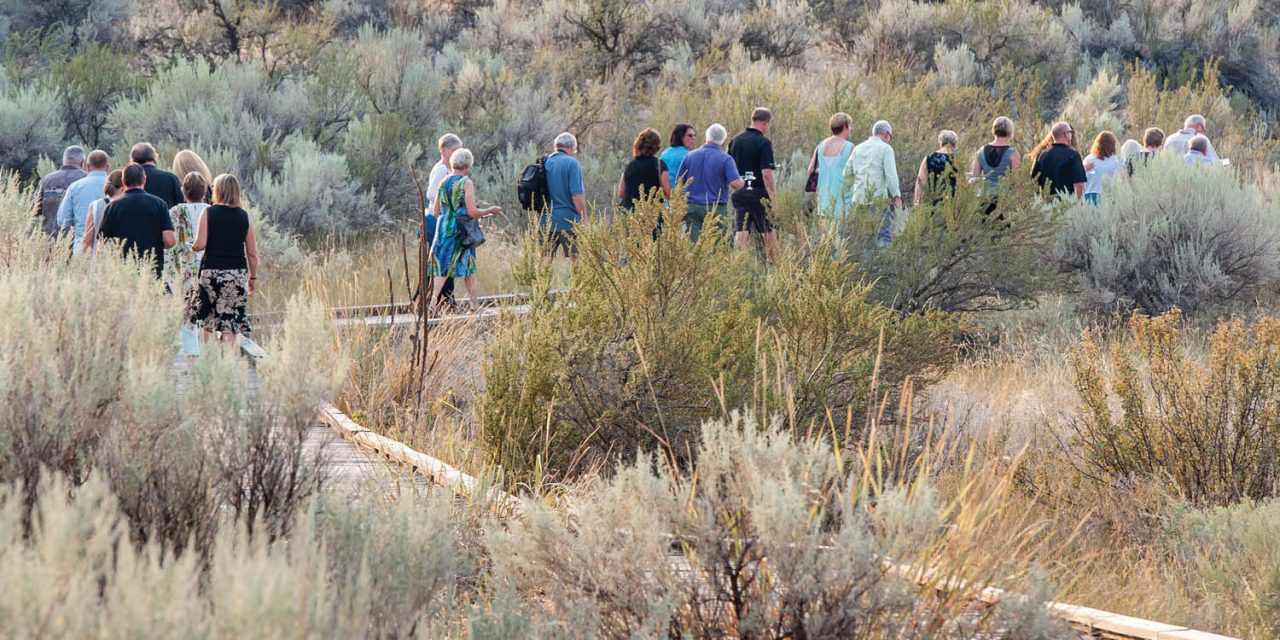

A group takes a tour along the boardwalk at the Osoyoos Desert Centre amidst its antelope brush ecosystem. (Richard McGuire file photo)
MLA Linda Larson’s initiative to have the Osoyoos Desert Centre declared a UNESCO World Heritage Site might be more difficult to achieve than participants on her ad hoc committee were led to believe.
In a recent interview, Larson said the paperwork “takes about two years,” a timeframe echoed by other participants at a committee meeting she held on April 9.
In fact, it can take decades, says a federal official responsible for the UNESCO nomination process.
Larson is proposing to nominate the Desert Centre for UNESCO status to help protect the environment and to attract tourism to the South Okanagan.
This is one of several initiatives she and her B.C. Liberal government are proposing instead of a national park reserve, which they oppose.
Mary Lou Doyle, acting manager for international and intergovernmental affairs with Parks Canada, did not comment on Larson’s specific proposal.
In an interview last week, however, she explained how a site in Canada is added to the world heritage list.
Parks Canada is the sole entity that represents the Canadian government for the UNESCO World Heritage Convention and is the only one that can submit Canadian nominations, Doyle said.
Canada currently has 17 UNESCO World Heritage Sites and there is a tentative list of another seven. That tentative list, however, was established in 2004 and there are no plans to add any additional nominations.
“It’s a long and arduous process,” said Doyle, adding only four sites nominated in 2004 have received UNESCO status and the others are still waiting.
“There are no specific plans at present to renew the tentative list,” she said. “The tentative list is still current. For a new site, we would take that on board and put it in the hopper for the future. We have inquiries on file that we’ve been collecting since the 2004 process closed.”
Even when the process is open, sites are carefully vetted under a four-stage process to ensure they meet the criteria for inclusion on the world heritage list.
“You can’t just have everything,” Doyle said. “It has to have good potential.”
First and foremost, a site must have “outstanding universal values,” Doyle said. It must also be protected under government legislation.
Citing UNESCO operational guidelines, Doyle said “outstanding universal value” means “cultural and/or natural significance which is so exceptional as to transcend national boundaries and be of common importance for present and future generations of all humanity.”
National or provincial park status of a site would not in itself make it more likely to be recognized, but it would give it the required protection, she said.
Among Canada’s current UNESCO sites are the Rocky Mountain national parks, SGang Gwaay in the Haida Gwaii, Head-Smashed-In Buffalo Jump in Alberta and the historic district of Old Quebec.
The international list includes such locations as the Great Wall of China, the Taj Mahal in India, the Acropolis in Greece, old Venice in Italy and Grand Canyon National Park in the United States.
The Osoyoos Desert Centre sits on 67 acres of leased provincial Crown land next to the Osoyoos landfill site. The land is an example of endangered antelope brush habitat.
Meanwhile, one of the participants on Larson’s committee believes that a larger area should be considered.
Dr. Daryll Hebert has worked in ecosystem management for about 30 years and has set up environmental programs for major companies, including Alberta-Pacific Forest Industries.
He is on the advisory board of the Nature Trust of B.C. He acknowledges, however, that he has no experience with potential UNESCO sites.
Hebert suggested to Larson’s committee that they should look at the desert ecosystem as a whole to see what its original outline was and then look at what pieces have been lost to human impact such as agriculture.
They should then look at the largest remaining pieces of this environment.
“I think what they were trying to do at the start was concentrate on this 67 acres,” said Hebert. “I was suggesting that they go back and start right at the top because there may be ways of getting some funding to buy some of it back.”
Hebert also pointed out that the Osoyoos area represents the northern extreme of this ecosystem, which extends from the United States. As an outskirts location, it is most likely to experience changes as global warming continues.
“There’s going to be a lot of changes, especially in that kind of ecosystem,” he said. “It should actually expand over the next 30, 40, 50, 100, 200 years.”
Hebert also suggested a marketing strategy to raise funds, including looking to the winery industry for a major contribution.
“They could at least indicate that they are doing something to protect these kinds of ecosystems instead of continually changing them into vineyards,” he said.
The project will be costly, he said.
Whether or not Larson’s initiative moves forward will depend on finding some people within the group to do the legwork, Hebert added.
“It’s got to be a few very dedicated people to be able to continue that process following the meeting in order to start arranging all the technical information and all the planning information,” Hebert said. “The sooner it’s started, the better off we can be.”
RICHARD McGUIRE
Osoyoos Times