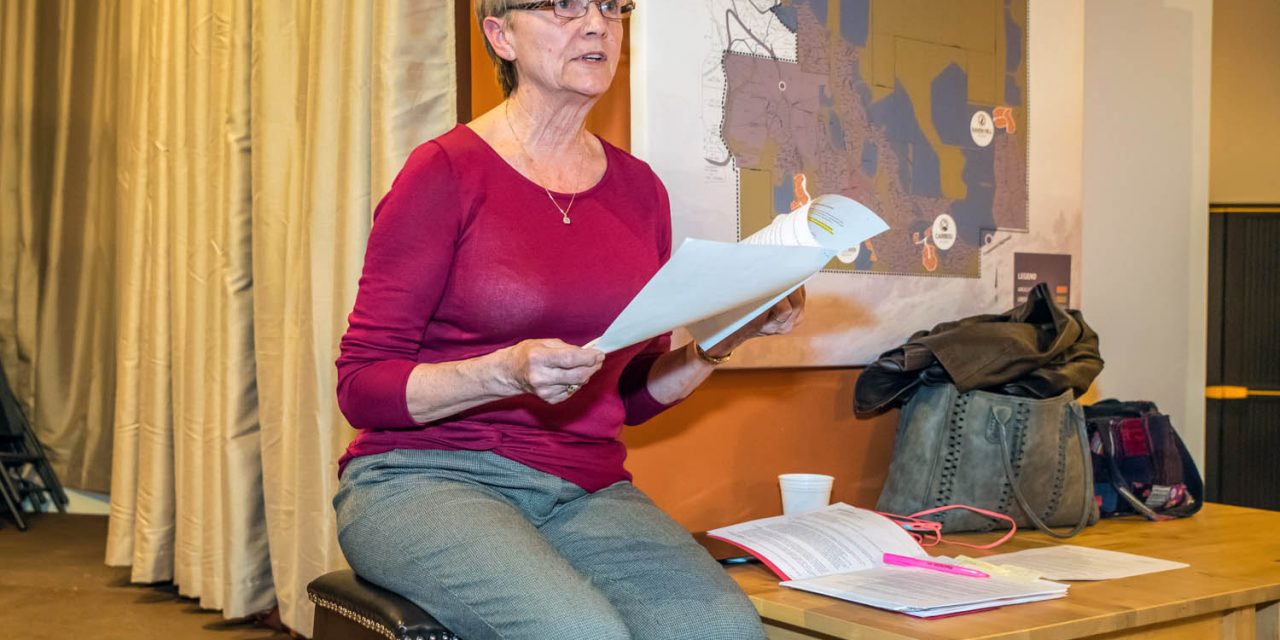
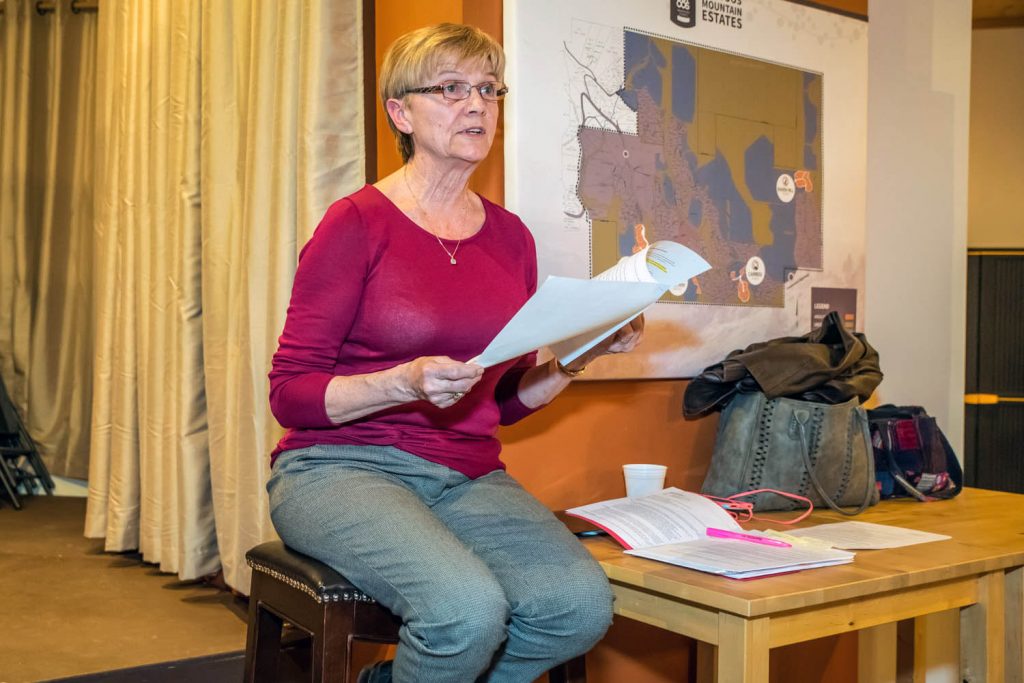
Linda Larson, the B.C. Liberal candidate and incumbent MLA, spoke to residents of the Anarchist Mountain community last Tuesday. The main topics of interest were healthcare and two-tier electricity rates, but Larson tried to avoid discussing electricity, instead bringing in FortisBC representatives to talk in her place. (Richard McGuire photo)
MLA Linda Larson downplayed the issue of bed reductions at South Okanagan General Hospital (SOGH) in Oliver when she spoke to residents of the Anarchist Mountain community last week.
During a discussion of healthcare, when one resident said, “It seems like there’s something happening at the Oliver hospital,” Larson disagreed.
“No there is not,” said Larson, the B.C. Liberal candidate, who spoke to about 35 residents at the Summit Centre last Tuesday.
Larson explained that there have only been 18 funded beds at the hospital for the past five years, even though there are 24 “real beds.”
“The other beds have been used occasionally in emergencies,” Larson said. “They are also used as a backstop with Penticton. We have a reciprocal agreement with Penticton about beds. But there is no change to the Oliver hospital other than that they are doing some reconfiguration.”
She added that it is not a sterile environment to have two beds in a room with a curtain between.
Play audio of Larson’s discussion of health issues with the Anarchist Mountain Community (runs 12:13):
Her comments came the same day that Dr. Peter Entwistle announced he was resigning as chief of staff at the hospital, in large part due to the cuts in beds, which he said would leave some patients on beds in the emergency department.
Entwistle subsequently announced he plans to run against Larson and NDP candidate Colleen Ross in the May 9 provincial election.
Skeptical about Larson’s claim that the bed reductions aren’t a problem, one woman asked Larson: “Then why has Dr. Entwistle resigned as the chief of staff of the Oliver hospital.”
“Do you know Dr. Entwistle?” Larson asked her.
“He’s my doctor,” she replied. “I know him well.”
Larson said Entwistle has only resigned from the emergency department and not from the hospital.
Entwistle, she said, “has been worked to death and he’s incredibly frustrated because he’s been working alone because he can’t convince other doctors to work in emergency like he does.”
She denied that Entwistle is leaving because of the reduction in beds, but she wouldn’t bite when a resident asked if the doctor is lying.
“I don’t think he’s lying,” she said. “I think it’s there is a perception there are 24 beds in there.”
The meeting was the second held by the Anarchist Mountain Community Society so that residents could talk to candidates in the May 9 provincial election. A meeting with NDP candidate Colleen Ross was held earlier in March.
Healthcare was the most discussed issue at the meeting after Larson declined to discuss two-tier electricity rates, the hottest issue for the residents who turned out.
When Larson was asked about the doctor shortage in the South Okanagan, she said the problem is that they can’t be trained fast enough.
“If I had a magic wand, I would just produce a zillion doctors overnight,” she said. “It’s not going to happen. We are training as many as we possibly can, as fast as we can.”
The B.C. Liberal government has increased the number of training spaces in universities, she said.
“They’re all full,” she added. “It takes a long time to train doctors.”
Larson said doctors no longer want to work 24 hours a day, seven days a week as they did 10 or 20 years ago.
“They are young,” she said. “They have families. They want to work nine to five, so now we have doctors with a different philosophy. They want to get a different life balance than the older doctors did and we have a shortage because of that.”
Asked why there aren’t incentives to bring doctors to rural areas, she said rural doctors already get paid more than doctors in cities.
“There’s already incentives in place,” she said.
Larson said the shortage of generalist doctors is everywhere.
“I don’t think there’s that many more general practitioners sitting around in downtown Vancouver either,” she said.
Asked why the government doesn’t collect MSP premiums through the income tax system – the practice in other provinces – Larson said this would result in higher taxes.
“The last thing that certainly my government wants to do is to add anything onto your taxes,” she said. “This isn’t a small amount of money. The MSP actually puts $2.5 billion dollars into the healthcare budget… If we take that $2.5 billion and spread it amongst taxpayers, I don’t think you really want us to do that.”
In the recent provincial budget, the government announced it is reversing its policy of increasing the MSP and will now reduce it by 50 per cent, eventually phasing it out.
Larson said this is only possible because with the strong economy, more British Columbians are employed and are paying taxes.
RICHARD McGUIRE
Osoyoos Times