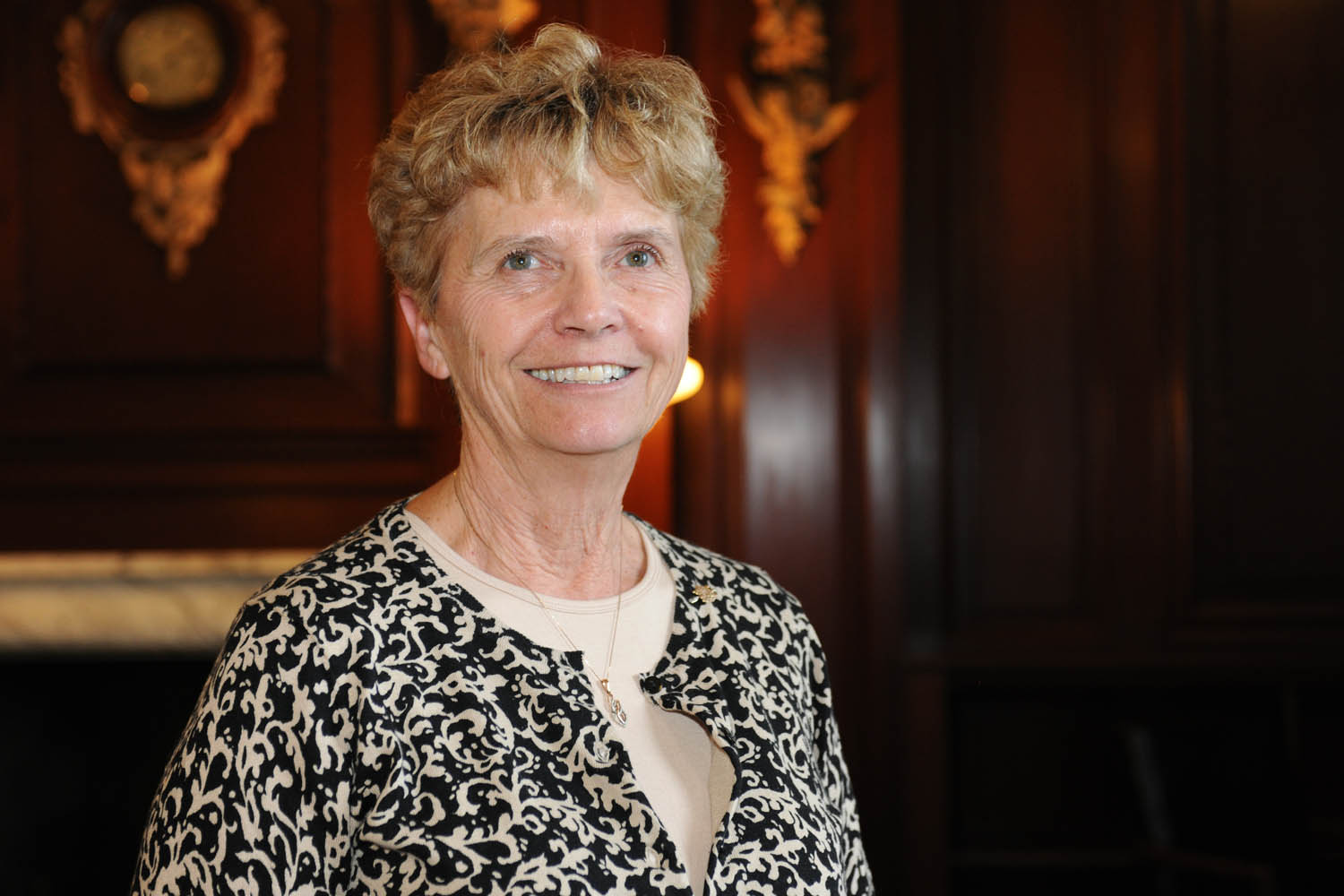
MLA Linda Larson. (File photo)
UPDATE: MLA Linda Larson announced on Wednesday that she is disbanding her “focus group.”
“Since announcing the creation of a five-person focus group to seek that input, it has become clear the idea has become a distraction from the thoughtful and needed debate that must occur. Therefore, I am announcing that the work of the focus group will not proceed and will be disbanded immediately,” she said in a statement issued at 2:34 p.m. on Wednesday, Dec. 9.
Below is the article that appeared in the Wednesday, Dec. 9 Osoyoos Times, which reveals the names of four of the five focus group members.
Two members of MLA Linda Larson’s secret focus group oppose a national park in the South Okanagan and two are undecided.
The Osoyoos Times has not yet been able to identify the fifth member of the group that will be reviewing public feedback on the provincial government’s Intentions Paper, which proposes two unconnected areas for a national park reserve.
Larson has refused to identify the members of her group saying that this would open them up to harassment.
Park supporters fear the anti-park MLA has stacked the group with opponents to skew their report.
The two national park opponents are Jesse Zeman of the B.C. Wildlife Federation, a major hunting, angling and conservation group, and Ernie Dumais, a member of the anti-park Grassland Park Review Coalition.
Those saying they are undecided are Beth Garrish, an Oliver realtor, and Mark Pendergraft, the chair and Area A (rural Osoyoos) representative on the board of the Regional District of Okanagan-Similkameen (RDOS).
Pendergraft acknowledges that he’s often identified as being on the “no” side and he has family members who own land in the affected area, but he says he sees both sides of the issue.
Unless the still unidentified fifth member supports a national park, the pro-park side is not represented. Nor is there representation from the town of Osoyoos or local First Nations.
Zeman, who lives in Kelowna and is a program manager with the B.C. Wildlife Federation, said his group actively supports conservation, but opposes involving Parks Canada.
“Our position on the area is that we support conservation,” he said, noting that members have contributed to the Nature Trust of B.C., the B.C. Conservation Foundation and the Okanagan Wildlife Heritage Society Fund.
“We recognize that it’s a very special part of British Columbia and of Canada, but in terms of Parks Canada’s approach, it’s not something that we have supported,” he said. “Their model tends to be more of an exclusive as opposed to an inclusive approach to conservation.”
Zeman said his organization is concerned that hunters would be excluded from the park and is also concerned about Park’s Canada’s track record on biodiversity.
Zeman said he agreed to serve on the focus group after the B.C. Wildlife Federation was asked to participate. As well as being a program manager with the group, he is a past director and also an avid hunter.
Dumais confirmed that he opposes a national park and has been involved with the anti-park Grassland Park Review Coalition.
“But I would like to emphasize that I have nothing against protecting the area through provincial park initiatives,” Dumais said.
The retired secondary school shop teacher, who taught in Oliver, has owned land in the Fairview area since 1970. He says that area would be affected by the proposed Area 2, which would become a provincial conservancy and not a national park.
He has acreage and grazes cattle and also has range tenure in the affected area.
Dumais said he has an interest in what’s going on in the community and has served on the advisory planning committee for the regional district and as a regional director.
“I believe there’s areas that should be protected,” he said. “The degree of protection is I think the question here.”
Garrish, a realtor with Royal LePage Okanagan Valley Wine Country, is also past chair and currently a director of the Oliver Tourism Association.
Although Garrish said she is interested in conservation to some extent, her main interest is tourism.
She said she hasn’t taken a position on either side of the national park debate and she comes at it with an open mind.
“That’s one of the reasons that I decided to accept,” she said, adding that Larson approached her and asked her to participate. “I thought it was really interesting to be able to hear all sides of the story.”
Pendergraft also said he will approach the focus group with an open mind on the national park question.
“Officially I’ve probably not taken a position,” he said. “I get asked lots of questions on it and because I have experience or knowledge from both sides, I quite often end up explaining the ‘no’ side a little bit. People quite often assume I’m ‘no.’ I’m probably painted with the ‘no,’ brush, but I really haven’t taken a position.”
Admitting he’s “torn” on the issue, Pendergraft said he sees both sides.
“One of the reasons I think I would potentially be all right for the position is because they should be fairly open minded,” he said. “I’m not biased in any one fashion.”
Pendergraft acknowledges that family members own property in the southern area that is proposed for a park. His mother Hazel Pendergraft and his uncles Jimmy and Gerald Pendergraft own land there.
The focus group will be tasked with preparing a summary of public submissions on the province’s document, Intentions Paper: Protected Areas Framework for British Columbia’s South Okanagan. That document was released in August and the deadline for public comment was the end of October.
The government received more than 400 responses to a web-based questionnaire, between 800 and 900 postcards from a pro-park Wilderness Committee campaign and several hundred letters and emails.
Larson has insisted the focus group won’t be making recommendations, but will simply be summarizing the feedback. Ministry of Environment staff will also be producing their own analysis of the feedback.
Meanwhile, Larson and Environment Minister Mary Polak continue to provide conflicting information on the mandate of the group, how it was selected and whether or not the ministry “vetted” its members.
Polak said recently that the group’s input “doesn’t carry more or less weight than anybody else’s input in this process.”
She also said the group is not a formalized ministry committee, that Larson chose them with Polak’s input and that it’s the job of MLAs to seek this kind of feedback from their constituents. Their input, the minister said, is being given directly to Larson.
“I’m fairly certain what she’s done is try to choose people who aren’t rigidly in either camp,” Polak said in a recent interview.
Larson, however, recently claimed in a note to Oliver blogger and town councillor Jack Bennest that, “The focus group will get their mandate directly from the ministry.”
She has said her list of potential members “was vetted” by the ministry – something a ministry spokesman denied, saying, “It is not the ministry’s practice to vet individuals who are simply providing input.”
In an interview last week with CBC Radio’s Daybreak South, Polak hedged on the question of whether or not the group was vetted.
“I suppose that depends on what you mean by vetting,” Polak told interviewer David French. “We simply take a look at who she’s pulled together and I said I thought she had chosen a good variety of people and I think that’s fine.”
The question of whether or not the group is acting in a ministry capacity is relevant because of Larson’s decision not to name them.
Normally committees chosen to advise a provincial ministry would be publicly named.
None of the group members the Osoyoos Times has been able to identify represent First Nations.
Polak acknowledged that First Nations aren’t represented on the group, but said her ministry has held separate discussions with the Okanagan Nation Alliance.
RICHARD McGUIRE
Osoyoos Times